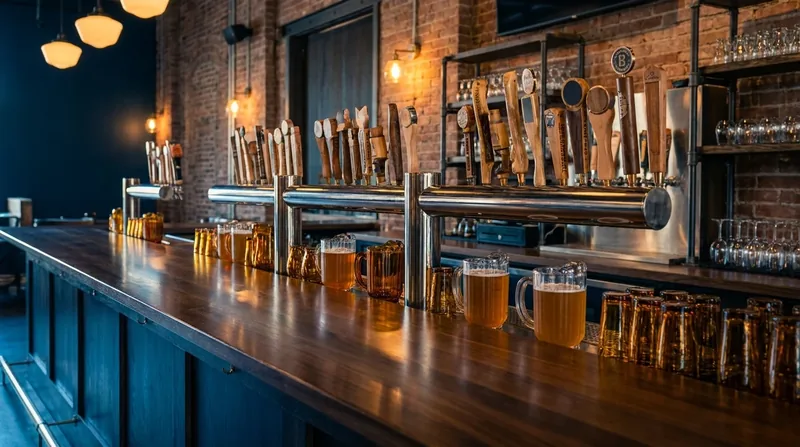
How to Start a Brewery in California: Type 23 Small Brewer ($1,135 Application, $500 a Year), No Spirits
How to Start a Brewery in California: Type 23 Small Brewer ($1,135 Application, $500 a Year), No Spirits
If you want to start a brewery in California, the license most small brewers begin with is the Type 23 small beer manufacturer license from the Department of Alcoholic Beverage Control (ABC). It covers brewers who make 60,000 barrels of beer a year or less. The non-general application fee is $1,135, the annual fee is $500 in 2026, and you can apply at any time of year because there is no priority drawing. The trade-off is that a Type 23 does not allow spirits, and it does not let you add a full bar. This guide covers what the license allows, what it costs, what it cannot do, the brewpub alternative, and the state and federal steps you need before you open.
Disclaimer: This article is informational content, not legal or tax advice. Fees, deadlines, and local rules change, so confirm every figure on the agency page before you pay. If you have multiple owners, outside investors, a complex lease, or plans for more than one license, talk with a qualified business attorney and a CPA.
What a Type 23 License Allows
The Type 23 is a manufacturing license built around your own beer. Under Business and Professions Code 23357, a licensed beer manufacturer may:
- Sell its own beer to consumers for drinking on the licensed premises, or on contiguous premises it owns and operates.
- Sell its own bottled beer for consumption off the premises.
- Sell its own beer to any licensee that sells beer, such as a bar or restaurant.
The limits matter just as much. A Type 23 may sell beer and wine from other sources only at a bona fide public eating place on its premises. It may not sell spirits. If your plan includes cocktails, a full bar, or liquor sales, a Type 23 will not get you there.
Type 23 Costs
| Item | Amount | Notes |
|---|---|---|
| Non-general application fee | $1,135 | Confirm the exact amount on ABC's fee schedule |
| Annual license fee (2026) | $500 a year | For brewers of 60,000 barrels a year or less |
| ABC fee increase | 3.31 percent | Rises on January 1, 2027, so confirm the amount with ABC |
| Type 01 (larger brewers) | $2,450 a year | For brewers above 60,000 barrels a year |
Type 23 Versus the Brewpub License (Type 75)
If you want a restaurant with a full bar, the Type 23 is the wrong license. The brewpub alternative is the Type 75 brewpub-restaurant license. It is a general-type license with three hurdles the Type 23 does not have:
- A $19,840 application fee.
- Issuance only through ABC's annual priority drawing, so you cannot apply on your own timeline. Check ABC's current drawing schedule rather than assuming one.
- An annual fee of $1,545, $1,260, or $985, depending on the size of the city where the premises sit.
Many owners open under a Type 23 first, sell beer on site and in bottles, and add food with a county health permit. They then decide later whether the numbers justify a Type 75. If you only want a bar, see the separate guide to starting a bar business in California.
A beer manufacturer that runs an eating place at its production premises may also make to-go sales under Business and Professions Code 23401.5. AB 2663 extended that authority through December 31, 2029. Confirm the conditions with ABC before you build a to-go program around it.
Events, Markets, and Taproom Food Rules
- Type 91 beer manufacturer's caterer permit: allows catered events, up to 36 event days a year.
- Type 84 beer sales permit: for certified farmers' markets, $145.
A taproom can avoid a county food permit if it meets a narrow test under Health and Safety Code 113789. The tasting room must serve only beer tasting. It may serve no beverage other than bottled beer, wine, and prepackaged non-potentially-hazardous drinks. Food is limited to crackers, pretzels, or prepackaged non-potentially-hazardous food. Under those conditions, the room is not a food facility and needs no county food permit.
The moment your taproom sells other drinks or prepares food, that exemption no longer applies. You then need a county health permit and a certified food safety manager. Ask your county environmental health department for its fee schedule, because county fees vary.
What to Gather Before You File
Filing does not require brewing equipment, but you should have these items ready:
- A business name you have checked in the Secretary of State business search and that meets the name rules in Step 1.
- A production plan showing expected annual barrels, so you can confirm you fall under the 60,000 barrel Type 23 limit.
- Ownership details for every member, manager, or officer, since state forms ask for them.
- A registered agent (a California resident or a corporation holding a Corporations Code 1505 certificate) and a California office address.
- A planned premises address, with the city's zoning answer in writing if possible.
- Paperwork for the federal brewer's notice from the Alcohol and Tobacco Tax and Trade Bureau (TTB).
Step-by-Step: Starting Your Brewery
Step 1: Form the Entity and Reserve the Name
Many breweries form as a California LLC. You file Articles of Organization (Form LLC-1) with the Secretary of State for $70 through bizfile Online. Online filings are normally processed within about 5 business days or less. Paper filings take 10 or more business days. For faster service, the Secretary of State offers 24-hour expedite for $350, same-day for $750 (received by 9:30 a.m.), and 4-hour for $500 (drop-off only, precleared).
Your name must contain 'limited liability company', 'L.L.C.', or 'LLC'. ('Limited' may be 'Ltd.' and 'company' may be 'Co.') It may not contain 'bank', 'trust', 'trustee', 'incorporated', 'inc.', 'corporation', or 'corp.' You can reserve a name for $10 for 60 days, and that reservation is not renewable for consecutive periods. California does not allow a domestic series LLC, so you cannot split the brand and the taproom into separate series.
Every California LLC must keep an agent for service of process. That agent is either an individual who resides in California or a corporation holding a Corporations Code 1505 certificate. The LLC must also keep an office in California. That office does not have to be where business activity takes place.
Step 2: Understand the Ongoing State Costs
The LLC must file a Statement of Information (Form LLC-12) for $20 within 90 days of filing the articles. After that, it files every two years during the six-month window ending on the last day of the anniversary month. If you miss it, the Franchise Tax Board assesses a $250 penalty after a Secretary of State notice.
Every LLC organized or registered in 2024 through 2026 owes the $800 minimum annual franchise tax from its first year. An LLC whose first taxable year begins in 2027, 2028, or 2029 pays $400 in year one under RTC 17941(g)(2), so confirm that amount with the Franchise Tax Board. An LLC also owes an LLC fee of $900, $2,500, $6,000, or $11,790 once California-source total income reaches $250,000, $500,000, $1,000,000, or $5,000,000. A busy taproom can reach those thresholds, so model it early with a CPA.
Step 3: Register a Fictitious Business Name If Needed
If you will operate under a name other than your LLC's legal name, such as a taproom brand, file a Fictitious Business Name Statement with the county clerk-recorder in the county of your principal place of business. File within 40 days of starting to do business. You must publish the statement in a newspaper once a week for four weeks, and the filing expires after five years. The statutory fee is $10 plus $2 per additional name or owner (Business and Professions Code 17929), but counties charge more and the newspaper publication fee is separate. Details are at the Secretary of State fictitious business names page.
Step 4: Get the Federal Brewer's Notice From TTB
The federal brewer's notice from the Alcohol and Tobacco Tax and Trade Bureau (TTB) is a separate federal approval. The state Type 23 does not replace it. Check with TTB for the current process and timing before you commit to an opening date, and do not promise landlords, lenders, or investors a date that depends on TTB until you have its timeline in writing.
Step 5: Confirm Zoning and the Local Business Tax
California has no general statewide business license. Most cities charge a local business tax or registration certificate, and 445 of 483 cities report revenue from one. There is no common formula, so the answer depends on your city. Counties license only regulated activities. Ask the city planning and business tax offices whether a brewery with a taproom is permitted at your address, whether a use permit is required, and what the local business tax or registration costs. Get those answers before you sign a lease.
Step 6: Apply for the Type 23 License With ABC
Submit your Type 23 application to ABC with the $1,135 non-general application fee. Confirm the exact amount on ABC's fee schedule before you pay. The annual fee is $500 in 2026, and ABC fees rise 3.31 percent on January 1, 2027. Because the Type 23 is available year round with no priority drawing, you control the timing of your filing. Build your schedule around ABC's processing time, which can change, so ask ABC for its current estimate.
Step 7: Register With CDTFA and Prepare Your Staff
If you sell taxable goods, which includes beer, merchandise, and taproom food, register with the California Department of Tax and Fee Administration (CDTFA) for a seller's permit. The seller's permit is free. It is not a business license, and it does not replace the entity filing or the ABC license. California sales tax is 7.25% statewide, and with district taxes city rates run from 7.25% to 11.75%. For wholesale purchases, the resale certificate has no required form. Learn more at the CDTFA website.
If you will have employees, register with the Employment Development Department (EDD) before your first payroll. The state minimum wage is $16.90 in 2026 and $17.40 from January 1, 2027, according to a secondary source, so verify the figure before you set pay rates. Servers and managers should also complete Responsible Beverage Service (RBS) certification.
Step 8: Hire Licensed Contractors and Get Health Permits
Build-out work above the $1,000 threshold requires a contractor with a Contractors State License Board license. Check each contractor's license status before you sign a contract. If your taproom will sell drinks beyond the tasting-room exemption or will prepare food, get your county health permit and certified food safety manager in place before opening.
Step 9: Calendar Your Recurring Filings
Set reminders for the LLC-12 Statement of Information, the franchise tax and LLC fee, the ABC annual fee, your sales tax returns, and any business tax your city requires. Missing a filing usually costs more than the filing itself.
Common Mistakes to Avoid
- Assuming a Type 23 lets you sell spirits or add a full bar. It does not.
- Signing a lease before confirming zoning and whether a use permit is needed.
- Choosing a name with a restricted word such as 'bank', 'trust', 'inc.', or 'corp.'
- Forgetting the $800 minimum franchise tax, the $20 Statement of Information, or the $250 late penalty.
- Treating the seller's permit as a business license. California has no general state business license.
- Assuming TTB approval follows a fixed timeline, then missing your opening date.
- Running a taproom that serves cocktails, wine by the glass from other sources, or food without a county health permit.
- Planning a Type 75 brewpub around a drawing date you have not confirmed with ABC.
- Setting up a series LLC to separate the brewery and taproom, which California does not allow.
Expected Results
A Type 23 can give a production brewery a legal way to sell its own beer on site, sell its own bottles for off-site consumption, and sell its beer to other licensees. Those rights may support several revenue streams, but no license guarantees sales, and results depend on location, product, management, and local competition. Keep marketing modest, avoid implying health benefits for your beer, and check labeling requirements with TTB before you print packaging.
Official Resources
- California Secretary of State, Business Programs Division
- bizfile Online filing portal
- Name availability and reservation
- California Department of Tax and Fee Administration
- California Small Business Development Center network for free or low-cost advising
This article is informational, not legal or tax advice. Confirm fees, deadlines, and ABC and TTB requirements with the agencies before you act, and consult a qualified attorney and CPA for your specific situation.
Keep exploring: related California guides
- How to Start a Bar in California
- How to Start a Packaged Food Business in California
- How to Start a Vending Machine Business in California
- How to Start a Winery in California
- How to Start an LLC in California (2026 Guide)
- How to Get a Business License in California (2026)
- How Much Does It Cost to Start an LLC in California? (2026)
- All California business types
- Every California guide in one place