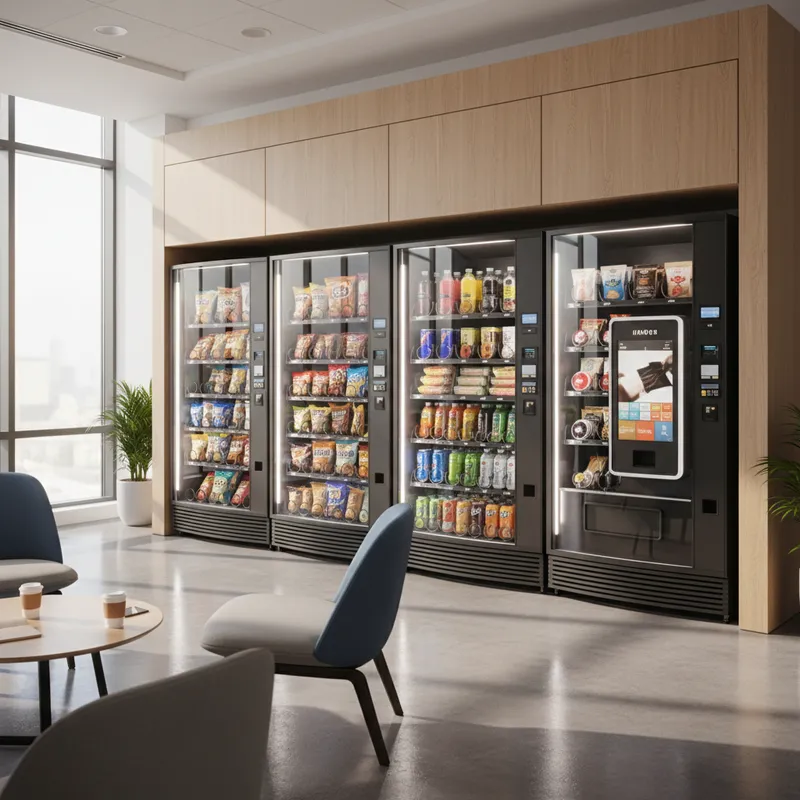
How to Start a Vending Machine Business in California
How to Start a Vending Machine Business in California
California doesn’t issue a statewide vending machine license. That sounds like good news. It isn’t, exactly — what you get instead is a patchwork of permits from different agencies at different levels of government, each with its own fees, renewal schedules, and enforcement teeth. Add the $800 annual franchise tax if you form an LLC, and California’s “no single license” system turns out to cost more and require more paperwork than most people expect going in.
Here’s what you actually need to do it legally.
California Licensing for Vending Machines
There’s no single permit that says “you may now operate vending machines in California.” Instead, your compliance picture depends on where your machines are, what they sell, and how you’re structured. Most operators need at least three things: a CDTFA seller’s permit, a city business license for each city they operate in, and potentially a county health permit depending on what the machines dispense.
CDTFA Seller’s Permit
If your machines make sales, you need a seller’s permit from the California Department of Tax and Fee Administration (CDTFA). One permit covers all your machines statewide — you don’t need a separate permit for each location or county. Registration is free at cdtfa.ca.gov.
There is one narrow exception: food sold through vending machines at 15 cents or less per item doesn’t require a seller’s permit. That threshold hasn’t been relevant to most vending businesses since roughly 1975. If you’re selling anything at modern prices — $1.50 chips, $2 water, $3 energy drinks — you need the permit.
The CDTFA permit is the gateway to collecting and remitting sales tax, which has its own complexity (covered in the next section). Don’t delay this one. Operating without a seller’s permit when you’re required to have one creates back-tax liability.
City Business Licenses
Every city where you place machines is a separate licensing jurisdiction. If you have machines in Los Angeles, Pasadena, and Burbank, that’s three city business licenses — each with its own fee, renewal date, and application process. Fees typically run $50–$300 per city per year, but they vary widely. Some cities charge a flat fee; others scale by revenue or number of locations.
Check each city’s business license office directly. Most have online portals now. A few cities also require you to list specific machine addresses on the license, which means updating paperwork when you move a machine.
County Health Permits for Food Machines
This is where it splits based on what you’re selling.
Shelf-stable snacks and sealed beverages — chips, candy bars, bottled water, sealed juice — generally don’t require a county health permit. The products are pre-packaged, commercially processed, and don’t require temperature control for safety.
Perishable or potentially hazardous foods are a different story. If your machine dispenses refrigerated sandwiches, fresh fruit cups, yogurt, or anything that requires temperature control to prevent bacterial growth, you need a food facility permit from your county’s environmental health department. Each county runs its own permitting program. Los Angeles County goes through the LA County Department of Public Health; Santa Clara County through the Department of Environmental Health; and so on.
Plan review may be required before you place temperature-controlled machines. Permit fees and inspection requirements vary by county. If you’re building a route around fresh food vending — a growing niche — budget time for the county health approval process. It’s not fast.
The $800 Franchise Tax Impact
This is the California-specific cost that blindsides most first-time vending operators who do their research using general business formation guides.
If you form a California LLC to run your vending business, you owe the Franchise Tax Board $800 per year — regardless of revenue, regardless of profit, and regardless of whether your machines have even been installed yet. It’s a minimum franchise tax, not a percentage of earnings. You owe it just for existing as a California LLC.
The AB 85 first-year exemption expired December 31, 2023. That exemption used to waive the $800 for an LLC’s first taxable year. It’s gone. LLCs formed on January 1, 2024 or later owe $800 from year one, due by the 15th day of the 4th month after formation.
Why This Hits Vending Hard
Run the math on a small operation. Five machines generating $500–$800/month total in gross revenue. After machine costs, product costs, location commissions, and your time, margins are thin in the early months. The $800 franchise tax is a fixed overhead line that doesn’t care how the route is performing. On a 5-machine starter operation, $800/year is meaningful money.
Compare that to a software business or consulting practice where $800 disappears into the revenue noise. For vending, especially in the first year when you’re still finding good locations and optimizing product mix, it’s a real number.
The Sole Proprietorship Alternative
Some California vending operators skip the LLC entirely and operate as sole proprietors specifically to avoid the $800. As a sole proprietor, there’s no entity-level franchise tax. You pay personal income tax on profits, but you don’t owe $800 just for existing.
The tradeoff is real: sole proprietors have no liability shield. If someone gets sick from a product your machine dispensed, or there’s a slip-and-fall near your machine, your personal assets are on the line. Whether that tradeoff makes sense depends on what you’re selling, where your machines are located, and your personal risk tolerance.
Carry general liability insurance either way. But the LLC’s liability protection is meaningfully stronger than insurance alone.
What About Foreign LLCs?
Some operators form an LLC in Nevada, Wyoming, or another low-fee state thinking they’ll avoid the California franchise tax. It doesn’t work. If your LLC is doing business in California — which means your machines are in California — you’re required to register as a foreign LLC with the California Secretary of State. That registration triggers the same $800 annual franchise tax. The California FTB doesn’t care where your LLC was formed; it cares where it operates.
Sales Tax Rules for Vending
California’s combined sales tax rate is 7.25% statewide as a base, but local add-ons push the actual rate higher — typically 8–10.25% depending on city and county. You collect this tax from customers (it’s already baked into the vending price they pay) and remit it to the CDTFA on a regular schedule.
For vending machines, this gets complicated because food has special treatment under California sales tax law.
The Governing Document: CDTFA Publication 118
The CDTFA publishes Publication 118, which specifically covers sales tax for vending machine operators. Read it. It’s not long, and it answers the specific questions that come up for vending — which food items are taxable, how to account for tax when prices are set (since you can’t charge $1.08 on a $1.00 machine), and how to report vending sales separately from other sales.
What’s Taxable and What Isn’t
Hot prepared food from vending machines is always taxable. If your machine heats a burrito or dispenses hot coffee, that sale is taxable at the full combined rate.
Cold food items are where the rules get nuanced. Generally, food products sold for human consumption are exempt from California sales tax — but not always, and vending machines have specific rules that differ from retail grocery stores. The key factors include whether the item is considered a “hot prepared food,” whether it’s sold for immediate consumption, and the price point.
Carbonated beverages sold through vending machines are taxable. Non-carbonated beverages have different treatment. Candy is taxable. Snacks like chips and crackers may be taxable depending on classification.
The practical reality: most vending operators work with their CDTFA account to properly categorize their product mix and apply the correct tax rate. When you register for your seller’s permit, the CDTFA can walk you through how to classify your specific products. Don’t guess — the back-tax exposure from miscategorizing product types adds up.
How Tax Collection Works in Practice
You can’t give change for a fractional cent, and you can’t charge $1.08 on a $1.00 machine. The CDTFA has a formula for calculating the taxable portion of vending sales. Essentially, you track your total taxable vending revenue and apply the tax rate to that figure when filing — the tax is considered included in the price customers paid. Publication 118 walks through the exact calculation method.
Startup Costs at a Glance
Before you commit, here’s what a real California vending operation costs to get off the ground.
Business formation and compliance:
- LLC filing (Form LLC-1): $70 at bizfileOnline.sos.ca.gov
- Statement of Information (Form LLC-12): $20, due within 90 days of formation
- Annual franchise tax: $800/year — starts year one, no exemption
- CDTFA seller’s permit: free
- City business license: $50–$300 per city, per year
Equipment:
- New vending machine: $3,000–$8,000 depending on type (snack, beverage, combo, refrigerated)
- Refurbished machine: $1,000–$3,000 — functional but may need repairs; buy from a reputable supplier
- Vehicle for restocking: use what you have, or budget $5,000–$15,000 for a used cargo van or SUV
Insurance and health permits:
- General liability insurance: $400–$800/year — non-negotiable if you want machine placement agreements with property owners
- County health permit (refrigerated/fresh food machines): varies by county, typically $100–$500+
Total for a 5-machine starter route:
Somewhere in the $10,000–$30,000 range for the first year, including the franchise tax. The spread is wide because equipment costs dominate — five new machines at the high end of the price range gets you to $40,000 before you’ve bought a single bag of chips. Most people start with refurbished machines to compress the upfront number.
That $800 franchise tax doesn’t sound like much against a $20,000 startup investment. But it recurs every year, forever, whether you’re profitable or not. Five years in, you’ve paid $4,000 in franchise tax alone. Build it into your unit economics from day one.
Before You Buy Your First Machine
Get your CDTFA seller’s permit first — it’s free and takes minutes at cdtfa.ca.gov. Then figure out your business structure: LLC if you want liability protection and can absorb the $800/year, sole proprietorship if you’re starting ultra-lean and comfortable with the risk tradeoff.
Lock down your first location before you buy machines. A machine sitting in your garage isn’t a business. The location — a break room, a gym, a school, a laundromat — is the asset. Good locations are harder to find than good machines.
Then buy one machine, place it, run it for 90 days, and see what the actual numbers look like before you scale. California’s cost structure means your margins need to be real before you commit to a 10-machine route.