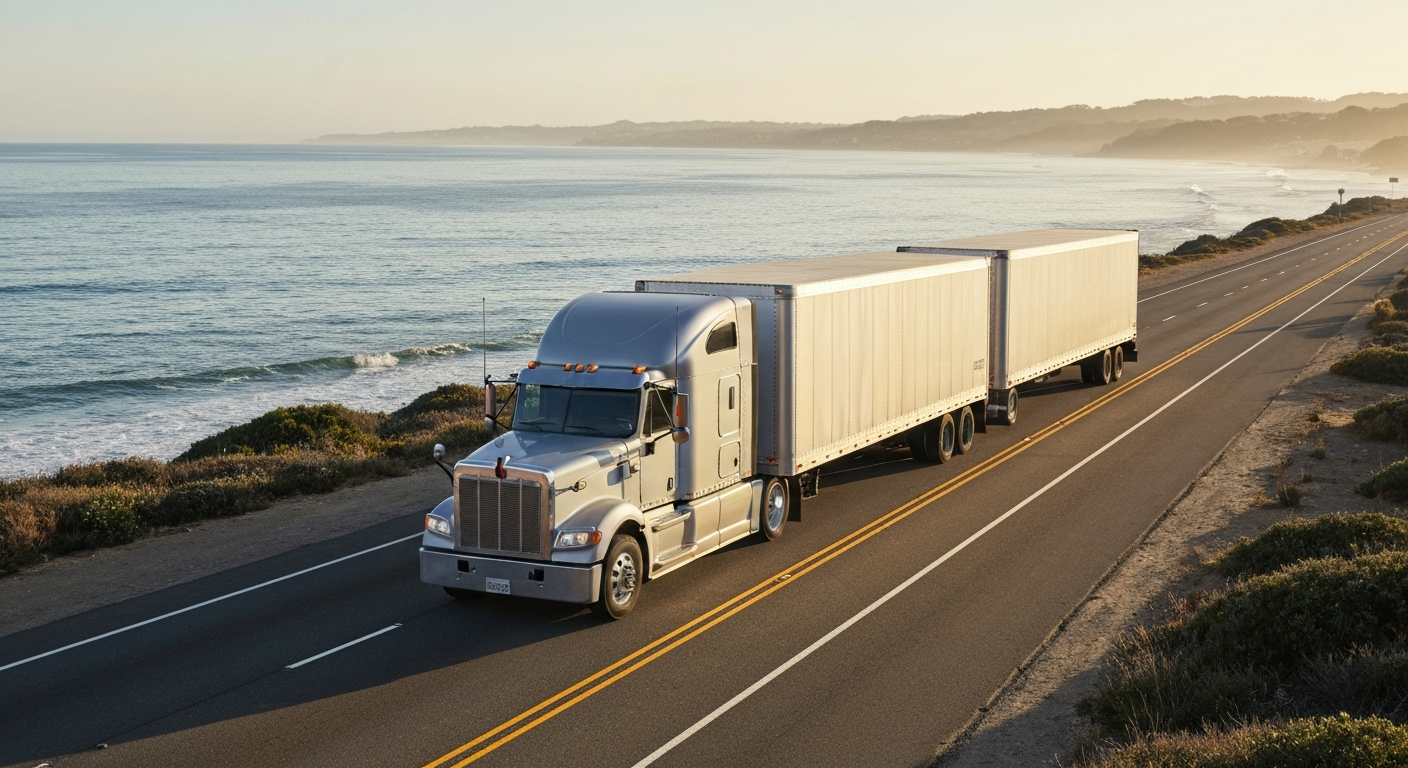
How to Start a Trucking or Freight Business in California
How to Start a Trucking or Freight Business in California
California is the largest freight market in the country. The ports of Los Angeles and Long Beach together handle about 40% of all containerized imports entering the United States. Oakland moves millions of tons of cargo annually. The demand is real, and it’s constant.
The barrier to entry is also real. California has the most complicated trucking startup process of any state — three separate agencies, strict insurance minimums, and environmental regulations that can add tens of thousands of dollars to your startup costs before you’ve hauled a single load. None of that should stop you. But you need to know what you’re walking into.
Here’s the full picture.
The Three-Agency Path
Most states require one or two agencies to get a trucking operation off the ground. California requires three. Miss any one of them and you’re either operating illegally or unable to get paid by brokers who require proof of authority.
Step 1: CHP — Your CA Number
Before you can get a Motor Carrier Permit, you need a CA Number. This is your California carrier identification number, issued by the California Highway Patrol.
File the Motor Carrier Profile (CHP 362) form with the CHP. This registers your business as a motor carrier in California’s system. The CHP uses this to track your safety record, inspection history, and compliance status. Without an active CA Number, the DMV won’t issue your permit.
Download the CHP 362 at chp.ca.gov. Processing typically takes a few weeks. Make sure your business entity is already formed before you file — the CA Number ties to your legal business name.
Step 2: DMV — Motor Carrier Permit
Once your CA Number is approved, apply for your Motor Carrier Permit (MCP) through the California DMV. This permit is what legally authorizes you to operate commercial vehicles on California roads for hire.
The MCP application goes through the DMV’s Motor Carrier Permit program. You’ll need your CA Number, proof of insurance, and payment of the permit fee (which scales with the number of vehicles in your fleet).
Do not skip this step. Operating a commercial vehicle for hire in California without a valid Motor Carrier Permit is a misdemeanor. The penalties: up to a $2,500 fine, potential jail time, and vehicle impoundment. Brokers and shippers will also ask for your MCP number before they’ll work with you. You can’t fake it.
Step 3: FMCSA — USDOT Number and MC Authority
If you’re hauling interstate — crossing state lines, or hauling goods that originate from or are destined for another state — you need federal authority from the Federal Motor Carrier Safety Administration (FMCSA).
Two things to get:
USDOT Number. This is your federal carrier identification. Required for any commercial vehicle operating in interstate commerce or meeting certain weight thresholds. Apply at fmcsa.dot.gov — it’s free.
MC Authority (Operating Authority). Required if you’re a for-hire carrier hauling regulated commodities interstate. The filing fee is $300. After approval, there’s a 10-day protest period before authority is granted. Budget 4-6 weeks for the full process.
Once you have MC authority, you must file proof of insurance with FMCSA (your insurer does this via a Form MCS-90 endorsement and BMC-91 or BMC-91X filing). Authority doesn’t activate until that insurance filing is confirmed.
For purely intrastate operations — only hauling within California — you may not need MC authority, but you still need the USDOT Number if your vehicles meet the weight threshold. When in doubt, get it anyway. Shippers and freight brokers often require it regardless.
California Environmental Regulations
This is where California separates itself from every other state. The California Air Resources Board (CARB) sets diesel emission standards that go well beyond federal requirements. If you’re buying used equipment, CARB compliance isn’t optional — it’s a hard requirement, and violations come with significant fines.
CARB Diesel Truck Standards
California’s Truck and Bus Regulation requires that diesel trucks operating in California meet specific particulate matter and NOx emission standards based on engine model year. Older engines — generally pre-2010 — don’t meet current standards and can’t legally operate in California without retrofits or replacements.
If you’re buying a used truck to keep startup costs down, you need to verify CARB compliance before you buy. A 2008 truck with 400,000 miles might look like a deal at $25,000. But if the engine doesn’t meet CARB standards, you either can’t operate it in California or you’re looking at a costly retrofit. Some retrofits work. Many don’t fully close the compliance gap for older engines.
The practical rule: buy a 2010 or newer engine if you want to operate without CARB restrictions. 2013 and newer is safer. Check the CARB fleet reporting tool at arb.ca.gov to verify any vehicle before purchase.
Fleets of multiple vehicles must also register with CARB and report their vehicles annually. Solo owner-operators aren’t exempt from this.
Advanced Clean Trucks Regulation
California’s Advanced Clean Trucks (ACT) rule is the longer-term pressure point. It requires truck manufacturers to sell a growing percentage of zero-emission vehicles, and it includes requirements for medium and large fleets to transition toward zero-emission trucks over time.
If you’re starting a single-truck owner-operator business today, ACT doesn’t immediately mandate you buy an electric truck. But if you build a fleet — particularly if you operate drayage trucks at California ports — the timeline accelerates. Port drayage trucks serving the San Pedro Bay (LA/Long Beach) must be zero-emission by 2035 under the CARB Drayage Truck Regulation.
The cost implications are real. CARB-compliant used trucks — 2010 or newer — run $40,000 to $100,000 depending on spec and mileage. Electric Class 8 trucks from Freightliner, Volvo, or Kenworth currently run $300,000-$400,000 before incentives. State and federal incentives exist (HVIP vouchers through CARB can offset $150,000+ for zero-emission trucks), but the capital requirements are substantial.
Compliance Retrofits
If you’re acquiring older equipment, retrofit options include diesel particulate filters (DPF) and selective catalytic reduction (SCR) systems. Verified retrofit systems can extend the operating life of pre-2010 engines, but costs run $10,000 to $30,000 or more per truck, and not all older engines are retrofit-eligible under CARB’s verified list.
Bottom line: budget CARB compliance as a line item, not an afterthought. It’s often the biggest hidden cost for new California carriers who came up in other states.
Insurance
California’s insurance minimums for commercial trucking are among the highest in the country. This isn’t where you cut corners.
Liability Coverage
The required liability minimum depends on what you’re hauling:
- Non-hazardous freight, vehicles under 10,001 lbs: $300,000
- Non-hazardous freight, vehicles over 10,001 lbs: $750,000
- Hazardous materials (certain types): $1,000,000 to $5,000,000
For most Class 8 trucking operations hauling general freight, $1,000,000 in primary liability is the de facto market standard — and what most freight brokers require before they’ll assign you loads. The federal FMCSA minimums align with these figures, and your insurer will file the required MCS-90 endorsement with FMCSA to activate your operating authority.
Expect to pay $12,000 to $30,000+ per year for a single-truck operation, depending on your cargo type, driving history, and the truck’s value. New authority carriers (less than two years in operation) pay more. Insurance companies consider new carriers higher risk, and they’re not wrong — statistically, the first two years are when most incidents happen.
Cargo Insurance
Primary liability covers damage you cause to others. It doesn’t cover the freight you’re hauling. Most shippers and brokers require $100,000 in cargo insurance as a condition of doing business. Add this to your coverage stack.
Workers’ Compensation
California requires workers’ compensation insurance for every employee — no minimum headcount, no exceptions. If you hire a second driver, you need workers’ comp before that person gets in the truck. No grace period. No “they’re just part-time” exemption.
The penalties for non-compliance in California are severe: stop-work orders, fines up to $100,000, and personal liability for any workplace injuries.
If you’re a solo owner-operator with no employees, you can exclude yourself from workers’ comp as the business owner. The moment you hire someone, the requirement kicks in.
Tow Truck Operations
If you’re running a tow truck operation specifically, California requires a tow truck driver certificate for each driver. This is a separate credential issued through the CHP, involving a background check and application process. Standard freight carriers don’t need this — but if towing is part of your service, factor it in.
Startup Costs
Let’s put real numbers on this.
Business Formation
Form an LLC before you start operating. It separates your personal assets from business liability — critical in an industry where a single accident can generate a multi-million dollar claim.
- LLC filing fee: $70 (Form LLC-1 at bizfileOnline.sos.ca.gov)
- Statement of Information: $20 (due within 90 days of formation)
- Annual Franchise Tax: $800/year, every year, starting with your first tax year — no first-year exemption in California
Get your EIN from the IRS at irs.gov/ein — free, takes 10 minutes online.
Equipment
This is your biggest variable.
Used CARB-compliant truck (2010+ engine): $40,000–$100,000. A well-maintained 2015 Freightliner Cascadia or Kenworth T680 with 500,000 miles might run $60,000-$75,000. Prices fluctuate with the used truck market, which has been volatile post-COVID.
Trailer: $20,000–$50,000 for a used dry van or flatbed. Reefer trailers run higher. If you’re starting in drayage (port work), you may not need your own trailer — chassis pools at the ports handle that.
Don’t buy a truck you can’t operate legally. Verify CARB compliance on any used truck before signing anything.
Permits and Authority
- CHP Motor Carrier Profile: minimal fee
- DMV Motor Carrier Permit: scales with fleet size; budget $100–$500 for a small fleet
- USDOT Number: free
- FMCSA MC Authority: $300
- UCR (Unified Carrier Registration): required for interstate carriers; fee based on fleet size, starts around $76/year for one truck
Insurance
- Primary liability (1 truck): $12,000–$30,000/year
- Cargo insurance: $1,000–$3,000/year
- Physical damage (truck and trailer): $3,000–$8,000/year
- Workers’ comp: if you have employees, add this
Budget $15,000–$40,000/year in total insurance costs for a single-truck operation. Higher if you’re hauling hazmat.
Total Lean Startup Budget
For a single-truck owner-operator starting from scratch in California:
| Item | Cost |
|---|---|
| LLC formation + first year franchise tax | ~$890 |
| Used CARB-compliant truck | $40,000–$100,000 |
| Trailer | $20,000–$50,000 |
| Insurance (year one) | $15,000–$40,000 |
| Permits and authority | ~$500–$1,000 |
| CARB compliance (if retrofit needed) | $0–$30,000 |
| Operating capital (fuel, maintenance, 60-day float) | $10,000–$20,000 |
| Total | $86,000–$240,000 |
The wide range reflects whether you’re buying a newer, already-compliant truck or inheriting an older one that needs work. The lean end assumes you find solid used equipment that’s already CARB-compliant and you’re starting intrastate with a single truck. The high end assumes you need a retrofit, buy a newer truck, and are hauling regulated cargo requiring higher insurance limits.
Most lenders offering commercial truck financing want 10-20% down plus proof of operating authority and insurance. SBA loans can cover equipment. Some carriers start with owner-operator leases through larger carriers (lease-on programs) to avoid the full capital requirement upfront — but you give up independence and earnings in exchange.
The Real Opportunity
California’s freight market is genuinely enormous. The LA/Long Beach port complex is the busiest in the Western Hemisphere. Oakland serves the Bay Area and Central Valley. The state’s agricultural output — the largest in the country — generates constant refrigerated freight demand. Tech and e-commerce have added last-mile complexity that keeps smaller carriers busy.
The environmental requirements are real costs, but they’re also a filter. Carriers who can’t or won’t comply eventually exit the market. CARB compliance, done right, means you’re running newer, more reliable equipment with lower maintenance costs over time. The operators who view it as an investment rather than a penalty tend to stick around longer.
Start with your CHP Motor Carrier Profile. Get your CA Number. Then your MCP. Then FMCSA authority if you’re going interstate. Get insured at market minimums, not just legal minimums. And verify CARB compliance on every piece of equipment before it enters your fleet.
That sequence — CHP, DMV, FMCSA, CARB, insurance — is the California trucking checklist. Work through it in order and you won’t get stuck.