How to Start a Lawn Care Business in California
How to Start a Lawn Care Business in California
California has more than 14 million housing units. Plenty of grass. And a regulatory structure that will catch you flat-footed if you don’t understand it before you start.
The good news: if you’re sticking to basic mowing and maintenance, the barrier to entry is genuinely low. But the moment you spray a weed killer or start grading soil for a new planting bed, you’ve crossed into licensed territory. Miss that, and you’re looking at fines from the California Department of Pesticide Regulation or the Contractors State License Board — neither of which is known for leniency.
Here’s how it actually works.
Do You Need a License?
The answer depends entirely on what you’re doing. California draws two hard lines.
Basic Mowing and Maintenance
Mowing, edging, blowing, trimming shrubs — none of that requires a state license. You do need a city business license, which is a local requirement that varies by municipality. Budget $50–$500 depending on where you operate. Los Angeles, San Francisco, and San Diego all have their own fee schedules and renewal timelines, so check with your city’s business licensing office directly.
That’s the easy version of this business. Some operators stay in this lane their entire careers and do fine. But if a client asks you to spray for weeds or treat for pests — even once — you’ve just left that lane.
Pesticide Application: The DPR Rules
The California Department of Pesticide Regulation (DPR) governs who can apply pesticides commercially. There are two tiers, and the distinction matters.
Qualified Applicator Certificate (QAC) — Maintenance Gardener Category
If you’re a maintenance gardener doing routine upkeep — mowing, pruning, general cleanup — and you only occasionally apply general-use pesticides as part of that maintenance work, you can operate under a QAC. This is the lighter certification. It’s designed for the solo operator or small crew doing lawn maintenance who needs to spray a broadleaf weed killer or apply a pre-emergent herbicide a few times a season.
The DPR QAC is not a business license. It’s a personal certification attached to you as the applicator. You pass the exam, you hold the certificate, and you’re authorized to apply general-use pesticides within the scope of your maintenance work.
To get it: you’ll pay a $40 application fee and $50 per exam section. The number of sections you take depends on which pest control category you’re certifying in. For most maintenance gardeners, that’s the Landscape Maintenance category. Total exam costs typically run $90–$140.
Pest Control Business License (PCB)
If pesticide application is a core service — not incidental to maintenance but a primary offering — you need a Pest Control Business License from DPR. This is the commercial-grade license. It requires a Qualified Applicator License (QAL, the higher-tier version of the QAC) to be associated with your business, either held by you or a designated responsible manager.
The PCB route is for businesses that advertise and sell pest control as a standalone service: weed control programs, fertilization treatment plans, fire ant treatment, lawn disease management. If you’re building a full-service lawn care company that competes with TruGreen-style operators, you’re in PCB territory.
Visit cdpr.ca.gov for exam schedules, study materials, and licensing requirements.
The CSLB C-27 Landscaping Contractor Line
This is the second gate, and it catches people who drift from “lawn care” into “landscaping” without realizing the distinction has a legal definition.
In California, any landscaping work that exceeds $500 in combined labor and materials requires a C-27 Landscaping Contractor license from the Contractors State License Board (CSLB). That threshold isn’t $500 profit — it’s $500 total project value. A $600 sprinkler repair crosses it. A new planting bed with irrigation does too.
What counts as C-27 work: irrigation system installation or repair, grading and drainage, hardscaping, retaining walls, landscape construction. What doesn’t: mowing, pruning, and cleanup work that doesn’t involve any construction component.
The C-27 license requires four years of journeyman-level experience in landscaping within the past 10 years, passing both the trade exam and the CSLB Law and Business exam, a $25,000 contractor bond, a $450 application fee, and a $200–$350 initial license fee. You also need to submit to Live Scan fingerprinting.
If you’re starting out with just mowing and basic maintenance, you don’t need this yet. But if you ever want to install a drip system or do any grading, get this license before you quote the job — not after.
More at cslb.ca.gov.
California Cost Structure
This is where California separates itself from every other state. The franchise tax alone puts you $800 in the hole before you earn a dollar.
LLC Formation: $70 + $800/Year
Filing your LLC with the California Secretary of State costs $70 (Form LLC-1, filed at bizfileOnline.sos.ca.gov). Within 90 days of formation, you file a Statement of Information (Form LLC-12) for $20, then every two years after that.
Then comes the Franchise Tax Board’s annual $800 franchise tax. Every LLC doing business in California owes this, regardless of revenue. It was $800 when you had one client. It’s still $800 if you have none. The first-year exemption that used to soften this blow expired on December 31, 2023 — it’s gone. Plan for $800 as a fixed annual cost from day one.
If your gross income crosses $250,000, the FTB adds a graduated LLC fee on top: $900 at $250K–$500K, $2,500 at $500K–$1M, and up from there. Good problem to have, but worth knowing.
Workers’ Comp: Mandatory, No Exceptions
California requires workers’ compensation insurance for all employees. Not employees over a certain number. Not employees above a certain wage. All of them. The moment you hire your first crew member, you need a workers’ comp policy.
This is not optional. California’s Division of Labor Standards Enforcement actively enforces it. Getting caught operating without coverage while you have employees exposes you to penalties and personal liability for any injury that occurs.
The cost varies based on your payroll size and the workers’ comp classification code for landscaping/lawn care work, which is considered moderate-to-high risk. Expect workers’ comp to be a real line item in your budget — not a rounding error.
If you’re operating solo with no employees, you can waive it. But the instant you bring someone on, get the policy first.
Minimum Wage: $16.90/Hour in 2026
California’s statewide minimum wage rises to $16.90/hour effective January 1, 2026. For context: if you’re running a two-person crew at minimum wage for a 40-hour week, that’s roughly $1,352 in gross wages per week before payroll taxes, workers’ comp, and any benefits.
Crew costs in California are not comparable to crew costs in Texas or Florida. Price your jobs accordingly. A lot of new operators underbid because they’re mentally using out-of-state labor math. Don’t.
Some cities have higher local minimums — San Francisco and Los Angeles both exceed the state floor. If you operate in those markets, check the local rate.
City Business License
Every city handles this differently. San Diego’s business tax registration runs around $34–$125 depending on business type. Los Angeles charges based on gross receipts. Smaller cities often have flat fees in the $50–$150 range. A handful of municipalities charge more.
Budget $50–$500 and factor in annual renewals. This isn’t the expensive part, but don’t skip it — operating without a city business license is the kind of thing that comes up when you’re bidding commercial contracts.
Equipment and Insurance
You can start lean. But “lean” in California still means meaningful capital.
Commercial Mower
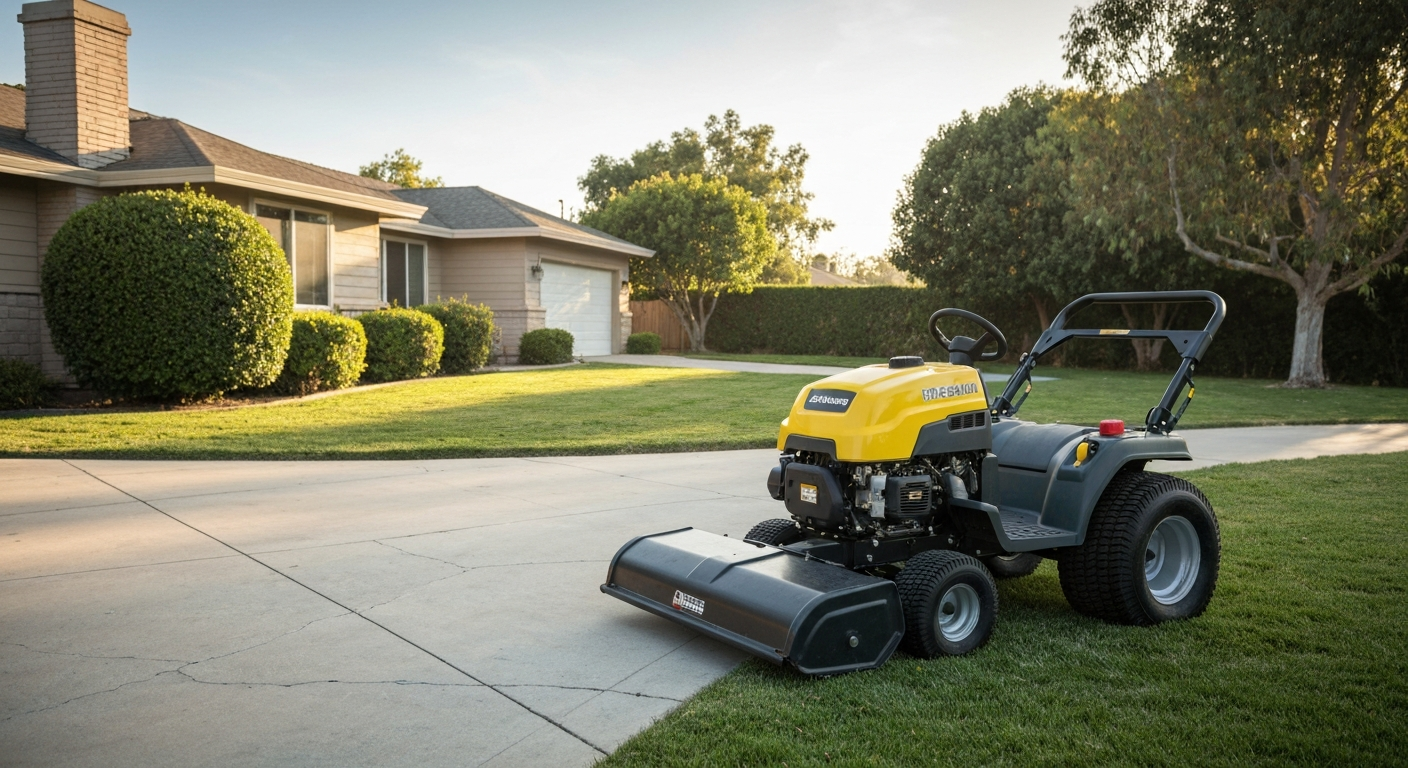
A residential mower won’t survive commercial use. A decent commercial walk-behind or stand-on mower from Exmark, Husqvarna, or Wright runs $3,000–$8,000 new. A zero-turn for larger properties: $7,000–$12,000. Used equipment is a reasonable option for starting out, but factor in maintenance costs — a used mower with hidden problems will cost you in downtime.
Trailer
You need a way to move equipment. An enclosed trailer offers theft protection and looks more professional to commercial clients. A basic open utility trailer runs $1,000–$2,500. Enclosed trailers start around $3,000–$5,000. Don’t forget the trailer hitch and wiring on your truck if it doesn’t already have one.
General Liability Insurance
Non-negotiable. A rock thrown by a mower blade through a client’s sliding glass door is a $1,500–$3,000 repair. Without liability coverage, that’s out of your pocket. General liability for a lawn care business in California runs $500–$2,000/year depending on your revenue and coverage limits. Most commercial property managers require proof of liability insurance before they’ll let you on site — so if you want those accounts, you need the certificate.
Workers’ Comp Insurance
Separate from general liability, and required as discussed above. Cost varies by payroll and classification. Get quotes from multiple carriers. The California State Compensation Insurance Fund (statefund.com) is one option that’s required by law to offer coverage to any California employer.
Commercial Auto Insurance
Your personal auto insurance policy almost certainly excludes commercial use — hauling a trailer full of equipment to job sites qualifies as commercial use. A commercial auto policy for a landscaping operation runs $1,200–$3,000/year depending on vehicle, driving history, and coverage. If you’re financing the truck, your lender may require specific coverage levels anyway.
Startup Costs at a Glance
Here’s the honest math, broken into two scenarios.
Formation and Licensing
- LLC filing: $70
- Statement of Information: $20
- Annual franchise tax: $800/year
- DPR certification (if applicable): $90–$190 in exam fees
- CSLB C-27 license (if applicable): $650–$800 in fees, plus bond
- City business license: $50–$500
Equipment
- Commercial mower: $3,000–$12,000
- Trailer: $1,000–$5,000
- Hand tools, blowers, trimmers, edgers: $500–$2,000
- Vehicle (if you don’t have one): $5,000–$20,000
Insurance (Annual)
- General liability: $500–$2,000
- Workers’ comp: varies by payroll
- Commercial auto: $1,200–$3,000
Total lean startup — mow-only, no chemical application: $8,000–$25,000, depending heavily on whether you already have a capable truck.
Total with chemical application services (DPR certification, additional equipment, sprayer, applicator training): $12,000–$35,000.
These ranges are wide because vehicle costs dominate the low end vs. high end. If you already own a work truck, you’re closer to $8,000–$15,000 to get started cleanly. If you’re buying everything from scratch, budget toward the top of those ranges.
Forming Your Business Entity
Sole proprietorship is simpler on paper, but it leaves you personally exposed. One injured employee, one damaged property claim — your personal assets are on the table.
An LLC separates your business liability from your personal finances. For $70 to file plus $800/year, that protection is worth it. File at bizfileOnline.sos.ca.gov.
Get an EIN from the IRS at irs.gov/ein — it’s free and takes about five minutes online. You’ll need it for your business bank account, payroll, and tax filings.
Open a dedicated business bank account before you take your first payment. Mixing personal and business finances is how you lose the liability protection an LLC is supposed to give you.
Your First 30 Days
The sequence matters here. Don’t buy equipment before you have your business structure sorted. Don’t take on employees before you have workers’ comp. Don’t spray a client’s lawn before you have your DPR certification.
- File your LLC and get your EIN
- Open a business bank account
- Get your city business license
- Purchase general liability and commercial auto insurance
- Register with the Franchise Tax Board
- If you’ll be applying pesticides, start the DPR QAC application process — the exam requires scheduling in advance
- Buy equipment
The DPR exam scheduling can take a few weeks. Start that process early so it’s not the bottleneck when you’re ready to launch.
California isn’t the easiest place to start a lawn care business. The costs are real, the regulations have teeth, and the labor market is tight. But the market is also massive, the demand is consistent, and clients who find someone reliable tend to stick around for years. Get the structure right from the start, price your work to cover California’s actual cost floor, and you’ve got a real business.