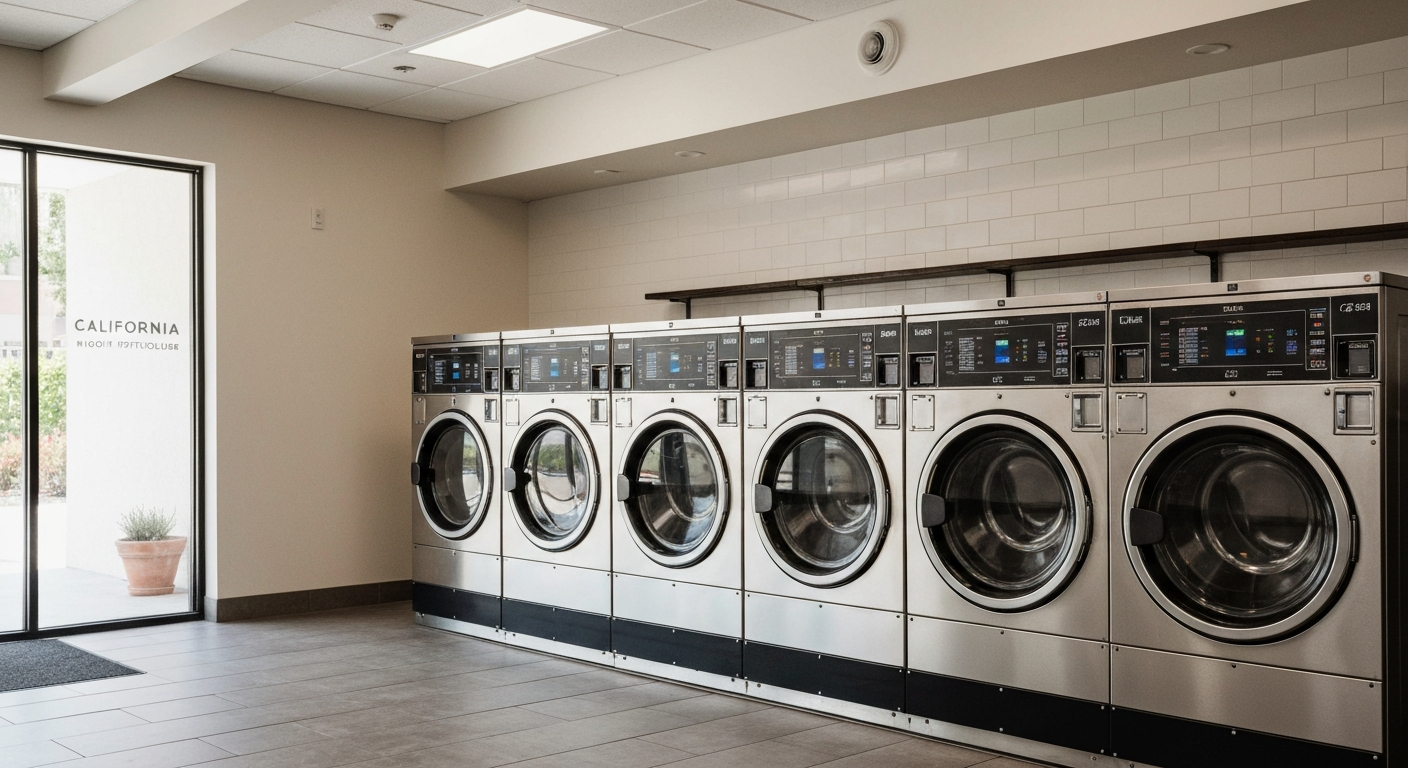
How to Start a Laundromat Business in California
How to Start a Laundromat Business in California
California has more renters than almost any other state. About 45% of households rent — and most apartments in older urban buildings don’t have in-unit laundry. That’s your market. Los Angeles, San Francisco, Sacramento, San Diego: dense populations, aging housing stock, and residents who need somewhere to wash their clothes. Demand is real and consistent.
But California is also one of the most expensive and regulated states in which to open a laundromat. Water restrictions, energy efficiency mandates, high construction costs, and a mandatory $800/year franchise tax mean your startup tab will run significantly higher than it would in Texas or Ohio. Expect to spend $250,000 to $600,000+ to get to opening day. That’s not a scare tactic — it’s what the numbers actually look like here.
Here’s exactly what you’re dealing with.
The Business Case in California
The fundamentals are strong. Laundromats are largely recession-resistant — people wash their clothes whether the economy is up or down. California’s renter population isn’t shrinking. And unlike many retail businesses, a well-run laundromat generates consistent daily cash flow without requiring you to be there every hour.
The challenge is the upfront capital and the ongoing regulatory environment. California construction labor costs run 30-50% higher than the national average. Permitting takes longer. Water is a political issue, not just a utility cost. And the state has opinions about your washing machines.
Know all of that going in, and you can build a profitable operation. Go in blind and you’ll blow your budget on surprises.
Choosing a Location
Location determines almost everything — foot traffic, lease rate, competition, and which local permits you’ll need.
Look for high-density residential areas with a high proportion of renters and limited in-unit laundry. Walk the neighborhood. Count apartment buildings. Check whether those buildings have laundry rooms already. Older buildings from the 1960s-80s are your best targets — they were built before in-unit laundry was standard, and retrofitting is expensive enough that most landlords haven’t bothered.
Commercial lease rates in California urban markets are brutal. In Los Angeles, San Francisco, and San Jose, you’re looking at $3-8 per square foot per month for retail/commercial space. A 2,000 square foot laundromat costs $6,000-$16,000 per month in rent before you’ve turned on a single machine. Factor that into your pro forma before you fall in love with a location.
Parking matters more than people think. Customers carry laundry — they drive. A location with no nearby parking will lose business to one that has it, even if everything else is equal.
Check zoning before you sign anything. Not every commercial zone allows laundromat operations, and finding out after you’ve signed a lease is an expensive lesson.
Licenses and Permits
California doesn’t have a single laundromat-specific license. Instead, you’re collecting a stack of approvals from multiple agencies. Start this process early — it runs in parallel, not in sequence.
City Business License
Every California city requires a business license to operate commercially within city limits. The fee varies: Los Angeles charges based on estimated gross receipts, San Diego has a flat fee structure, smaller cities often charge $50-200 for a basic license. Go to your city’s finance or business licensing department directly. Don’t assume the fee is small — in some LA zip codes it’s calculated as a percentage of revenue.
Certificate of Occupancy, Zoning, and Fire Inspection
Before you open, the building needs a certificate of occupancy confirming the space is approved for your type of use. If you’re doing any build-out — and you will be — you’ll need building permits first, then a final inspection to get the CO.
Zoning approval confirms a laundromat is a permitted use at that address. Some cities classify laundromats as personal services, others as retail. Some require a conditional use permit in certain zones. Check with your city’s planning department before signing a lease.
Fire inspection is typically part of the CO process but can also be a standalone annual requirement. You’ll need to meet fire code for commercial spaces: proper exits, sprinklers if required, fire extinguishers, and so on.
Water and Sewer Connection Permits
This is where laundromats get complicated fast. Commercial laundry operations use significant amounts of water and discharge significant wastewater. Your local water district and sewer authority both want to know about you.
You’ll need a commercial water service connection permit and likely a sewer use permit. Some municipalities require a grease trap or lint interceptor for laundry discharge — lint is a sewer system problem at scale. Contact your local public works or utilities department early. These permits take time and can require engineering documentation.
CDTFA Seller’s Permit
If you sell any retail products — laundry detergent, fabric softener, dryer sheets, bleach — you need a seller’s permit from the California Department of Tax and Fee Administration (CDTFA). The permit itself is free. Register at cdtfa.ca.gov. California’s base sales tax is 7.25%, plus local add-ons that vary by city. In some LA neighborhoods, you’re collecting 10.25%.
Note: the coin-op or card-op washing and drying service itself is generally not subject to California sales tax. But anything you sell over the counter is.
CalRecycle: Waste Handling
California takes waste seriously. CalRecycle regulates proper disposal of commercial waste including lint, packaging, and any hazardous materials you might use (certain cleaning chemicals). Your trash hauler should be a licensed commercial waste hauler. Keep records. Some cities require commercial recycling programs for businesses above a certain size.
Water and Environmental Compliance
This section deserves its own conversation because it will shape your equipment decisions, your operating costs, and potentially your ability to get permits at all.
California’s Water Reality
California operates under persistent drought conditions. Water agencies across the state have authority to impose restrictions on commercial users, and laundromats are high-volume water users by definition. A single commercial washer uses 15-40 gallons per cycle depending on the machine. Multiply that by 20-30 machines running all day.
Some water districts have implemented tiered pricing that penalizes high-volume users. Others have specific efficiency requirements for commercial laundry operations. Check with your local water district before you buy a single machine — their requirements may determine what you can buy.
High-Efficiency Equipment: Required or Strongly Incentivized
California’s Title 20 energy efficiency regulations and voluntary programs through the California Energy Commission push commercial laundry toward high-efficiency equipment. Some water districts make it a condition of your commercial water permit. Others offer rebates that make high-efficiency equipment the obvious financial choice regardless.
ENERGY STAR certified commercial washers use roughly 35-50% less water than standard machines. Front-load washers are significantly more efficient than top-loaders. In California, this isn’t just an environmental preference — it affects your water bill, your utility rebate eligibility, and in some jurisdictions, your permit approval.
Contact your local water district and utility provider before finalizing equipment orders. Many offer substantial rebates — sometimes $500-$1,000 per machine — for certified high-efficiency equipment. That adds up fast across a full laundromat build-out.
Water Recycling Systems
Water recycling and heat recovery systems capture and treat rinse water for reuse. These systems are expensive upfront — installation runs $20,000-$60,000 depending on capacity — but they’re increasingly expected in California commercial laundry operations, especially in water-stressed regions like Southern California.
Some water agencies in drought-prone areas now require commercial laundry operators to demonstrate water conservation measures as a condition of service. A water recycling system is the strongest demonstration you can make. It also reduces your water bill meaningfully over time.
Sewer Surcharges
Commercial laundry discharge is classified as high-strength wastewater in many California municipalities. That means surcharges on top of standard sewer rates, calculated based on volume and the chemical composition of what you’re discharging.
Budget for sewer costs that are substantially higher than a typical commercial tenant. And install lint interceptors — most jurisdictions require them for commercial laundry, and clogged municipal sewer lines from laundry lint are a real enforcement issue.
Business Structure
Form an LLC before you open. The $70 filing fee (Form LLC-1) with the California Secretary of State is the easy part. The harder part is accepting that California charges every LLC $800 per year in franchise tax, starting with your first tax year — there’s no first-year exemption here.
File your Articles of Organization at bizfileOnline.sos.ca.gov. Within 90 days of formation, file your initial Statement of Information for another $20. Get your EIN from the IRS at irs.gov/ein — it’s free and takes about 10 minutes online.
For a business with equipment worth $200,000+ and daily cash handling, the liability protection of an LLC isn’t optional. It’s basic risk management.
Startup Costs
Let’s be specific. These are California numbers — not national averages.
LLC Formation: $70 + $800/year
The $70 covers your Articles of Organization. Then $800 every year to the Franchise Tax Board, regardless of whether you’re profitable. Budget it as an operating cost from day one.
Equipment: $100,000–$300,000
This is your biggest line item and the one with the widest range. A basic 20-machine operation with commercial front-loaders and dryers starts around $100,000. A full-scale 40-machine laundromat with large-capacity machines, water heating equipment, and folding tables runs $200,000-$300,000.
New vs. used matters here. New commercial washers run $1,500-$4,000 each; dryers $1,200-$3,000. Used equipment can cut costs by 40-60% but comes with maintenance risk. Many operators finance new equipment through equipment loans — lenders like it because the machines serve as collateral.
Coin-op vs. card-op systems are a separate decision. Card-based payment systems are increasingly the standard in urban California markets and add to your equipment cost.
Build-Out: $75,000–$200,000
California construction is expensive. Plumbing for commercial laundry is complex — you need hot and cold water lines to every machine, drain lines, a water heater with commercial capacity, and lint interceptors. Electrical requires heavy-gauge wiring and potentially a panel upgrade.
A bare-bones build-out in a space that’s already been used for laundry might run $75,000. Building out a raw retail space from scratch in a California metro area easily hits $150,000-$200,000 once you factor in permits, labor, materials, and inspections. Permitting alone in cities like Los Angeles can add $10,000-$20,000 and months to your timeline.
Payment Systems: $2,000–$10,000
A card-based payment system (or hybrid coin/card) for a mid-size laundromat runs $2,000-$10,000 installed. This includes the central control unit, card readers on machines, and the point-of-sale infrastructure. Monthly processing fees apply on top.
It’s worth it. Card systems generate transaction data, allow remote monitoring, and reduce the cash-handling headaches that come with coin-only operations.
Insurance: $2,000–$6,000/year
You need general liability, commercial property, and business interruption coverage at minimum. Given the water risk in a laundromat — a machine overflow can cause serious property damage — make sure your property policy covers water damage specifically. Annual premiums for a California laundromat typically run $2,000-$6,000 depending on location, size, and coverage limits.
If you have employees, workers’ compensation is mandatory in California — no minimum employee threshold, no exceptions. That’s an additional cost on top of general liability.
Working Capital: $20,000–$75,000
You need cash reserves to cover rent, utilities, and payroll (if any) during the ramp-up period before revenue stabilizes. Three to six months of operating expenses is the standard recommendation. For a laundromat with $8,000/month in rent and $5,000/month in utilities, that’s $39,000-$78,000 in reserves just for those two line items.
Don’t open without it. The first few months are unpredictable.
Total: $250,000–$600,000+
Add it up: equipment, build-out, permits, first/last/security on the lease, payment systems, insurance, working capital, and LLC costs. You’re at $250,000 on the very low end for a small existing-space buildout, and $600,000+ for a larger ground-up build in an expensive California market.
That’s 20-40% higher than comparable projects in most other states. The construction premium is real. Permitting adds time and money. Water system requirements add cost that operators in less regulated states don’t face.
Financing Options
Most laundromat operators don’t fund this entirely out of pocket. SBA 7(a) loans are commonly used — they cover equipment, build-out, and working capital, and laundromats qualify as eligible businesses. Equipment financing through manufacturers or commercial lenders is another route, keeping the SBA loan for build-out and working capital.
Some equipment suppliers offer in-house financing programs specifically for laundromat builds. Shop those alongside traditional lenders — terms vary significantly.
Operations Basics
A few things to nail down before you open:
Utilities. Commercial water and gas rates in California are high. Model your utility costs conservatively. A 30-machine laundromat in Los Angeles can run $4,000-$8,000/month in water, gas, and electricity.
Staffing. Fully unattended laundromats are possible but require robust security systems, reliable machines, and a solid maintenance plan. Attended laundromats command higher prices and lower vandalism rates. Many operators start attended and shift to semi-attended over time.
Maintenance. Budget 5-10% of gross revenue annually for repairs and maintenance. Commercial machines are workhorses but they break. Build a relationship with a commercial laundry equipment repair technician before opening day, not after your first breakdown during peak hours.
AB5 compliance. If you hire workers, California’s AB5 independent contractor rules are strict. Most laundromat attendants will need to be classified as employees, not contractors. That means payroll taxes, workers’ comp, and minimum wage compliance — California’s minimum wage is $16.90/hour as of 2026.
Next Steps
Start with a location search and a conversation with your local water district — those two things will shape every other decision. If the water district’s requirements for your target area are manageable and the lease math works, the rest is execution.
Get your LLC filed at bizfileOnline.sos.ca.gov once you’re serious. Talk to an SBA lender early — the loan process takes 60-90 days, and you want financing lined up before you’re ready to sign a lease, not after.
California is a hard place to open a laundromat. The costs are real, the regulations are real, and the permitting timeline will test your patience. But the demand is also real — and a well-run laundromat in a high-density California market can generate strong returns for a long time.