How to Start a Landscaping Business in California
How to Start a Landscaping Business in California
California has one rule that surprises almost every new landscaper: if a single job exceeds $500 in combined labor and materials, you need a state contractor license. Not just a business license. A full C-27 Landscaping Contractor license from the Contractors State License Board (CSLB) — complete with exams, a surety bond, and four years of documented experience.
That’s the dividing line. Below it, you can mow lawns and edge sidewalks with nothing more than a local business license. Above it, you’re in contractor territory, and the state treats unlicensed work as a misdemeanor.
This guide covers both paths — the maintenance-only route and the licensed contractor route — along with every cost and requirement you’ll actually face in California.
Why Start a Landscaping Business in California?
The obvious answer: the weather. Most of California has a year-round growing season, which means year-round revenue. There’s no three-month winter shutdown like landscapers in Minnesota or Ohio deal with. Grass grows in January. Clients need service in February. That alone makes California fundamentally different from most other markets.
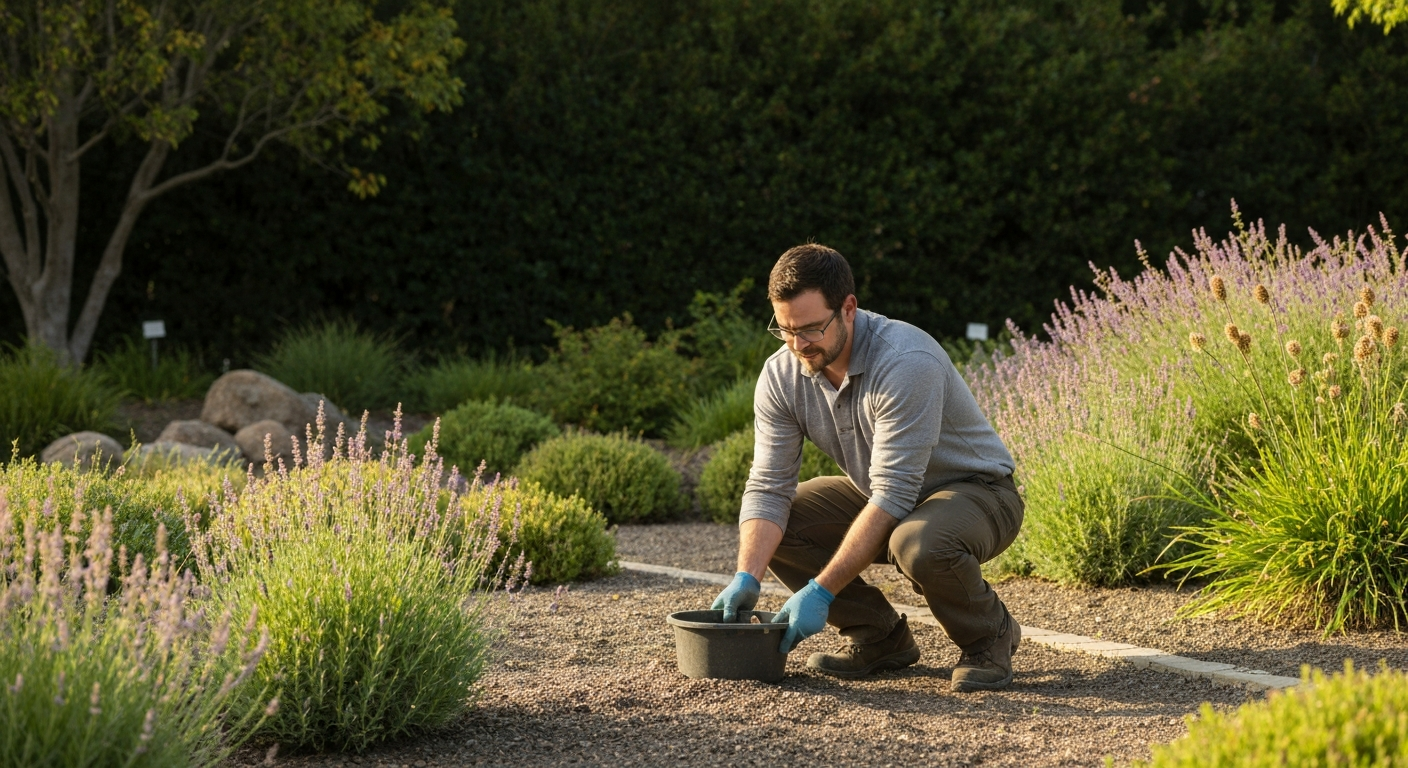
But the more interesting opportunity is drought. California’s ongoing water scarcity has created serious demand for xeriscaping, drought-tolerant plantings, and water-efficient irrigation systems. Homeowners who used to pay for weekly lawn maintenance are now ripping out grass and replacing it with decomposed granite, native plants, and drip irrigation — and they’re paying well for it. Water agencies across the state offer rebates for turf removal, which pushes more homeowners into the market for a landscaper who knows what they’re doing.
That’s a premium service category. A crew that can design and install a drought-tolerant front yard can charge $8,000–$25,000 for a project that takes a week. Basic lawn mowing doesn’t get you there.
Then there’s sheer market size. 39+ million residents, millions of single-family homes, and commercial properties ranging from strip malls to corporate campuses all need some form of landscape maintenance or improvement. The residential and commercial market in California is enormous. The two-tier structure matters: basic lawn maintenance has a lower barrier to entry but modest margins. Full landscape construction and design has a higher barrier — that C-27 license — but significantly higher margins. Many landscapers start on the maintenance side and move up.
Step 1: Do You Need a CSLB License?
This is the first question to answer, and the answer depends entirely on your job size.
If any single project exceeds $500 in combined labor and materials, yes — you need a C-27 Landscaping Contractor license. That threshold includes both labor and materials together. Install sod, charge $300 for labor and $250 for materials? That’s $550 combined. You needed a license.
It’s easy to hit $500. A small planting bed renovation, a basic irrigation repair, any job involving hardscape or soil work — these cross the threshold quickly. The $500 limit is not a revenue threshold or an annual cap. It applies to each individual project.
Operating without a license on jobs over $500 is a misdemeanor in California. First offense: fines up to $5,000, up to six months in jail, or both. The CSLB actively investigates complaints and runs sting operations. This isn’t a rule people quietly ignore.
Below $500 per job: you can legally perform basic maintenance — mowing, edging, blowing, basic weeding — without a CSLB license. You still need local business licenses, and all the other rules (insurance, AB5, taxes) still apply. But the state licensing requirement doesn’t kick in.
A lot of landscapers start this way. Maintenance-only, strictly under $500 per job, building clientele and cash flow while working toward the C-27 requirements. It’s a legitimate path. Just know the ceiling is real — quote a job at $600 without a license and you’ve committed a crime, even if the work itself is excellent.
Step 2: Getting Your C-27 License
If you’re going the licensed contractor route — or planning to eventually — here’s what the CSLB actually requires.
Eligibility: You must be at least 18 and have four years of journey-level experience in landscaping within the past 10 years. Journey-level means working as a skilled landscaper, not as a laborer or helper. If you have a related degree (horticulture, landscape architecture, etc.), it can substitute for up to three of those four years.
Application fee: $450, non-refundable, filed at cslb.ca.gov. Pay it, submit your application, wait for CSLB to schedule your exams.
Exams: Two of them. The trade exam covers landscaping-specific knowledge — plants, irrigation, drainage, soils, pest management. The law and business exam covers California contractor law, contracts, and business practices. Both are required. You can take prep courses; several are available online specifically for the C-27.
Initial license fee: $200–$350 depending on your ownership structure (sole owner, partnership, corporation, LLC).
Surety bond: $25,000 contractor’s bond, filed with CSLB. You don’t pay $25,000 — you pay a premium to a bonding company, typically $250–$500 per year depending on your credit history.
Workers’ compensation: If you have employees, CSLB requires proof of workers’ comp coverage before they’ll issue the license. No employees yet? You can file a workers’ comp exemption — but the moment you hire someone, that changes.
License renewal: Every two years. Don’t let it lapse; operating on an expired license has the same legal exposure as operating unlicensed.
Total government fees in year one: roughly $650–$800, not counting the bond premium or exam prep. Budget $1,000–$1,300 for the full licensing process.
Step 3: Form Your Business Entity
Before you take on clients, decide how you’re operating legally.
LLC: Most landscaping businesses should form an LLC. It costs $70 to file Articles of Organization at bizfileOnline.sos.ca.gov. The real cost is what comes next.
California’s $800/year franchise tax hits every LLC doing business in the state. It’s due by the 15th day of the 4th month after formation — so if you form in January, you owe $800 by April 15. There’s no longer a first-year exemption; that ended December 31, 2023. This is a flat fee regardless of whether you made any money. It’s not optional. Budget for it from day one.
Within 90 days of forming your LLC, you also file a Statement of Information (Form LLC-12) with the Secretary of State: $20. It’s required, and it repeats every two years.
Sole proprietorship: No state filing fee, but no liability protection. For a landscaping business operating heavy equipment on client property — mowers near landscaping, trucks on driveways, crews near irrigation systems — the liability exposure is real. One damaged irrigation line or one worker injury on a client’s property can create personal financial liability. The $70 LLC fee is cheap protection.
EIN: Get one from the IRS at irs.gov. Free. Takes about 10 minutes online. You’ll need it for your bank account, payroll, and tax filings.
Step 4: Insurance Requirements
California doesn’t give you options on some of these.
Workers’ compensation is mandatory for all California employers — every single one, even if you have just one part-time employee. No minimum threshold, no exceptions. Penalties for non-compliance start at $10,000. If a crew member gets hurt on a job and you don’t have workers’ comp, you’re personally liable for medical costs and face significant fines. This is not a line item to skip.
General liability insurance: If you hold a C-27 license, CSLB requires proof of at least $1 million in liability coverage. Even if you’re operating maintenance-only without a CSLB license, general liability is effectively required — clients will ask for your certificate of insurance, and commercial property managers won’t let you on site without it. Budget $75–$150/month ($900–$1,800/year) for GL coverage, depending on your revenue and crew size.
Commercial auto insurance: Your personal auto policy won’t cover a truck used for business. If you’re hauling a trailer with mowers, driving to job sites, or carrying equipment, you need commercial auto. Required, not optional.
Inland marine insurance: Covers tools and equipment in transit. Your mowers, trimmers, blowers, and specialty equipment aren’t covered by standard commercial auto or general liability when they’re being transported. For a landscaper whose entire operation lives on a trailer, this matters.
AB5 and Landscaping Workers
California’s AB5 law changed how businesses classify workers, and it hits landscaping companies hard.
AB5 uses an “ABC test” to determine if a worker is an employee or an independent contractor. To classify someone as a contractor, you must prove all three prongs:
- (A) The worker is free from your control and direction.
- (B) The worker performs work outside the usual course of your business.
- (C) The worker is customarily engaged in an independently established trade.
The B prong kills it for landscaping crews. If you run a landscaping company and you hire a landscaper to do landscaping, that worker is performing your company’s core business. They fail prong B. You cannot legally classify them as an independent contractor. Period.
This isn’t a gray area. Plan to hire employees, not subcontractors, for your regular crew. That means payroll taxes — budget roughly 10–12% above wages for employer-side payroll taxes — plus workers’ comp, mandatory paid sick leave, and California’s other employment requirements.
What you can do: subcontract to other licensed contractors for specialty work. Bringing in a licensed irrigation contractor or a licensed hardscape contractor for a specific portion of a project is generally permissible. They run their own business, carry their own license, and aren’t your employees. That’s a legitimate subcontracting relationship. Just make sure they’re actually licensed — your CSLB license doesn’t cover their work.
Local Permits and Regulations
State licensing and entity formation are just the beginning. California’s regulatory requirements extend to the local level and into specific service categories.
City/county business license: Required everywhere. Fees range from $15 to $300+ depending on your city. Use CalGold (calgold.ca.gov) — enter your business type and location and it generates a list of every permit and license you need at the state, county, and city level. Genuinely useful.
CDTFA Seller’s Permit: Landscaping services themselves aren’t generally subject to sales tax. But if you sell plants, mulch, soil, or other materials separately as a retail transaction, you may need a Seller’s Permit from the California Department of Tax and Fee Administration. Free to register at cdtfa.ca.gov. Worth clarifying with a tax professional based on your specific billing practices.
Water regulations: California’s drought restrictions actively affect irrigation work. Many local water districts have rules about irrigation system installation, watering schedules, and turf removal. Before quoting irrigation jobs, check with the local water district — rules vary significantly between, say, the East Bay MUD service area and a small rural district in Riverside County.
Pesticide use: This one catches people off guard. If you apply pesticides — herbicides, insecticides, fungicides — you need either a Qualified Applicator License (QAL) or a Qualified Applicator Certificate (QAC) from the California Department of Pesticide Regulation (DPR). This is completely separate from your CSLB license. A C-27 license doesn’t authorize you to apply restricted pesticides. Check cdpr.ca.gov for exam and application requirements.
Startup Costs at a Glance
Here’s what you’re actually looking at, broken down honestly:
Formation and compliance:
- LLC filing: $70
- Franchise tax (year one): $800
- Statement of Information: $20
- Local business license: $15–$300
- EIN: $0
CSLB licensing (if pursuing C-27):
- Application fee: $450
- Initial license fee: $200–$350
- $25,000 surety bond premium: $250–$500/year
Insurance:
- General liability: $900–$1,800/year
- Commercial auto: varies by vehicle and coverage
- Workers’ comp: varies by payroll
- Inland marine: $200–$600/year
Equipment:
- Mowers, trimmers, blowers, hand tools: $5,000–$20,000
- Trailer: included or $1,500–$5,000
- Work truck (used): $10,000–$30,000
Total first-year estimate (maintenance-only, no CSLB license): $8,000–$20,000, mostly equipment and vehicle.
Total first-year estimate (licensed contractor): $15,000–$40,000+, depending heavily on equipment investment and whether you already own a truck.
The equipment is the biggest variable. A solo operator starting with a used zero-turn mower, a basic trailer, and a used truck can get off the ground for less. A two-crew operation targeting larger residential and commercial clients needs real equipment from day one.
Getting Your First Clients
The fastest path to early revenue is referrals from neighbors, Nextdoor posts, and local Facebook groups. Seriously. A landscaping business with clean work and a reliable schedule will get word-of-mouth referrals faster than almost any other trade, because most people’s experience with landscapers involves no-shows and inconsistent quality.
Show up. Do good work. Send invoices the same day. That’s a competitive advantage in this market.
For commercial clients, you’ll need your certificate of insurance before anything else. Get that GL policy in place, get the certificate, and you can start bidding on commercial maintenance contracts. Property management companies, HOAs, and commercial landlords all work from vendor lists — once you’re on one, recurring work follows.
The drought-related services — xeriscaping consultations, turf removal projects, drip irrigation installation — are where the premium pricing lives. If you’re pursuing the C-27 license, position yourself in this category. Water agencies like the Metropolitan Water District and many local utilities actively market turf removal rebate programs to homeowners. You can be the contractor they call.
Start with the license question. Decide your path. Then build from there.