How to Start an HVAC Business in California
How to Start an HVAC Business in California
California has 39 million people, triple-digit summers in the Central Valley, and mountain towns that drop below zero in January. That’s not a seasonal market — that’s year-round work. But getting licensed to do it costs more here than almost anywhere else in the country, and the compliance requirements stack up fast.
Here’s exactly what you need, what it costs, and what trips up first-time HVAC business owners in this state.
The C-20 HVAC Contractor License
Every HVAC contractor doing work valued at $1,000 or more (parts plus labor) in California needs a license through the Contractors State License Board (CSLB). For HVAC, that’s the C-20 Warm-Air Heating, Ventilating, and Air-Conditioning license — a Class C Specialty Contractor designation.
The C-20 covers everything you’d expect: installation, maintenance, and repair of heating, cooling, and ventilation systems in both residential and commercial settings. If you’re installing a split system in a Fresno ranch house or replacing rooftop units on a San Jose office building, you need this license.
The $1,000 threshold changed in 2025. Before January 1, 2025, the limit was $500. AB 2622 raised it to $1,000. Anything under that, you can work without a CSLB license. Anything over — and almost every HVAC job clears that easily — you’re legally required to be licensed.
Experience Requirements
CSLB requires four years of full-time journey-level HVAC experience within the past ten years. Journey-level means hands-on field work, not sales, management, or apprentice-level tasks. You need to have actually been doing the work — pulling refrigerant lines, wiring controls, commissioning systems.
If you’ve been working as a tech for four-plus years, you likely qualify. If you’re newer to the trade, you’ll need to log the time before you can apply.
The Two Exams
There’s no way around the testing requirement. CSLB requires you to pass two separate exams:
- The C-20 trade exam — covers the technical knowledge specific to warm-air heating and air conditioning
- The Law and Business exam — covers California contractor law, licensing requirements, contracts, and business practices
Both require a 72% passing score. You can take them in either order, but most people sit for both around the same time. CSLB will send you scheduling information once your application is approved.
Don’t underestimate the Law and Business exam. Plenty of experienced technicians fail it the first time because they assume it’ll be easy compared to the technical test. Study it seriously.
Fees
- Application fee: $450
- Initial license fee: $200
- Total to get licensed: $650
Your license is valid for two years. Renewal runs $450. Budget for it — a lapsed license means you can’t legally work, and CSLB enforcement in California is real.
EPA Section 608 Certification
The C-20 license handles the state side. But HVAC adds a federal requirement on top: EPA Section 608 certification under the Clean Air Act.
Anyone who purchases, handles, or recovers refrigerants must hold this certification. That means you. And it means every technician on your crew. This isn’t optional, and it isn’t California-specific — it’s federal law, enforced by the EPA regardless of what state you’re in.
Which Type to Get
Section 608 certifications come in four types:
- Type I — small appliances (under 5 lbs of refrigerant)
- Type II — high-pressure systems (most residential and commercial AC)
- Type III — low-pressure systems
- Universal — covers all three types
Get Universal. It costs the same or only slightly more than the individual certifications and covers every system type you’ll encounter. There’s no reason to box yourself in.
Cost and Logistics
Testing runs $20 to $200, depending on the provider. ESCO Group, Mainstream Engineering, and NATE are among the common testing organizations. Some HVAC training programs include the exam in their curriculum. Others require you to find your own testing site.
One major advantage: EPA 608 certification doesn’t expire. Once you pass, it’s yours permanently. No renewal fees, no continuing education requirements for the cert itself. Pass it once, done.
Get this before you touch any refrigerant work on a job. Handling refrigerants without certification is a federal violation — the fines are significant.
Bond, Insurance, and Workers’ Comp
This is where California’s cost stack separates itself from other states. Let’s go through each piece.
Surety Bond
CSLB requires a minimum $25,000 contractor’s surety bond. This protects your clients if you fail to complete a job or cause damage. The bond isn’t insurance for you — it’s protection for the public.
Your annual premium on a $25,000 bond is typically $100 to $500 per year, depending on your credit. Good credit means you’re at the low end. Recent financial issues push it higher.
Workers’ Compensation — No Exemptions
This is the one that surprises solo operators. As of January 1, 2025, all licensed CSLB contractors must carry workers’ compensation insurance — no exemptions. That includes sole proprietors with no employees.
Previously, licensed contractors with no employees could file an exemption. That option no longer exists. If you’re a one-person HVAC business with a C-20 license, you’re required to carry workers’ comp.
Annual cost for a solo HVAC tech in California: $2,000 to $12,000+, depending on payroll, experience modifier, and your insurer. HVAC carries a relatively high workers’ comp classification code because the work involves electrical systems, heights, and mechanical equipment. Plan for the higher end until you build a claims-free history.
General Liability Insurance
CSLB doesn’t require general liability, but every commercial client will ask for it, and every homeowner should want you to have it. If you accidentally damage a customer’s property — say, a refrigerant leak ruins hardwood floors, or an electrical mistake causes a fire — your liability policy covers the claim.
Recommended minimum: $1 million per occurrence. Budget $3,000 to $15,000 per year. Where you land depends on your revenue, the types of jobs you take (residential vs. commercial), and your claims history.
Commercial Auto Insurance
Your work truck isn’t covered by a personal auto policy when you’re using it for business. You need commercial auto insurance on every vehicle in your fleet. If you have one van, that’s one policy. If you grow to five trucks, that’s a fleet policy.
Factor this into your overall insurance budget. A single commercial vehicle policy runs roughly $1,500 to $3,500 per year in California, depending on the vehicle, driver history, and coverage limits.
The Full Insurance Picture
Ballpark your total insurance costs — workers’ comp, general liability, and commercial auto combined — at $5,000 to $18,000 per year for a solo operation. That’s a real line item in your business budget, not a rounding error.
Startup Costs at a Glance
Here’s what it actually costs to get an HVAC business off the ground in California. No hand-waving.
Business Formation
LLC formation: $70 (Articles of Organization, Form LLC-1, filed at bizfileOnline.sos.ca.gov)
Then the $800/year franchise tax hits — every California LLC pays this to the Franchise Tax Board, regardless of revenue. If you make $0 your first year, you still owe $800. The first-year exemption that used to exist expired December 31, 2023. It’s gone. Budget for it immediately.
You’ll also need to file a Statement of Information (Form LLC-12) within 90 days of formation, then every two years. That’s $20.
Licensing and Certification
- CSLB application + initial license: $650
- EPA Section 608 (Universal): $20 to $200
Insurance and Bond (Annual)
- Surety bond premium: $100 to $500
- Workers’ comp: $2,000 to $12,000+
- General liability: $3,000 to $15,000
- Commercial auto: factor in separately
Total insurance stack: $5,000 to $18,000+ per year
Equipment
This is where the real money goes.
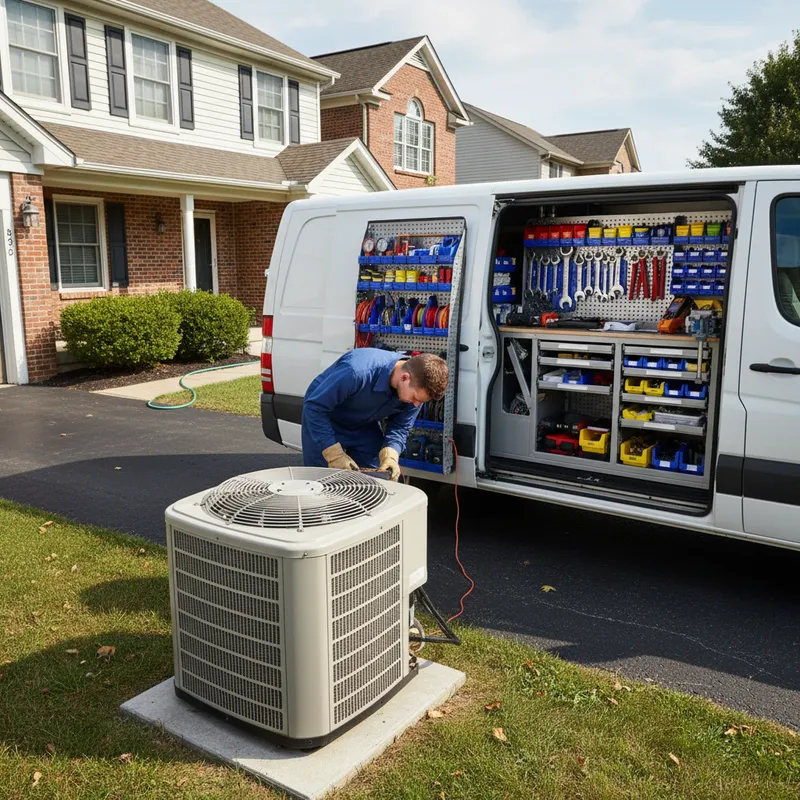
A properly equipped HVAC service vehicle — a cargo van or truck with shelving, stock parts, refrigerant, and basic tools — runs $35,000 to $70,000. That’s the vehicle itself plus upfitting. You can start with a used van and reduce that number, but don’t go cheap on the vehicle and then have it break down on your third job.
Your tools and specialized equipment add another $5,000 to $25,000:
- Refrigerant recovery machine (required by law)
- Manifold gauge set
- Micron gauge
- Vacuum pump
- Digital multimeter and electrical testing equipment
- Pipe and duct tools
- Refrigerant cylinders
- Hand tools, power tools, ladders
If you already own tools from years as a tech, you’re ahead. If you’re starting from scratch, you’re at the high end of that range.
The Total
Solo startup cost (before vehicle): $18,000 to $45,000+
Add the vehicle and you’re looking at $53,000 to $115,000+ to launch properly. That’s not a discouraging number — it’s a realistic one. Plenty of HVAC businesses get off the ground for less by leasing equipment, buying a used vehicle, or doing installs as a subcontractor while building capital.
California’s Cost Stack vs. the Reward
Let’s be direct: California is the most expensive state in this network to run an HVAC business. The $800 franchise tax, the no-exemption workers’ comp requirement, the highest state income tax in the country (up to 13.3%), the minimum wage at $16.90/hour and climbing — it stacks up fast compared to Nevada, Arizona, or Texas.
But here’s the thing about California’s climate: it’s not one climate. It’s every climate.
Palm Springs hits 120°F. Mammoth Lakes drops to -20°F. The Bay Area has microclimates that shift every five miles. Sacramento runs 100-degree summers and 35-degree winters. The Central Coast needs different equipment than the Inland Empire. California HVAC contractors don’t go quiet in shoulder seasons the way technicians in moderate-climate states do — the desert heat runs until November, and the mountain jobs pick up in October.
That year-round demand is real. And California’s housing density — 14 million housing units, millions of commercial buildings — means the customer base is enormous. The margins need to account for the cost structure, but the volume is there if you build the business right.
Before You File Anything
Get the EPA Section 608 Universal certification first if you don’t have it. It’s the cheapest, fastest box to check — $200 or less, no expiration, done. Then start the CSLB application process, which takes time to work through (document gathering, exam scheduling, processing). Form your LLC in parallel once you have a business name confirmed.
Don’t wait until you have the license in hand to figure out insurance. Start getting quotes from insurers who specialize in California contractors early — some take weeks to bind coverage, and CSLB will ask for proof of workers’ comp as part of the licensing process.
The CSLB website has the full C-20 application checklist, exam prep resources, and a license lookup tool to verify your own status once issued. Use it. The information there is current, and the checklist is genuinely helpful.
One more thing: get your EIN from the IRS before you open a business bank account. It’s free at irs.gov/ein, takes about 10 minutes online, and you’ll need it for your workers’ comp policy, your bank, and your tax filings.
California HVAC is a real business. The startup requirements are legitimate, the costs are higher than other states, and the compliance expectations don’t leave much room for shortcuts. But the demand is there, the rates support the costs, and a licensed, insured HVAC contractor in California is building something that holds value.