How to Start a Hair Salon Business in California
How to Start a Hair Salon Business in California
California requires 1,000 hours of cosmetology training to get licensed. Virginia requires 1,500. Georgia requires 1,500. Most states cluster between 1,200 and 1,500 hours. That gap isn’t trivial — it’s three to five months of school, which means California stylists can get licensed and working faster than almost anywhere else in the country.
That’s the upside.
The downside is the California cost layer: an $800/year franchise tax that hits every LLC regardless of revenue, mandatory workers’ comp insurance from the moment you hire your first employee, a $16.90/hour minimum wage taking effect in 2026, and salon build-out costs that routinely run 30–50% above national averages. You can open a hair salon here. Plenty of people do. But you need to know the real numbers before you sign a lease or enroll in cosmetology school.
This guide covers both: the licensing path and the cost structure.
Establishment License
Every hair salon operating in California needs an establishment license from the California Board of Barbering and Cosmetology (BBC). That’s true whether you’re opening a 10-chair commercial salon, a one-chair suite, or a home salon. If regulated cosmetology services are happening there, the establishment needs to be licensed.
The BBC’s website is barbercosmo.ca.gov. That’s where you’ll find the Establishment Application, the current fee schedule, and the inspection requirements. The fee varies depending on the type of establishment, so check the current schedule directly — the BBC updates it periodically.
Home salons are permitted in California. This is worth emphasizing because many states prohibit them outright or bury the option in so much red tape that it’s not practical. In California, you can operate a licensed hair salon out of your home if you complete the Establishment Application and meet all the same requirements as a commercial salon — proper ventilation, sanitation, separate entrance in some cases, and so on. It’s a real path, not a technicality.
One important caveat: the BBC establishment license is the state requirement. It doesn’t replace local permits. You’ll need to contact your city and county to find out what additional business licenses, zoning approvals, or health permits apply to your specific location. A home salon in Los Angeles has different local requirements than a commercial salon in Sacramento. Call your city’s business licensing office before you build anything out.
Cosmetologist License
Before you can work in a salon — or hire licensed staff who expect you to know what you’re talking about — you need to understand how California cosmetology licensing works.
The 1,000-hour requirement is genuinely low. At most accredited cosmetology programs, 1,000 hours takes roughly six months of full-time schooling. Compare that to the 1,500 hours required in states like Virginia, Georgia, and Texas, which pushes the timeline to nine or ten months. That difference matters if you’re trying to get licensed and start earning, or if you’re building a salon and want to recruit newly licensed stylists.
To qualify for a California cosmetologist license, you must:
- Be at least 17 years old
- Have completed 10th grade (or its equivalent)
- Complete 1,000 hours of training at a state-approved cosmetology school
After completing your hours, you take a written exam only. California eliminated the practical exam requirement — you won’t be demonstrating a haircut or color application in front of an examiner. That’s a meaningful reduction in stress and cost compared to states that require both components.
The initial license fee is $125, which covers both the exam and the license itself. Renewal runs $50 biennially. Those are some of the lowest licensing fees in the country. The state isn’t squeezing you on the credential side.
If you’re opening a salon and hiring stylists, every person performing cosmetology services must hold a current California cosmetologist license. Same goes for barbers, manicurists, and estheticians — each has its own license category under the BBC, with different hour requirements and fees. A hair salon that also offers nail services, for example, needs to ensure its nail techs hold manicurist licenses (400 hours of training, separate exam).
California Cost Structure
Here’s where California diverges sharply from most other states. The licensing side is affordable and accessible. The operating cost side is not.
LLC Formation and the $800 Franchise Tax
If you form an LLC to operate your salon — which is the standard structure for a small business with liability exposure — you’ll pay $70 to file your Articles of Organization with the California Secretary of State at bizfileOnline.sos.ca.gov. Straightforward.
But then comes the $800/year franchise tax, paid to the Franchise Tax Board (FTB). Every California LLC owes this, every year, regardless of whether the business made money. A salon that grossed $40,000 in its first year owes $800. A salon that had a slow opening month and lost money still owes $800. The first-year exemption that used to soften this blow expired on December 31, 2023. It’s gone.
You’ll also file a Statement of Information (Form LLC-12) within 90 days of formation, and then biennially after that. The fee is $20.
If your salon takes off and hits gross income over $250,000, there’s an additional LLC fee on top of the franchise tax: $900 for income between $250K and $500K, scaling up from there. That’s a problem most new salons would love to have — but it’s worth knowing.
Workers’ Compensation Insurance
California requires workers’ comp insurance for every employee, with no minimum headcount threshold. One employee. That’s it. The moment you put someone on payroll — a receptionist, an assistant, a part-time shampoo tech — you’re required to carry coverage.
For a hair salon with two or three employees, workers’ comp typically runs $1,500–$3,000/year depending on payroll size and your claims history. It’s not optional, and the penalties for going without it include stop-work orders and significant fines. Don’t skip this.
Minimum Wage
California’s minimum wage hits $16.90/hour on January 1, 2026. If you’re staffing a salon with hourly employees — front desk, assistants, junior stylists — that’s your floor. Some cities are higher. San Francisco and Los Angeles have local minimums that exceed the state rate, so check your city’s current ordinance.
For a full-time employee at $16.90/hour, you’re looking at roughly $35,000/year in base wages before payroll taxes, benefits, or tips. Build that into your staffing model before you commit to a lease.
AB5 and the Booth Rental Model
Many salons operate on a booth rental model: licensed stylists rent a station from the salon owner and keep their own revenue, operating as independent contractors. It’s common, and in many states it’s clean and simple.
In California, it’s complicated. AB5 — the state’s independent contractor classification law — applies strict criteria to determine whether a worker is truly an independent contractor or effectively an employee. The test (called the ABC test) requires, among other things, that the worker perform work that is “outside the usual course of the hiring entity’s business.” A stylist renting a booth in a hair salon is performing the exact service the salon is in the business of providing. That’s a problem under the ABC test.
The booth rental model isn’t automatically illegal in California, but it requires a genuinely independent contractor relationship — the stylist sets their own hours, brings their own clients, controls their own pricing, and operates as a separate business. If the salon is directing their work, requiring specific hours, or controlling their methods, the arrangement looks like employment under California law. The penalties for misclassification include back wages, penalties, and tax liability.
If you’re planning to run a booth rental salon, talk to a California employment attorney before you open. This is one area where getting it wrong is expensive.
Startup Costs at a Glance
Before you sign anything, here’s what a realistic California hair salon startup actually costs. These aren’t worst-case numbers. They’re honest ranges based on California’s market.
LLC formation: $70 state filing fee, plus $800/year franchise tax every year going forward. Budget $870 in year one just for the legal entity.
Establishment license: Fee varies — check the current schedule at barbercosmo.ca.gov. You’ll also need to budget for the inspection process and any build-out modifications required to pass.
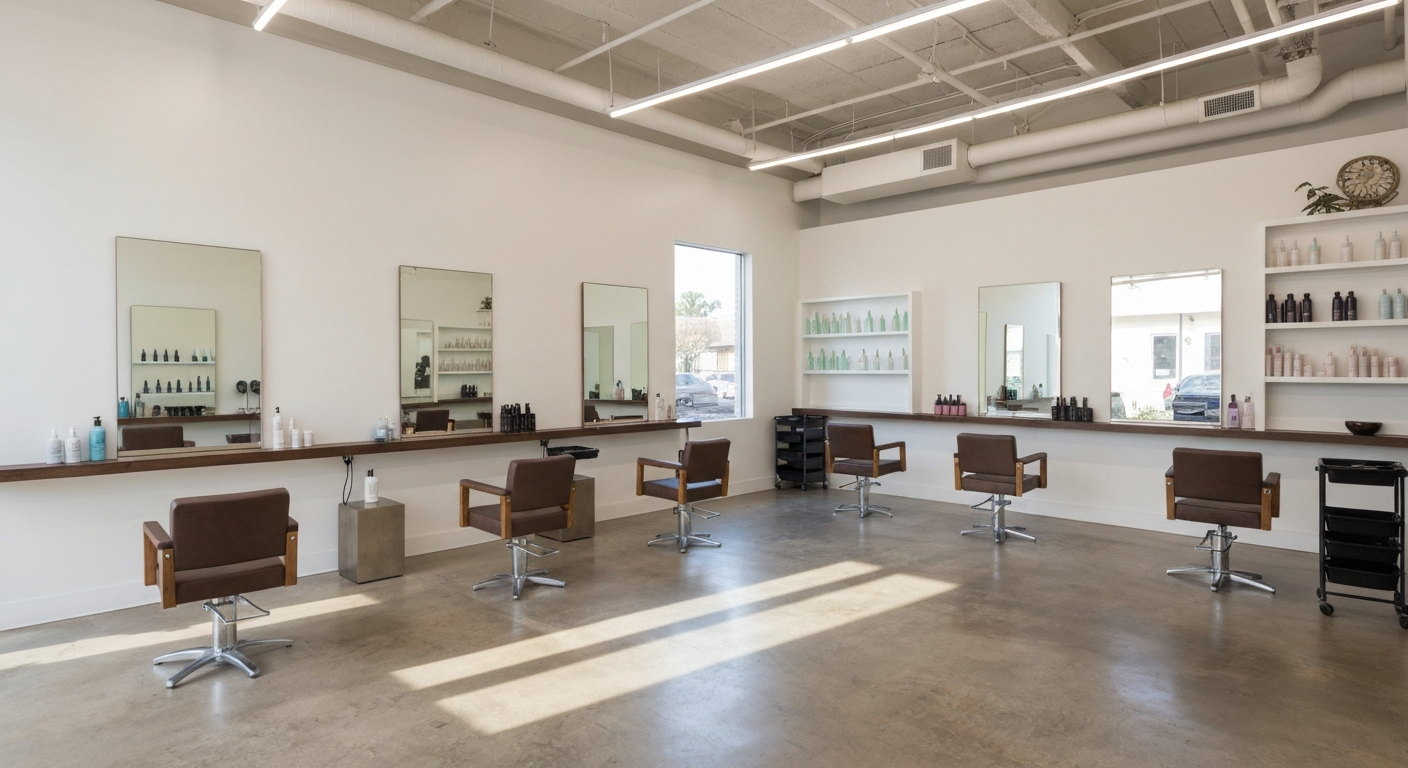
Salon build-out: $30,000–$100,000. California construction costs run 30–50% above the national average. Union labor requirements in some cities, permitting timelines that stretch months, and material costs all contribute. A basic two-chair salon in a California city will cost more to build out than the same space in Phoenix or Atlanta. If you’re taking over an existing salon space that’s already plumbed and wired, you can come in at the lower end. Starting from raw retail space in a major metro, you’re looking at the upper end or beyond.
Equipment: $5,000–$15,000. Styling chairs, shampoo bowls, dryers, color stations, mirrors, and storage. Used equipment can cut this significantly. New chairs alone run $300–$800 each.
Product inventory: $2,000–$5,000 to open with a working stock of color, treatments, styling products, and retail. Don’t underestimate this — running out of a color line mid-week is a real operational problem.
Insurance: $1,500–$4,000/year. This covers general liability and property at minimum. If you have employees, add workers’ comp on top of that.
Total for a lean commercial startup: $50,000–$100,000. That’s not a scare number — that’s a realistic floor for a small, well-planned salon in California. Factor in three months of operating expenses as a cash reserve on top of that, because most salons don’t break even in the first 90 days.
Home salon startup: $5,000–$15,000. This is the path that makes sense if you’re a licensed stylist going solo, want to build a client base before committing to commercial rent, or genuinely prefer the model. You still need the BBC establishment license, local permits, and proper setup — but you’re skipping the build-out and lease, which is where most of the cost lives. A home salon won’t scale past a few chairs, but as a starting point or long-term solo practice, the economics are hard to argue with.
What to Do First
The licensing and business formation steps don’t have to happen in any particular order, but here’s a logical sequence:
-
Get your cosmetologist license (if you don’t already have one). Enroll in a BBC-approved school, complete your 1,000 hours, pass the written exam, and pay the $125 initial fee.
-
Form your LLC at bizfileOnline.sos.ca.gov — $70 filing fee. Get an EIN from the IRS at irs.gov/ein — free.
-
Apply for your establishment license through the BBC at barbercosmo.ca.gov. This triggers the inspection process.
-
Contact your city and county about local business licenses, zoning, and any additional health department permits. Don’t assume state licensing is sufficient.
-
Get workers’ comp insurance before your first employee starts. Not after. Before.
-
Register with the California Department of Tax and Fee Administration (CDTFA) at cdtfa.ca.gov if you’ll be selling retail products. California’s base sales tax rate is 7.25%, with local add-ons depending on your city.
The $800 franchise tax is due by the 15th day of the 4th month after formation, so plan your cash flow accordingly. It comes faster than most new owners expect.
California’s cost structure is real, and it’s not going away. But the low training hours, the written-only exam, and the legitimate home salon option give you flexibility that most states don’t. Know the numbers going in, build your model around them, and the path is clear.