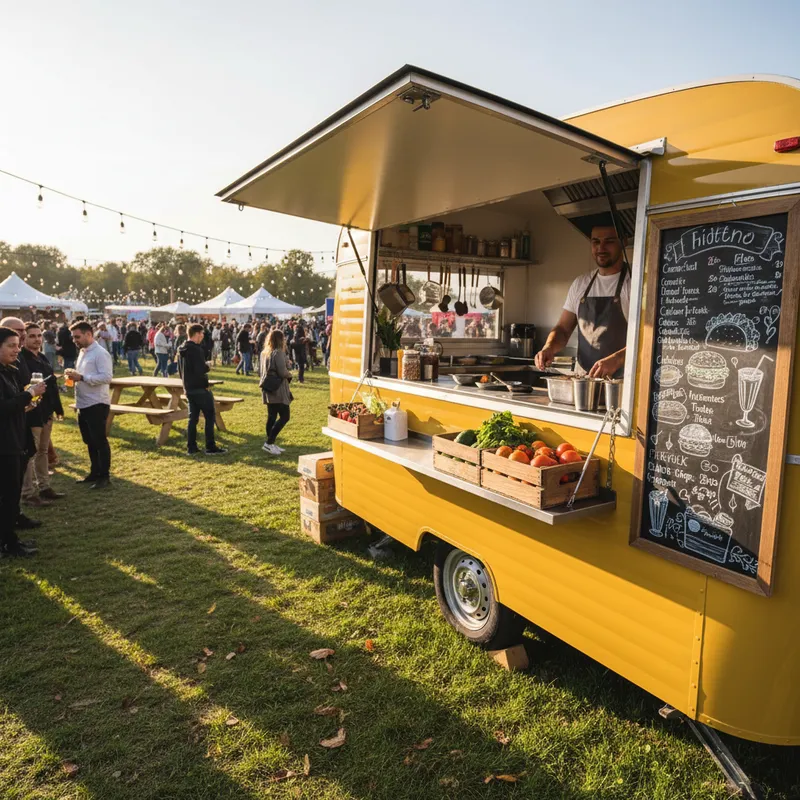
How to Start a Food Trailer Business in California
How to Start a Food Trailer Business in California
California has more food trucks per capita than almost anywhere in the country. It also has one of the most complicated, expensive, and county-fragmented permitting systems you’ll find. Before you spend $60,000 on a trailer build, you need to understand what you’re actually signing up for.
The core challenge: California food trailer permitting is not handled at the state level. Your county’s environmental health department controls your health permit — and that permit is only valid in that county. Want to operate in Los Angeles, Orange County, and San Diego? That’s three separate permits, three separate applications, three separate fees, and three separate inspections. Most states don’t work this way. California does.
Add the $800/year franchise tax, $16.90/hour minimum wage (effective January 1, 2026), mandatory workers’ comp, and the commissary requirement that applies everywhere in the state — and you’re looking at one of the most expensive places in the country to run a food trailer. This guide walks through every piece of the puzzle with realistic numbers.
County Health Department Permit
This is the permit that actually determines whether you can sell food. Every mobile food facility in California — food trucks, food trailers, push carts — requires a valid health permit from the county environmental health department (often called the Department of Environmental Health or DEH) where you plan to operate.
The critical thing to understand: a permit from one county does not transfer to another. Los Angeles County issues its permit. Orange County issues its own. San Diego County issues its own. If you want to work a corporate lunch circuit that crosses county lines, or do a weekend festival in a different county than your usual spots, you need a separate permit for each county. There’s no workaround, and enforcement does happen.
Plan review before you build
Most counties require you to submit detailed kitchen layout plans before they’ll even accept your application. This is not optional and it’s not a formality — the health department reviews where every piece of equipment sits, how your three-compartment sink is positioned, how you’re handling wastewater, where you store food, and how your ventilation works. Some counties require these plans before you build the trailer. Others accept them after the build but before the inspection.
Do not build your trailer and then figure out the health permit. You could end up required to relocate equipment, add sinks, or reconfigure your layout before getting approved. Get the county’s plan review requirements first. Los Angeles County Environmental Health has a mobile food facility page at ehservices.publichealth.lacounty.gov. For other counties, search “[county name] environmental health mobile food facility” — each county has its own portal.
Pre-opening inspection
After plan review, you’ll need a pre-opening inspection before you can operate. An environmental health inspector will physically examine your trailer to confirm it matches the approved plans and meets CalCode (California Retail Food Code) standards. Equipment must be NSF-certified. Surfaces must be cleanable. Hot and cold holding temperatures must be achievable and verifiable.
Required food safety certifications
Every food employee handling non-prepackaged potentially hazardous foods must have a valid California Food Handler Card. These are obtained through an accredited online course — typically $10-20 and about 2 hours.
That’s the baseline. You also need at least one Certified Food Protection Manager (CFPM) per facility. This is a more serious certification — think ServSafe Manager or equivalent. It requires passing a proctored exam and costs $100-$200 depending on the course. The CFPM doesn’t need to be present every shift, but someone in a management role needs to hold the credential.
Permit fees
Fees vary dramatically by county, and that’s not an exaggeration. Los Angeles County’s mobile food facility permit runs around $500-$800/year depending on your operation type. San Diego County is in a similar range. Some smaller counties charge less. Some charge more. Budget for $400-$900 per county per year, and confirm current fees directly with each county’s environmental health department before you plan your financials.
Commissary Requirement
Every mobile food facility in California — without exception — must have a licensed commissary agreement. This is state law under the California Retail Food Code, and no county will issue you a health permit without proof of one.
A commissary is a licensed commercial kitchen that serves as your operational home base. You use it for food prep that can’t happen on the trailer, cleaning equipment and utensils, disposing of wastewater and grease, and storing food and supplies. The commissary must itself hold a valid health permit. Your personal kitchen doesn’t qualify. A friend’s restaurant kitchen doesn’t qualify unless it’s licensed as a commissary and the operator agrees in writing.
Daily return requirement
Most California counties require mobile food facilities to return to their commissary daily. Not weekly. Daily. This affects how you choose a commissary location — it needs to be geographically practical relative to where you’re operating. A commissary in Pomona doesn’t make sense if you’re running lunch service in Santa Monica every day.
Before your health permit is issued, you must have a signed commissary agreement in place. No agreement, no permit. The commissary operator signs the agreement and assumes some responsibility for your compliance. Some commissaries are selective about who they work with.
Finding and budgeting for a commissary
Shared commercial kitchen spaces specifically designed to support food trucks and trailers are increasingly common in California’s major metros. LA, the Bay Area, San Diego, and Sacramento all have dedicated commissary facilities. A basic Google search for “commissary kitchen for food trucks [city]” will surface options. The California Department of Public Health doesn’t maintain a public commissary directory, so local food truck associations and Facebook groups are actually useful resources here.
Cost: expect $500-$2,000/month depending on your market and how much kitchen time you need. In Los Angeles and the Bay Area, $800-$1,500/month is realistic for a reasonable setup. This is a fixed operating cost that doesn’t go away — it’s part of your monthly burn whether you’re generating revenue or not.
Business Permits and Seller’s Permit
The county health permit covers food safety. It doesn’t cover the business side. You need a few additional registrations before you’re fully legal.
CDTFA Seller’s Permit
California requires a seller’s permit from the California Department of Tax and Fee Administration (CDTFA) for any business selling tangible goods — food qualifies. The permit is free to register at cdtfa.ca.gov. This registration puts you in the system for collecting and remitting California sales tax.
California’s base sales tax rate is 7.25%, but local add-ons push it higher in most cities. In Los Angeles, you’re collecting closer to 10.25%. In some Bay Area cities, over 10%. Your point-of-sale system needs to be configured correctly for wherever you’re operating.
City business licenses
Every city where you regularly operate will want a business license. This is separate from the county health permit and separate from the state seller’s permit. Fees vary — typically $50-$300+ per city per year, though some cities charge more for food vendors.
Here’s the practical challenge: if you operate in multiple cities within a county, you may need multiple city licenses even though you only need one county health permit. A food trailer working lunch spots in Pasadena, Burbank, and Glendale — all in Los Angeles County — technically needs a business license in each city.
Zoning and mobile vendor ordinances
California cities have widely varying rules about where food trucks and trailers can park and operate. Some cities actively welcome them. Others have restrictive ordinances that limit hours, require minimum distances from brick-and-mortar restaurants, or restrict operation to designated vending zones.
Before you commit to a regular location, verify that city’s mobile food vendor ordinance. Some cities require a separate mobile vending permit on top of the business license. Los Angeles has specific rules about street vending (SB 946 legalized sidewalk vending statewide in 2018, but cities retain some local enforcement). Do not assume a spot is legal because you’ve seen other trucks there.
Insurance and Workers’ Comp
Insurance is not optional, and in California, several categories are effectively mandatory for a legally operating food trailer.
Commercial auto insurance
Your personal auto policy won’t cover a commercial vehicle being used for business. You need commercial auto insurance for the vehicle towing your trailer (or the truck itself, if you’re running a food truck). Budget $1,500-$4,000/year depending on your vehicle, driving history, and coverage level. If you’re financing the trailer or truck, the lender will require specific coverage minimums.
General liability insurance
A $1 million general liability policy is standard for food vendors, and many event organizers and private property owners require proof of it before letting you operate on their property. Cost runs $1,000-$2,500/year. Some operators go to $2 million aggregate for better event access.
Product liability
General liability policies sometimes include product liability, but verify this explicitly. Product liability covers claims arising from your food — including foodborne illness. One serious claim without coverage can end the business. Make sure your policy explicitly covers food products.
Workers’ comp
California requires workers’ comp for all employees. No exemptions, no workarounds. If you have even one part-time employee, you need workers’ comp coverage. The cost depends on your payroll and the classification of work, but for food service workers, expect meaningful premiums on top of your other insurance costs.
And don’t forget: California’s minimum wage is $16.90/hour effective January 1, 2026 (some fast food and healthcare sectors are already higher). If you’re staffing even one employee for a 30-hour week, your labor cost is real. Most California food trailer operators who are keeping costs down are either sole operators or running lean with one part-time helper.
Startup Costs at a Glance
Here’s where California’s cost stack becomes very visible. These aren’t worst-case numbers — they’re realistic ranges for a legitimate, properly permitted operation.
One-time startup costs:
- LLC filing: $70 (Form LLC-1 with the California Secretary of State at bizfileOnline.sos.ca.gov)
- Statement of Information: $20, due within 90 days of formation
- Food trailer — used: $15,000-$50,000. A used trailer in decent shape that passes inspection is the realistic entry point for most first-timers.
- Food trailer — new custom build: $40,000-$100,000. Fully custom builds from reputable fabricators can exceed $100K.
- County health permit application and plan review: $400-$900+ per county (varies significantly — confirm with each DEH)
- Food Handler Cards: $10-$20 per employee
- Certified Food Protection Manager exam: $100-$200
- Commercial auto insurance down payment
- General liability insurance down payment
Annual/ongoing costs:
- $800 franchise tax: Due every year to the California Franchise Tax Board (FTB). The first-year exemption that existed under AB 85 expired December 31, 2023 — it’s gone. You owe $800 from year one.
- CDTFA seller’s permit: Free to register
- County health permit renewal: $400-$900/year per county
- City business licenses: $50-$300+ per city per year
- Commissary: $500-$2,000/month ($6,000-$24,000/year)
- Insurance (auto + general liability): $4,000-$8,000/year total
- Workers’ comp: Varies by payroll
Total startup estimates:
For a lean startup — used trailer, single county, no employees yet:
$30,000-$65,000 to get through the door
For a new custom build targeting multiple counties with a part-time employee:
$75,000-$150,000+
Those numbers assume you’re doing everything legitimately. The operators you see cutting corners on permits and commissary agreements are taking real risks — county environmental health departments do conduct field inspections and can shut you down on the spot.
The County-by-County Math
If you want to work Los Angeles County, Orange County, and San Diego County — a logical route for a Southern California trailer — you’re looking at three separate county health permits. Three plan reviews. Three inspections. Three annual renewal fees. Potentially different CalCode interpretations by different inspectors.
This isn’t hypothetical. Food trailer operators who work festival circuits, corporate catering routes, or seasonal locations across county lines deal with this constantly. The administrative overhead is real, and so is the cost.
The practical advice: start in one county. Get your operation dialed in — commissary relationship solid, routes established, permit renewal smooth — before adding a second county. Spreading too thin in year one while still figuring out your food cost and throughput is a recipe for burning cash fast.
What to Do First
Get the county health department requirements before anything else. Before you buy a trailer. Before you sign a commissary agreement. Before you file your LLC.
Call or email the environmental health department in the county where you plan to operate. Ask specifically for their mobile food facility requirements packet and their current fee schedule. Most counties post this online, but calling confirms you have the current version.
Then find your commissary. The commissary search will tell you a lot about your operating territory — what’s available, what it costs, and whether the location is practical for your planned routes. Your commissary agreement is what unlocks your health permit application.
After that: file your LLC ($70 at bizfileOnline.sos.ca.gov), register for your CDTFA seller’s permit (free at cdtfa.ca.gov), and line up your insurance before your pre-opening inspection. Some counties want proof of insurance as part of the permit application.
California is genuinely hard to operate a food trailer in. The permit complexity is real, the costs are high, and the regulatory requirements are serious. But the market is also enormous, the food culture is real, and well-run operations do make money here. The ones that survive year one are the ones that went in knowing exactly what they were getting into.