How to Start an Electrician Business in California
C-10 Electrical Contractor License
California doesn’t mess around with a separate journeyman license and a separate contractor license. The CSLB’s C-10 Electrical Contractor classification is your one license — it covers all electrical work in the state, from residential panel upgrades to commercial high-voltage installations. Get it, and you’re licensed to operate. Don’t have it, and you’re not.
The threshold that triggers the requirement: any electrical project where the total cost (labor plus materials combined) exceeds $1,000. That bar went up from $500 on January 1, 2025, thanks to AB 2622, but $1,000 still isn’t much. Basically every real electrical job you’ll run requires this license.
If you’re coming from a state like Virginia, the California system is actually simpler in one way. Virginia requires a tradesman license AND a separate contractor license. California collapses that into one. The C-10 IS your license to work and to run a business. One application, one board, one renewal.
Experience requirement. You need 4 years — specifically 8,000 hours — of journey-level electrical experience within the last 10 years. Not apprentice hours. Journey-level means you were doing the work independently, not working under close supervision as a trainee. CSLB accepts that experience from several sources: W-2 employment, sole proprietor work, or hours documented through a union or apprenticeship program that verifies you reached journey level.
Document your hours carefully before you apply. CSLB will ask for verification, and vague claims don’t pass. If you worked union, your union hall can provide certified records. If you were a W-2 employee, a letter from a former employer on company letterhead spelling out your dates, job title, and duties is standard. The more specific, the better.
One thing worth knowing: the Responsible Managing Employee (RME) or Responsible Managing Officer (RMO) system. If you’re forming a company, the person who qualifies with experience and passes the exams is the RME or RMO — they’re the license holder of record for the business entity. For a solo operation, that’s you. For a partnership or corporation, it might be you or a designated qualified employee.
Exam and Application
Two exams stand between your experience and your license. First is the C-10 Electrical trade exam — this tests your technical knowledge: NEC code, wiring methods, load calculations, motor controls, grounding, overcurrent protection. It’s a real exam, not a formality. Second is the Law and Business exam — covers contractor law, licensing requirements, workers’ comp, lien law, contract requirements, and basic business practices. Passing score on both is 72%.
PSI administers both exams. You’ll schedule them after CSLB approves your application. Study materials are available through CSLB’s website at cslb.ca.gov, and several third-party prep courses exist specifically for the C-10. Given that you’re investing $650 in application and license fees plus months of paperwork, a $100-200 exam prep course is cheap insurance.
The application fee is $450. After you pass both exams, the initial license fee is $200. Total CSLB cost: $650. Add fingerprinting and a background check, which runs approximately $49-$59 depending on the LiveScan location you use.
The 90-day window. This is the part people miss. After you pass your exams, you have 90 days to submit proof of your surety bond and workers’ compensation insurance. If you don’t get those documents in within that window, you lose your exam results and have to start over. Not postpone — start over. So before you even sit for the exams, know which bonding company and insurance carrier you’re going to use. Have those relationships ready to activate the day your results come in.
CSLB processes applications at cslb.ca.gov. The online licensing system is called BreEZe, and it’s where you’ll track your application status, submit documents, and eventually renew every two years.
Bond, Insurance, and Workers’ Comp
This is where solo operators get surprised. The insurance requirements for a California electrical contractor aren’t optional, and they aren’t cheap.
Surety bond: $25,000 minimum. The bond protects your customers if you default on a contract or violate license law. You don’t pay $25,000 — you pay an annual premium to a surety company, which actually covers that amount. For most contractors with decent credit, that premium runs $100-$500 per year. Poor credit pushes it higher. The bond must be on file with CSLB before your license is issued and must stay current for your license to remain active.
Workers’ compensation: mandatory, no exceptions. As of January 1, 2025, every licensed contractor in California must carry workers’ comp insurance. That includes sole operators with zero employees. The exemption that previously allowed solo contractors to opt out is gone. This isn’t optional, it’s not a gray area, and CSLB requires proof of coverage before issuing your license. If you’re a sole operator working alone, you’re insuring yourself against your own on-the-job injuries. For a solo electrical contractor, workers’ comp typically runs $2,000-$8,000 per year depending on your payroll, the specific work classification, and your claims history. Electrical work carries a higher risk classification than, say, painting, so expect to land toward the middle or upper part of that range.
General liability insurance. CSLB doesn’t technically require it, but every commercial client will, and any homeowner with a brain will ask for it. A $1 million per occurrence policy is the standard floor. For electrical contractors, general liability typically runs $3,000-$12,000 per year depending on revenue, type of work (residential vs. commercial), and coverage limits. Get at least $1 million/$2 million aggregate.
Commercial auto insurance for your service vehicle is separate from personal auto and required the moment you’re using that truck for business. Rates vary significantly based on vehicle value, driving history, and coverage, but budget $1,500-$3,500 per year for a single work truck.
Tools and equipment coverage protects your gear if it’s stolen off the job site or damaged. Electrical test equipment alone — a good Fluke multimeter, clamp meters, circuit analyzers, conduit benders — adds up fast. A tools floater typically runs $500-$1,500/year and covers equipment on and off premises.
Total annual insurance package for a solo electrical contractor: budget $5,000-$15,000 per year. That’s a real operating cost that needs to be built into your labor rate from day one.
Business Formation
Your CSLB license and your business entity are separate things. The license goes to you (or your RMO/RME). The business entity is what you invoice under, open a bank account with, and use to limit your personal liability.
LLC. For most solo electrical contractors starting out, an LLC is the right call. It separates your personal assets from business liability, it’s simple to run, and California’s setup is straightforward. File Articles of Organization (Form LLC-1) through the Secretary of State’s online portal at bizfileOnline.sos.ca.gov. Filing fee: $70.
Then comes the California reality check: the $800 annual franchise tax. Every LLC doing business in California owes $800 per year to the Franchise Tax Board, minimum, regardless of revenue. That first payment is due by the 15th day of the 4th month after you form the LLC. It doesn’t go away until you formally dissolve the entity. Build it into your overhead.
Within 90 days of forming your LLC, file a Statement of Information (Form LLC-12) with the Secretary of State — $20, and it repeats every two years.
EIN. Get your Employer Identification Number from the IRS at irs.gov/ein. Free, takes about 10 minutes online, and you’ll need it to open a business bank account, hire employees, and file taxes. Even if you never hire anyone, get the EIN — using your Social Security number for business purposes is unnecessary exposure.
City business license. California has no statewide business license, but every city has its own. Los Angeles, San Jose, Fresno, Sacramento — they all have different applications, different fees, and different renewal cycles. Check with your city’s business licensing office before you start taking jobs. Fees typically run $50-$500 per year depending on the city and your projected revenue.
CDTFA Seller’s Permit. If you sell materials to customers — not just install them, but charge for materials as a separate line item — you need a seller’s permit from the California Department of Tax and Fee Administration at cdtfa.ca.gov. It’s free to register. California’s base sales tax rate is 7.25%, but local add-ons push most areas to 8.5-10.5%. Many electrical contractors use a lump-sum contract to simplify this, but if you itemize materials, get the permit.
Startup Costs at a Glance
Here’s what you’re actually looking at to launch a solo electrical contracting business in California:
| Item | Cost |
|---|---|
| LLC formation (Articles of Organization) | $70 |
| LLC franchise tax (annual minimum) | $800/year |
| Statement of Information (LLC-12) | $20 |
| CSLB application + license fees | $650 |
| LiveScan fingerprinting | ~$50 |
| Surety bond premium | $100-$500/year |
| Workers’ comp insurance (mandatory) | $2,000-$8,000+/year |
| General liability insurance | $3,000-$12,000/year |
| Commercial auto insurance | $1,500-$3,500/year |
| Tools and equipment coverage | $500-$1,500/year |
| Electrical tools and test equipment | $5,000-$20,000 |
| Service vehicle | $20,000-$45,000 |
Total startup cost (solo, before vehicle): roughly $15,000-$35,000. That’s a wide range because workers’ comp and general liability premiums vary significantly based on how much you earn and the type of work you take on. Commercial electrical work carries higher risk classifications than residential.
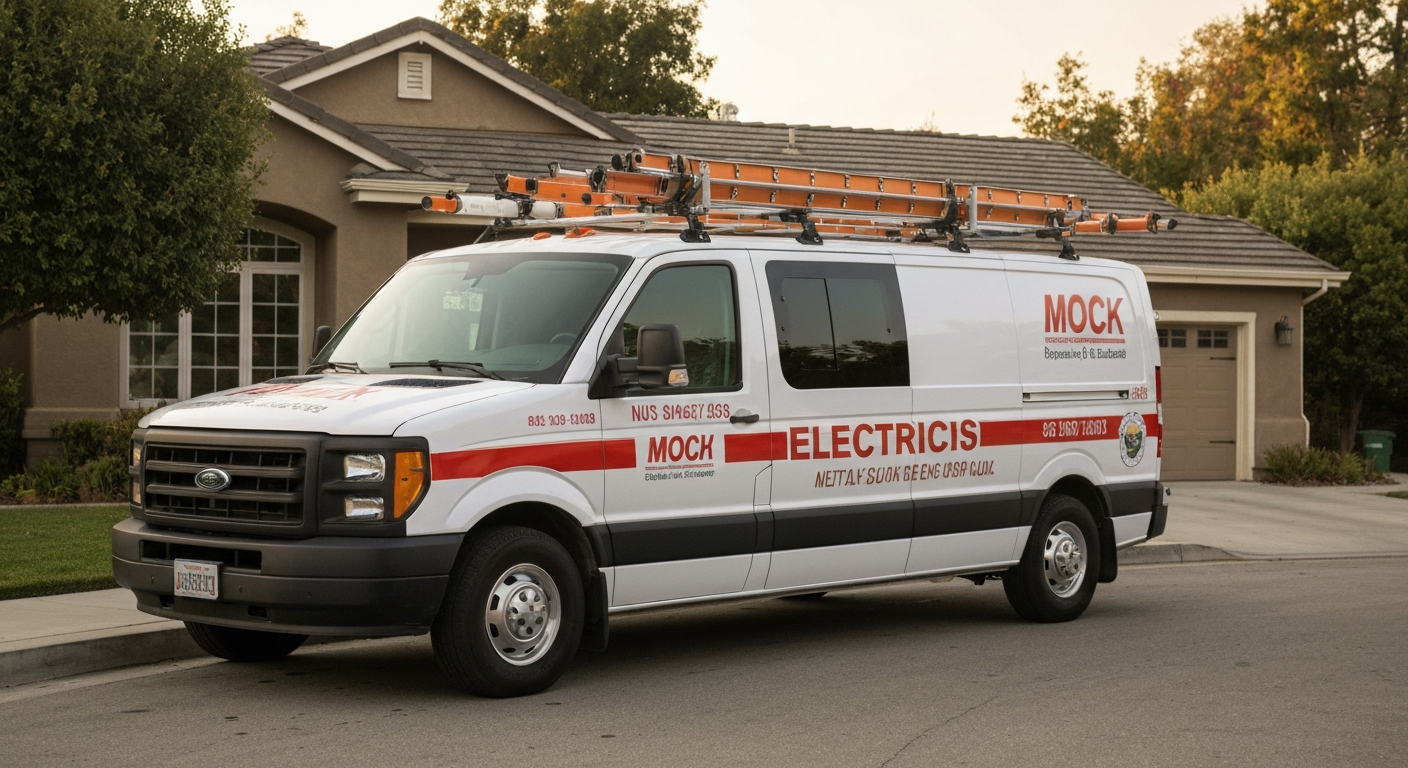
The vehicle is the biggest wildcard. A new Ram ProMaster or Ford Transit fully outfitted runs $45,000+. A solid used van with 80,000 miles on it might be $20,000. Either way, it’s your biggest line item and the one that most separates “doing this seriously” from “I’ll figure it out.”
A few costs that don’t appear in that table but matter: accounting software ($200-$600/year), estimating software if you go commercial ($500-$2,000/year), and a website with basic SEO — even a $50/month website makes you findable when homeowners search for local electricians. These aren’t optional extras once you’re trying to grow.
On the mandatory workers’ comp: if you’re a solo operator and this feels unfair, that’s understandable — you’re essentially required to carry coverage for yourself, which functions more like disability insurance than traditional workers’ comp. But the law is clear, CSLB enforces it, and operating without it puts your license at risk. Factor it in from the start.
The path is clear: get your experience documented, apply to CSLB, pass both exams, line up your bond and workers’ comp carrier in advance, form your LLC, and get your city license. The 90-day window after your exams is the tightest constraint in the whole process — the contractors who get tripped up are the ones who pass the exams and then scramble to figure out insurance. Don’t be that person.