How to Start a Daycare Business in California
How to Start a Daycare Business in California
California has a genuine childcare shortage. Counties across the state are classified as “childcare deserts,” meaning there are more than three children under five for every licensed childcare slot. That gap creates real demand — and real opportunity for people who want to run a daycare business.
But California doesn’t make it cheap or fast. The state runs one of the most regulated childcare systems in the country, with licensing handled entirely through the California Department of Social Services (CDSS), Community Care Licensing Division. Before you open your doors to a single child, you’ll need state licensure, criminal background clearances, training hours, fire inspections, and depending on your setup, a significant capital investment.
Here’s how it actually works — including the math most guides skip.
California CDSS License Types
Every licensed daycare in California falls into one of three categories. Which one fits your situation determines your costs, your capacity, and your regulatory burden.
Small Family Child Care Home
This is a daycare you run inside your own residence. You can care for up to 8 children total, including your own children under age 10 (they count against the ratio). The application fee is approximately $73 — the lowest barrier to entry of any licensed childcare option in the state.
You must actually live there. This isn’t a rental property you convert into a daycare; it’s your home. That requirement limits who can pursue this path, but it also dramatically reduces startup costs. No commercial lease, no commercial build-out.
Large Family Child Care Home
Same concept — your personal residence — but capacity goes up to 14 children. You’re required to have a qualified assistant present. The application fee is approximately $140.
The jump from 8 to 14 kids sounds appealing, but the staffing requirement changes the economics. You’re now paying at least one employee at California’s minimum wage, which hits $16.90/hr in 2026. Run the numbers before assuming more kids automatically means more profit.
Child Care Center (CCC)
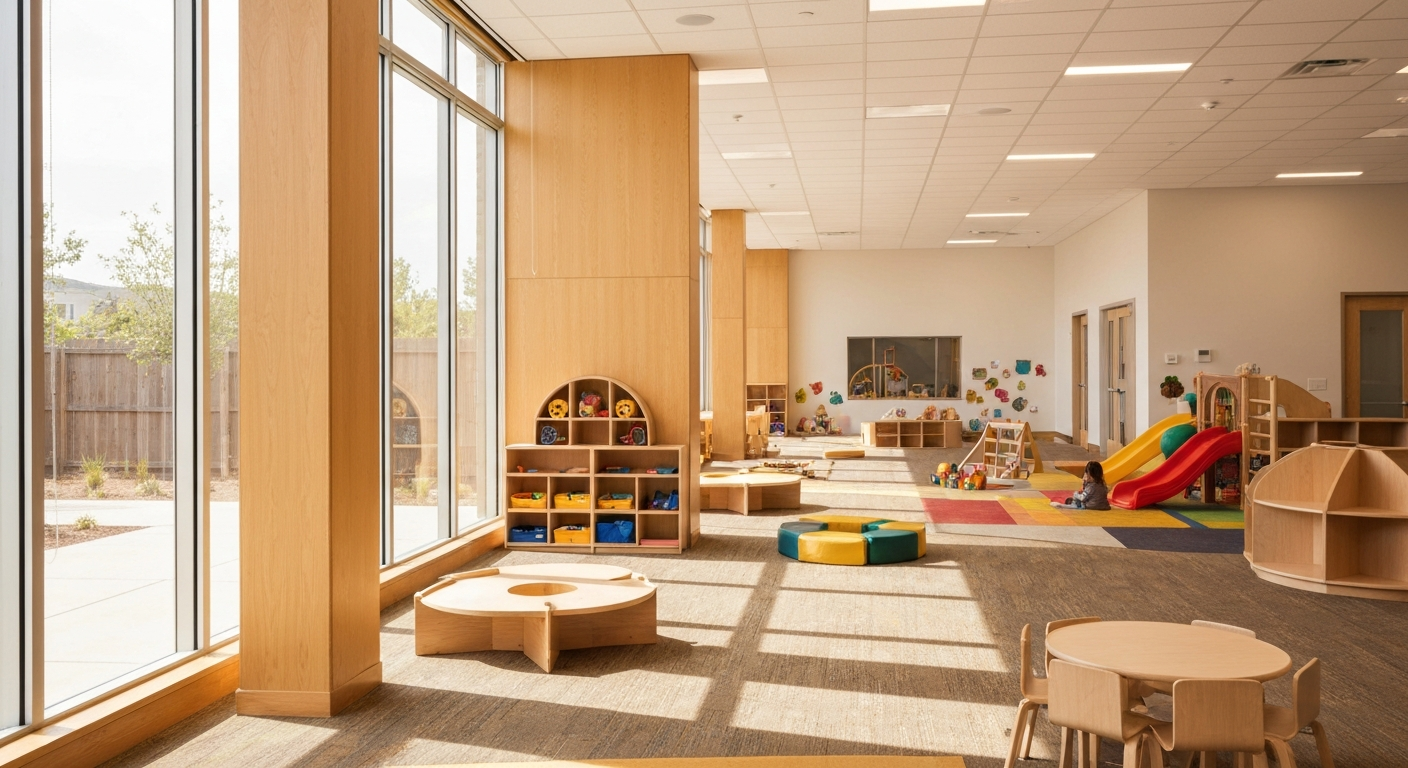
A commercial facility — not your home. No hard cap on the number of children, though capacity is determined by your square footage, staffing ratios, and what CDSS approves. This is the path for anyone opening a standalone daycare building or leasing commercial space.
The application fee alone runs $484 to $2,400+, depending on capacity. That’s just the CDSS application. It doesn’t include lease deposits, build-out costs, equipment, or the months of preparation required before you can even submit the paperwork.
All licenses are issued by CDSS, Community Care Licensing Division at cdss.ca.gov. You must be at least 18 years old to hold a California childcare license.
Pre-License Requirements
Before CDSS approves any license, you’ll need to check several boxes. None of these are optional, and some take weeks or months to complete. Start early.
LiveScan Fingerprinting
Every person 18 or older who lives in or works in the facility must complete LiveScan fingerprinting. CDSS runs criminal record checks through both the California Department of Justice (DOJ) and the FBI. If anyone in your household — including a spouse or adult child who isn’t involved in the daycare — has a disqualifying criminal history, it affects your application.
Budget $50–$100 per person. Most UPS stores, libraries, and local police departments have LiveScan stations. Processing time varies, but plan for 2–4 weeks minimum.
TB Testing
All adults associated with the facility must have a current tuberculosis (TB) test on file. A negative result clears you; a positive requires follow-up medical evaluation. This is a quick step — most urgent care clinics or county health departments can handle it in a day or two — but it’s easy to forget until CDSS asks for it.
CPR and First Aid Certification
You need 8 hours of CPR and First Aid training. This must be a hands-on course, not an online-only certification. Pediatric CPR is required, not just adult CPR. The American Red Cross and American Heart Association both offer approved courses throughout California, typically running $50–$150 per person.
Preventative Health and Safety Training
An additional 8-hour training requirement that covers nutrition, recognition of illness, prevention of childhood injuries, and lead poisoning prevention. This is separate from CPR/First Aid. Some providers bundle it with other childcare training programs; others offer it standalone. Expect $50–$150 here as well.
Fire Clearance
Your local fire authority must inspect and clear the facility before CDSS will finalize your license. For home-based daycares, this typically means confirming you have working smoke detectors, carbon monoxide detectors, proper egress (escape routes), and fire extinguishers. Centers face a more involved inspection. Contact your local fire department early — inspection scheduling can take weeks.
Zoning Approval
For home-based daycares, California law (Health and Safety Code Section 1597.40) generally preempts local zoning ordinances from prohibiting family daycare homes. But you still need to check with your city or county planning department and notify neighbors in some cases. For centers, zoning is a serious hurdle — commercial childcare facilities aren’t permitted in every zone, and getting a conditional use permit can take months.
California Cost Reality Check
This is where California separates itself from every other state. The licensing fees are one thing. The ongoing operational costs are another.
The $800 Franchise Tax
If you form an LLC for your daycare — which most advisors recommend for liability protection — California charges an $800/year franchise tax, paid to the Franchise Tax Board. This applies regardless of whether your business makes money. Your first year of operation, you might not enroll a single child before you owe $800 to the state.
Compare that to Virginia, where an LLC pays $50/year in annual registration fees. California’s franchise tax is 16 times more expensive just for entity maintenance. It’s not the biggest line item in your budget, but it’s a meaningful illustration of California’s regulatory cost premium.
And note: the first-year exemption (AB 85) that used to waive this fee for new LLCs expired December 31, 2023. It’s gone. You owe it from year one.
Minimum Wage
California’s minimum wage hits $16.90/hr effective January 1, 2026. If you run a center-based daycare with four employees working 40-hour weeks, you’re looking at a minimum labor base of roughly $140,000/year before payroll taxes and benefits. That’s the floor — experienced teachers and directors command more.
This isn’t an argument against hiring people. It’s an argument for building accurate financial projections before you sign a lease.
Mandatory Workers’ Comp
California requires workers’ compensation insurance for all employees. No exceptions. For childcare businesses — which deal with physical activity, children who bite, and staff who lift kids — workers’ comp premiums run higher than many industries. Budget this as a real line item, not an afterthought.
The Bottom Line on Capital
Home-based daycare in California is genuinely accessible. A Small Family Child Care Home can be operational for $5,000–$20,000 in startup costs if your home already meets basic safety requirements.
Center-based daycare is a different category. You’re realistically looking at $100,000–$500,000+ in startup costs once you account for lease deposits, facility modifications to meet licensing standards, commercial kitchen or food prep areas, outdoor play space, equipment, insurance, and the months of carrying costs before you’re licensed and fully enrolled. That range isn’t a worst case — it’s the realistic spread for a first-time operator in California.
Insurance Requirements
California doesn’t mandate specific insurance types for daycare licensure beyond workers’ comp, but running a daycare without proper coverage is a liability you can’t afford. Children get hurt. Parents sue. Protect yourself.
General Liability
A minimum of $1 million per occurrence is the standard recommendation for childcare businesses. This covers bodily injury, property damage, and personal injury claims that happen at your facility. Some landlords require higher limits — $2 million aggregate is common in commercial leases.
Professional Liability (Errors and Omissions)
General liability doesn’t cover claims related to your professional services — things like allegations that you failed to supervise a child properly, or that your staff made a mistake in administering medication. Professional liability fills that gap. For a childcare business, this coverage is essential.
Workers’ Comp
Already covered above, but worth repeating: mandatory for every employee in California. No exemptions. If you have even one part-time assistant, you need it. Get quotes from multiple carriers — rates vary significantly.
Commercial Property Insurance
If you’re leasing a facility, your landlord’s insurance covers the building — not your equipment, furniture, toys, or improvements you’ve made to the space. A commercial property policy covers your stuff. For home-based operations, check with your homeowners insurer; most standard homeowners policies exclude business activities, and you may need a rider or separate business policy.
Total insurance budget for a small home-based operation: $3,000–$5,000/year. For a center, budget $5,000–$8,000/year or more depending on capacity and claims history.
Startup Costs at a Glance
Here’s every cost item laid out cleanly, broken down by home-based vs. center-based.
Licensing and Entity Formation
- LLC filing with California Secretary of State: $70 (Form LLC-1 at bizfileOnline.sos.ca.gov)
- Statement of Information (Form LLC-12): $20, due within 90 days of formation
- Annual franchise tax: $800/year, starting year one
- CDSS license application: ~$73 for Small Family Child Care Home, ~$140 for Large Family Child Care Home, $484–$2,400+ for a Child Care Center
Pre-License Compliance
- LiveScan fingerprinting: $50–$100 per person (every adult in the home or on staff)
- TB testing: $20–$75 per person (often available free or low-cost at county health departments)
- CPR/First Aid certification (8 hours): $50–$150 per person
- Preventative Health and Safety training (8 hours): $50–$150 per person
- Total per-person training/clearance cost: roughly $150–$300
Facility
Home-based modifications — safety gates, outlet covers, egress improvements, outdoor fencing, storage for hazardous materials — typically run $5,000–$25,000 depending on your home’s current condition. Some homes need almost nothing. Others need significant work.
Center-based facility costs are a different universe. Plan check fees, architect fees, construction, ADA compliance, commercial kitchen or prep area, outdoor play equipment that meets ASTM safety standards, bathroom ratios for children — this adds up to $50,000–$250,000 for the physical space alone, before furniture and supplies.
Equipment and Materials
- Furniture, cribs, mats, tables, chairs: $3,000–$10,000
- Toys, books, art supplies, educational materials: $1,000–$5,000
- First aid supplies, cleaning products, PPE: $300–$1,000
Insurance
$3,000–$8,000/year depending on operation type and size.
Total Realistic Startup Costs
| Path | Low End | High End |
|---|---|---|
| Home-based (Small Family Child Care Home) | $8,000 | $25,000 |
| Center-based (Child Care Center) | $100,000 | $500,000+ |
The home-based path is where most first-time California daycare operators should start. You’re building a client base, establishing your reputation, and learning the operational reality of childcare — without betting $300,000 on a lease you signed before you enrolled your first family.
The CDSS Application Process
Once your pre-license requirements are complete, here’s how the actual application works.
Submit your application packet to CDSS, Community Care Licensing Division. The packet includes your completed application forms, proof of all training certifications, LiveScan clearance documentation, your TB test results, and the application fee.
After submission, CDSS will conduct a site inspection. For home-based licenses, this is an in-home visit where a licensing evaluator walks through the space to verify it meets Title 22 regulations — California’s childcare licensing standards. For centers, the inspection process is more involved and may require multiple visits.
Timeline: Plan for 3–6 months from application submission to license approval, minimum. Centers often take longer. Don’t sign a commercial lease contingent on a 60-day licensing approval — it almost never works that way.
Once licensed, you’ll operate under ongoing oversight. CDSS conducts unannounced inspections. Complaints from parents trigger investigations. Violations result in citations, and serious violations can result in license suspension or revocation. The regulatory relationship doesn’t end when you receive your license.
One More California-Specific Issue: AB5
If you’re thinking about hiring contractors instead of employees to control costs, understand California’s AB5 first. California uses the ABC test to determine worker classification, and it’s strict — most workers who perform work central to your business operation must be classified as employees, not independent contractors.
For a daycare, a teacher who works regular hours caring for children in your facility is almost certainly an employee under California law. Misclassifying them as a contractor creates significant legal exposure: back taxes, penalties, and potential lawsuits. If you’re hiring help, assume it’s W-2 from day one.
Where to Start
The shortest path to a licensed California daycare:
- Confirm your home meets basic zoning and safety requirements — or identify commercial space if you’re going center-based
- Schedule LiveScan fingerprinting for everyone 18+ in the household
- Get your TB test done
- Enroll in CPR/First Aid (8 hours) and Preventative Health & Safety (8 hours) training
- Form your LLC at bizfileOnline.sos.ca.gov ($70 filing fee)
- Download the CDSS application packet at cdss.ca.gov and schedule a pre-application consultation with your local Community Care Licensing office
That consultation step is worth doing before you submit anything. Licensing evaluators will walk you through what they expect to see during the inspection. It’s free, and it prevents you from spending money on modifications that don’t actually satisfy Title 22 requirements.
The childcare shortage in California is real. The demand is there. But go in with clear eyes about what it costs — especially if you’re eyeing a center. Start with a home-based license, build your reputation, and scale from a foundation that’s actually sustainable.