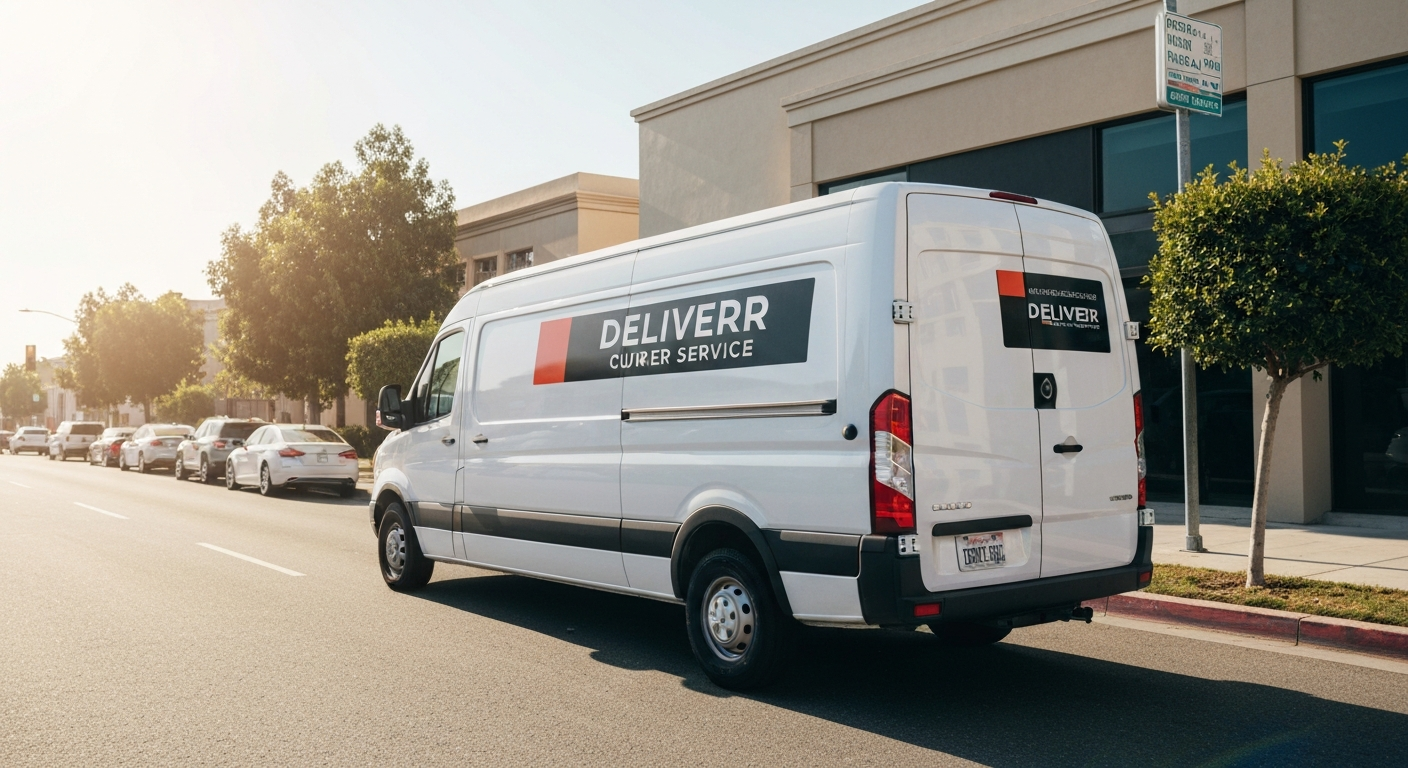
How to Start a Courier and Delivery Service in California
How to Start a Courier and Delivery Service in California
California’s courier industry is genuinely lucrative right now. Same-day delivery demand has exploded, medical transport is a high-margin niche, and 39+ million people generate more package volume than most countries. But California also piles on compliance requirements that will blindside you if you’re not ready for them.
Two in particular define this business: the Motor Carrier Permit (MCP), which applies to literally any vehicle hauling goods for pay, and AB5, which almost certainly classifies your drivers as employees — not contractors. Most new operators get both wrong. This guide covers what you actually need to do.
Why Start a Courier Business in California?
The demand is real. E-commerce has permanently shifted consumer expectations toward same-day and next-day delivery, and California’s sheer population density makes last-mile logistics both challenging and profitable. Los Angeles, the Bay Area, San Diego — these are some of the most delivery-intensive markets in the country.
Medical courier is one of the best niches nobody talks about. Hospitals, labs, and clinics constantly need specimens, pharmaceuticals, and medical records transported between facilities. It’s time-sensitive, requires chain-of-custody documentation, and the clients pay well because the stakes are high. Unlike restaurant delivery, you’re not competing with DoorDash.
B2B document delivery still has a pulse too. Legal filings, signed contracts, architectural plans, title documents — plenty of professionals need physical delivery of sensitive materials and won’t trust them to USPS.
On the revenue side: small solo operations typically gross $50,000–$200,000 per year. Add drivers and vehicles, and that scales significantly. The ceiling is real.
The California-specific reality check: your compliance costs are higher than virtually any other state. You’re looking at the $800/year franchise tax, the MCP requirement, commercial auto insurance on every vehicle, workers’ comp the moment you hire, and AB5’s employee classification mandate. Plan for these upfront. They’re not optional and they’re not negotiable.
Step 1: Choose Your Business Structure
Don’t run a delivery operation as a sole proprietor. Vehicles get into accidents. Packages get damaged or lost. Clients sue. A sole proprietorship offers zero separation between your personal assets and your business liabilities. One bad accident and your personal savings are in play.
LLC is the right call for most courier businesses. File your Articles of Organization (Form LLC-1) online at bizfileOnline.sos.ca.gov for $70. That gives you liability protection and a clean legal entity to hold your MCP, insurance policies, and employment relationships.
The California tax reality hits immediately: the $800/year franchise tax to the Franchise Tax Board (FTB) applies from day one. The AB 85 first-year exemption expired December 31, 2023. Budget for it. You’ll also need to file a Statement of Information (Form LLC-12) within 90 days of formation — that’s $20, and it repeats biennially.
If you’re planning to scale aggressively — multiple locations, outside investors, possible acquisition — a corporation ($100 filing) gives you more structural flexibility. For most operators starting with a handful of drivers and vehicles, an LLC is simpler and sufficient.
Get your EIN from the IRS at irs.gov — it’s free, takes about 10 minutes online, and you need it before you can open a business bank account, hire employees, or apply for your Motor Carrier Permit.
Step 2: Get Your Motor Carrier Permit (MCP)
This is the part most new courier operators miss entirely.
Any person or business transporting property for compensation in California must obtain a Motor Carrier Permit from the DMV. Not just trucking companies. Not just box trucks. Any vehicle — sedan, cargo van, motorcycle, SUV — used for paid deliveries requires an MCP. There’s no vehicle-size exemption. If you’re being paid to move goods, you need this permit.
A quick note on what the MCP is NOT: don’t confuse it with the CPUC’s TCP (Transportation Charter Party) permit, which covers passenger carriers — limos, charter buses, rideshares. That’s a completely different system for a completely different industry. Courier and delivery operations fall under the DMV’s MCP program.
How to get it:
Apply online through the DMV at DMV.ca.gov under Industry Licenses and Permits. You’ll also need a CA Number from the California Highway Patrol (CHP) — this is your safety compliance identifier, separate from the MCP itself.
MCP fees scale with fleet size. Expect approximately $250 for one vehicle, $352 for 2–4 vehicles. The permit is valid for 12 months and must be renewed annually. Don’t let it lapse — operating without a valid MCP is a violation that can result in fines and your vehicles being placed out of service.
Insurance minimums for MCP: You must carry at least $300,000 combined single limit liability coverage for property carriers. Some cargo types — hazardous materials, certain high-value goods — require significantly higher limits, up to $5,000,000. Your insurance carrier needs to file proof of coverage directly with the DMV as part of the MCP process.
The CHP will also inspect your operation under the Basic Inspection of Terminal (BIT) program. This covers vehicle maintenance records, driver qualification files, and overall safety compliance. It’s not a one-time box to check — it’s an ongoing compliance obligation. Keep your maintenance records organized from day one.
Step 3: AB5 and Worker Classification — The Compliance Minefield
This is where independent courier businesses consistently get into serious trouble.
AB5 — California’s worker classification law — uses the ABC test as its default. To classify someone as an independent contractor, you must prove all three prongs:
A. The worker is free from control and direction in the performance of their work.
B. The work performed is outside the usual course of the hiring entity’s business.
C. The worker is customarily engaged in an independently established trade, occupation, or business.
Prong B is the one that kills courier businesses. Your company delivers packages. Your drivers deliver packages. The work your drivers perform is the core of your business — it cannot possibly be “outside the usual course” of what you do. This isn’t a gray area. A delivery driver working for a courier company is an employee under AB5. Full stop.
What about Prop 22? This is where the confusion comes from. Proposition 22, passed by California voters in 2020, created a carve-out for app-based transportation and delivery platforms — think Uber, Lyft, DoorDash, Instacart. Drivers for those platforms can be classified as independent contractors under Prop 22’s specific framework, which includes certain minimum earnings guarantees and benefits.
Prop 22 does not apply to you. It’s explicitly limited to app-based platforms. If you’re running an independent courier service — even if you have an app or dispatch software — you are not a covered platform under Prop 22. Your drivers are employees.
One more recent development worth knowing: AB 1340, signed in late 2025 and effective January 2026, granted unionization rights to approximately 800,000 rideshare and delivery drivers working for app-based platforms. This matters for the Uber/DoorDash world but doesn’t change the classification analysis for independent courier operations. Your situation is governed by AB5.
What employee status actually costs you:
- Employer’s share of FICA: ~7.65% of payroll
- State unemployment insurance (UI) contributions
- Workers’ compensation insurance (more on this below)
- California’s mandatory paid sick leave (minimum 40 hours/year as of current law, increasing to 5 days under recent updates)
- Potential entitlement to health benefits depending on hours worked
The penalty for getting this wrong is severe. Misclassification exposes you to back wages, unpaid payroll taxes, and Labor and Workforce Development Agency (LWDA) penalties of $5,000–$25,000 per misclassified worker. The EDD audits delivery businesses. This is an active enforcement priority in California. Budget for proper employment from day one — it’s cheaper than the alternative.
Step 4: Insurance Requirements
California delivery operations need multiple insurance policies. This isn’t the place to cut costs.
Commercial auto insurance is non-negotiable and often misunderstood. Personal auto policies exclude commercial use. If your driver is in an accident while making a paid delivery and you’ve been relying on their personal insurance, that claim will be denied. Every delivery vehicle needs a commercial auto policy. Budget $3,000–$8,000 per vehicle per year, depending on vehicle type, driver history, and coverage limits.
Motor carrier liability is the minimum required under your MCP: $300,000 combined single limit for standard property carriers. Your commercial auto policy may satisfy this requirement, but confirm with your broker that it’s structured to meet MCP filing requirements specifically. Some cargo types require much higher limits — verify this for your specific operation.
Workers’ compensation is mandatory the moment you have one employee. No minimum threshold, no exceptions — California’s rule here is absolute. Penalties for non-compliance start at $10,000 per violation. Workers’ comp rates for delivery drivers vary based on payroll and classification codes, but assume it’s a meaningful percentage of wages. Get quotes early.
General liability insurance isn’t legally required by the state, but essentially every commercial client will require it before signing a contract with you. Target $1 million per occurrence as a minimum. Annual premiums run approximately $500–$1,500 depending on revenue and operations. This is straightforward to get and worth every dollar.
Cargo insurance covers damage to goods while in transit. Not legally required, but virtually every business client will ask for it — and without it, you’re personally liable for lost or damaged shipments. Expect $1,000–$3,000/year for a small fleet.
Medical courier operations add one more layer: if you’re handling specimens, controlled substances, or pharmaceuticals, look at professional liability (errors and omissions) coverage as well. A mishandled specimen that causes a delayed diagnosis creates a very different liability exposure than a lost birthday present.
Step 5: Local Licenses and Specialized Permits
City business license: You need one from every city where you maintain a physical presence — office, warehouse, dispatch center. Costs range from $15 to $300+ depending on the city. Some cities have gross-receipts-based fees that scale with revenue. Check each city’s requirements individually; there’s no statewide uniformity here.
CDTFA Seller’s Permit: Generally not required for pure delivery services, since you’re providing a service rather than selling goods. But if you sell packaging materials, supplies, or any physical product alongside your delivery service, you’ll need to register at cdtfa.ca.gov.
Medical courier specifics: All handlers need HIPAA compliance training — this isn’t optional and it’s not difficult, but it needs to be documented. Biological specimens may require hazardous materials handling training under DOT/IATA regulations depending on the specimen type and transport method.
Food delivery: If your drivers handle open or prepared food — not sealed restaurant orders, but actual open food items — California Food Handler Cards are required within 30 days of hire. As of January 1, 2024, you as the employer must pay for training and testing costs and provide two hours of paid leave for completion.
Interstate operations or hazmat: If you cross state lines or transport hazardous materials, you need a USDOT Number in addition to your California MCP. Apply at fmcsa.dot.gov. This is federal, separate from state requirements, and enforced by the Federal Motor Carrier Safety Administration.
CalGold at calgold.ca.gov is genuinely useful here. Enter your business type and location and it generates a permit checklist specific to your situation. Worth 15 minutes of your time before you assume you’ve covered everything.
Startup Costs at a Glance
No fluff — here’s what you’re actually spending:
| Item | Cost |
|---|---|
| LLC Articles of Organization | $70 (one-time) |
| Franchise tax | $800/year |
| Statement of Information | $20 |
| Motor Carrier Permit (1 vehicle) | ~$250/year |
| Commercial auto insurance | $3,000–$8,000/year per vehicle |
| Workers’ comp | Varies by payroll/classification |
| General liability | ~$500–$1,500/year |
| Local business license | $15–$300 |
| Vehicle (used van to new cargo van) | $5,000–$40,000 |
First-year estimate, solo operator with one vehicle: $10,000–$20,000 in fees, insurance, and vehicle costs — assuming you’re the only driver and don’t trigger the workers’ comp requirement yet.
First-year estimate, 3 drivers and 3 vehicles: $35,000–$75,000+. The jump comes from tripling your commercial auto insurance, adding workers’ comp across three employees, and vehicle acquisition for the fleet.
These aren’t scary numbers for a business with real revenue potential. A medical courier route or a B2B document delivery contract can generate $80,000–$120,000 in annual revenue from a single driver. The math works — but only if you’ve priced your compliance costs into your rates from the start.
The Short Version
California’s courier industry has genuine opportunity. The compliance path is more demanding than most states, but it’s not complicated once you know what it actually requires.
Get your LLC filed and your EIN in hand first. Then apply for your Motor Carrier Permit — every vehicle, no exceptions. Treat your drivers as employees from day one; Prop 22 doesn’t apply to you and the misclassification penalties aren’t worth gambling on. Stack your insurance properly: commercial auto, workers’ comp, general liability, cargo. And check CalGold for anything specific to your location or cargo type.
The operators who build durable courier businesses in California aren’t the ones who cut corners on classification or skip the MCP. They’re the ones who bake compliance into their pricing, build real employment relationships with their drivers, and compete on reliability instead of racing to the bottom on costs.