How to Start a Business in Stockton, California
How to Start a Business in Stockton, California
You’re looking at a city that’s quietly become California’s best-kept supply chain secret. Stockton isn’t Sacramento. It isn’t San Francisco. And that’s precisely why entrepreneurs and logistics operators are moving here.
The math is simple. You can lease 50,000 square feet of industrial space in Stockton for what you’d pay for 5,000 in the Bay Area. You can hire experienced warehouse workers at competitive wages instead of competing for talent. You’re 75 miles from San Francisco’s market but 2,000 miles cheaper per month in overhead. And you have direct access to California’s only inland deepwater seaport—a $1.8 billion economic engine that’s already attracted Amazon, FedEx, Target, and Williams Sonoma.
But Stockton isn’t frictionless. You still owe California’s $800 franchise tax. Your sales tax is 9%. And the city has its own business licensing requirements that differ from what you might expect.
This guide walks you through the actual mechanics of starting a business in Stockton—what you’ll pay, what you’ll file, what the city requires, and why the port-driven logistics advantage matters if it applies to your business model.
Why Start a Business in Stockton?
The City Itself
Stockton is California’s 11th largest city by population, with approximately 324,975 residents as of 2024. That’s bigger than Oakland, Anaheim, or Santa Ana. But it’s not a household name for entrepreneurs outside logistics and distribution.
The median household income is around $79,907 as of 2024—genuinely affordable by California standards. That means your customers, your employees, and your own cost of living don’t require venture funding just to survive. A family home that costs $1.2 million in the Bay Area runs $400,000-$600,000 in Stockton’s better neighborhoods.
The Port
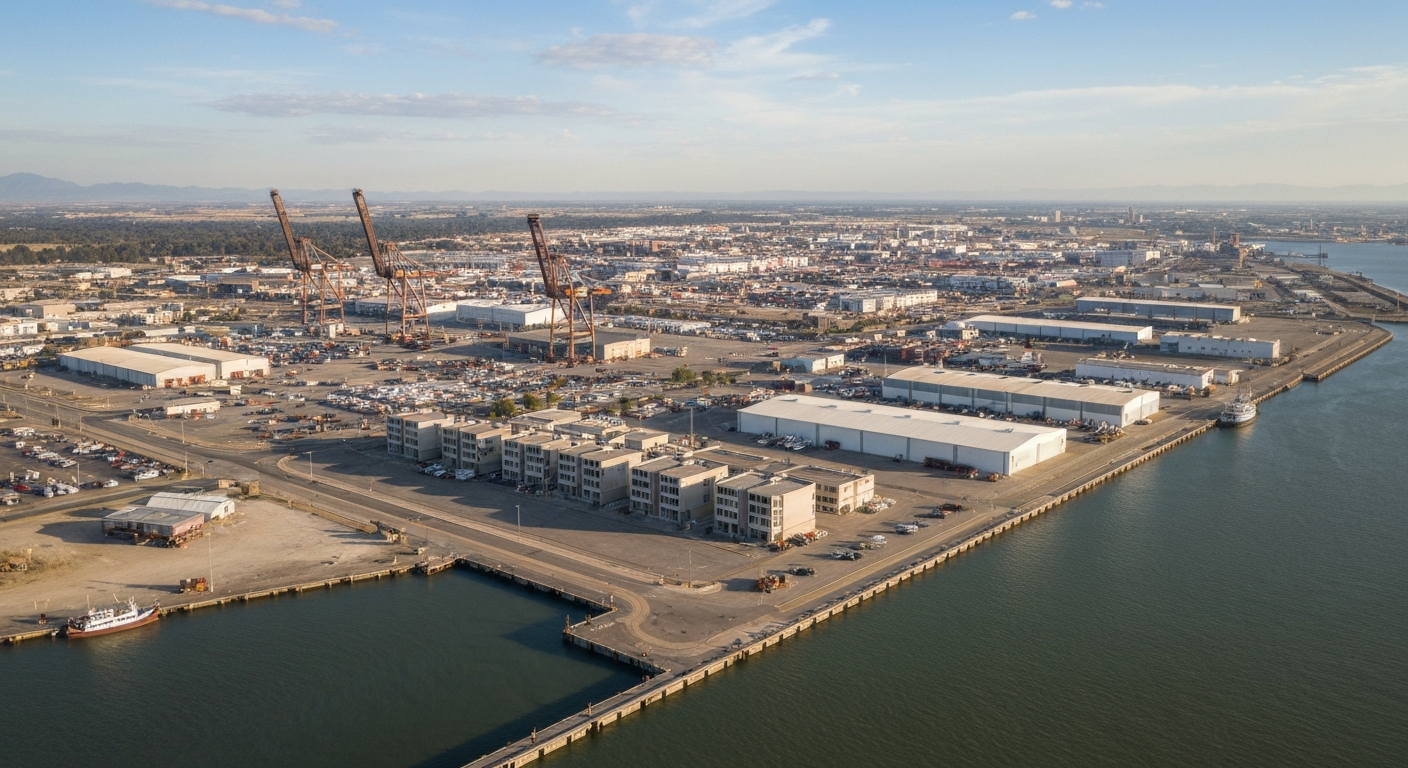
The Port of Stockton is the real story. It’s California’s only inland deepwater seaport, situated on the San Joaquin River about 80 miles from the Pacific Ocean. In fiscal year 2024, the port handled 3.7 million metric tons of cargo, trading with 55+ countries.
That isn’t theoretical economic activity. The port supports approximately 10,077 direct and indirect jobs across logistics, warehousing, agriculture, manufacturing, and related services. It’s a $1.8 billion economic engine. When you hear that Amazon has multiple e-fulfillment centers here, that FedEx operates a regional hub, that Target, Williams Sonoma, Ashley Furniture, Lowe’s, Medline, John Deere, and Niagara Bottling all have distribution centers in San Joaquin County—they’re not here by accident. They’re here because the port, the rail, and the highway access make the economics work.
The Labor Market
San Joaquin County held the second-highest concentration of transportation and warehousing jobs in the entire United States as of 2021. That concentration hasn’t shrunk. It’s grown.
The top three employment sectors in Stockton are Health Care & Social Assistance (19,929 jobs), Retail Trade (17,688 jobs), and Transportation & Warehousing (13,790 jobs). Average hourly wages in the region sit around $30.59 as of May 2024, according to the Bureau of Labor Statistics—below the national average of $32.66. That means labor costs are genuinely competitive. You’re not overpaying for talent.
Unemployment in Stockton ranges from 7-8%, which is higher than California’s state average. Most economists see that as a problem. For a business owner, it’s an advantage. It means there’s available workforce. You can hire.
Step 1: Choose Your Business Structure
Before you pay anything to the state or the city, you need to decide what you’re legally filing as. The vast majority of Stockton small businesses choose an LLC. Here’s why, and what it costs.
LLC: The Default Choice
An LLC (Limited Liability Company) gives you personal liability protection—if your business gets sued, your personal assets are usually shielded. It’s simpler to manage than a corporation and more flexible for taxation.
To form an LLC in California, you file Articles of Organization (Form LLC-1) with the California Secretary of State online at bizfileOnline.sos.ca.gov. The state filing fee is $70—one-time.
Within 90 days of formation, you’re required to file a Statement of Information (Form LLC-12). That costs $20. After that, you file it again every two years. Another $20 each time.
So far, the state fees are minimal. But here comes the non-negotiable part.
The $800 Franchise Tax
Every LLC doing business in California pays $800 per year to the Franchise Tax Board (FTB). This is not optional. This is not a penalty. This is baseline.
This applies whether you’re profitable, whether you earned a dollar, whether you spent the year failing. You owe $800.
The first-year exemption that existed under AB 85 expired on December 31, 2023. There is no grace period. If you form an LLC in 2025, you owe the $800 franchise tax for that year.
If your LLC generates gross income over $250,000 in a year, you also owe an additional LLC fee on top of the $800. That scales: $900 if you’re between $250K and $500K in gross income; $2,500 if you’re between $500K and $1 million; $6,000 if you’re between $1 million and $5 million; $11,790 if you’re at $5 million or above.
This is separate from income tax. It’s separate from sales tax. It’s California’s way of funding state government while you do business here.
Corporations
If you choose to incorporate instead, the state filing fee is $100 for Articles of Incorporation. You also pay the $800 franchise tax minimum. Corporations are typically more formal, more expensive to maintain, and overkill for a startup unless you’re planning to take on investors or go public. Most Stockton businesses skip this.
Sole Proprietorship
You can also operate as a sole proprietor—just you, no formal filing with the state. But here’s the trap: you get zero liability protection, your personal assets are exposed if something goes wrong, and you still owe that $800 franchise tax if you ever decide to formally structure yourself as an LLC later. By then you’ve operated without protection for months or years.
Don’t do this. File the LLC.
Step 2: Register for State Taxes
Once your LLC exists on paper, the state wants to know how you’ll handle taxes. This involves multiple agencies, but most of it is free or takes five minutes.
Get Your EIN
Your Employer Identification Number (EIN) is a nine-digit ID the IRS uses to track your business for tax purposes. You need one even if you’re a one-person LLC.
Go to irs.gov/ein and apply online. It’s free. You’ll get your number instantly—same day.
CDTFA Seller’s Permit
If your business sells tangible goods—anything physical—you need a Seller’s Permit from the California Department of Tax-Fee Administration (CDTFA). This is free. Register at cdtfa.ca.gov.
If you’re a pure service business (consulting, coaching, digital services), you don’t need this. If you sell products, you do.
This permit is what lets you charge sales tax to customers and remit it to the state.
Sales Tax in Stockton
Stockton’s combined sales tax rate is 9.0% as of 2026. This breaks down as:
- California state tax: 6%
- San Joaquin County tax: 0.25%
- Stockton city tax: 1.25%
- Special district tax: 1.5%
That 9% applies to most goods sold in the city. Some categories have different rates or exemptions, but the standard is 9%. You’ll charge it at point of sale and remit it to CDTFA monthly or quarterly depending on your sales volume.
State Income Tax
California taxes business income at progressive rates up to 13.3%—the highest state income tax rate in the nation. Your actual liability depends on your business structure and profit. An LLC taxed as a sole proprietorship pays self-employment tax plus state income tax on net profit.
Employer Withholding
If you hire employees, you need to register for employer withholding with the Employment Development Division (EDD). They’ll issue you a state employer account number and walk you through payroll tax obligations.
AB5 Classification
California’s AB5 law strictly defines what makes someone an independent contractor versus an employee. The default is that people you work with are employees—not contractors—unless they meet specific legal tests. This matters immediately if you’re planning to hire help. Misclassifying someone as a contractor when they should be an employee can result in penalties, back wages, and payroll taxes owed retroactively.
Step 3: Get Your Stockton Business License
The state license is one thing. Stockton requires its own.
Every business operating in Stockton must obtain a city business license. No exceptions. This is enforced.
Where to Apply
You can apply online, by mail, by email, or in person at:
City Hall, Finance Department
425 N. El Dorado Street
Stockton, CA 95202
Phone: (209) 937-8313
Email: [email protected]
The Fees
The annual registration tax is $24—base fee for every business.
On top of that, you pay a mill tax based on your gross receipts. The rate depends on your industry:
- Retail and miscellaneous businesses: 0.9 mills per dollar of gross receipts
- Wholesale and newspapers: 0.4 mills per dollar
- Manufacturing: 0.25 mills per dollar
- Contractors: $45/year plus 0.5 mills per dollar of gross receipts
A “mill” is one-tenth of a cent. So if you run a retail business with $100,000 in annual gross receipts, you’d pay 0.9 mills per dollar: $100,000 × 0.009 = $900 in mill tax, plus the $24 registration fee, for a total of $924 annually.
Additionally, all new applications and renewals include a $4 State of California pass-through fee.
Approval Process
Some applications require additional approval from other city and state departments depending on your business type. If you’re operating a food service business, for example, you’ll also need health department sign-off. If you’re running a bar or liquor business, the Department of Alcoholic Beverage Control has to sign off. These aren’t automatic.
Plan for 1-2 weeks if your business doesn’t require special approvals. Longer if it does.
Step 4: Handle Zoning and Location
Where you physically operate matters. Stockton has zoning rules like any city.
Zoning Verification
Stockton’s Community Development Department handles zoning verification and planning. Before you sign a lease or buy a property, confirm that your business type is allowed in that zone.
The city’s major commercial corridors are Pacific Avenue, March Lane, Hammer Lane, and Waterloo Road. These are where you’ll find established retail, office, and mixed-use activity.
If you’re in the logistics and warehousing business, the Port District and adjacent industrial zones are purpose-built for you. That’s where the distribution centers cluster, where rail and highway access is optimized, and where landlords understand your operational needs.
Home-Based Businesses
If you’re running a home-based business, check your residential zoning restrictions first. Some cities allow certain home businesses; others don’t. Stockton permits home-based businesses under specific conditions, but you need to verify before you start. Zoning violations can result in cease-and-desist orders.
Building Permits
Any construction, renovation, or tenant improvements to your space require a building permit from the city. Don’t skip this. Building without a permit creates liability and can complicate insurance claims or future sales.
The Logistics Advantage
This is what separates Stockton from a generic mid-sized California city.
The Port Infrastructure
The Port of Stockton operates an inland deepwater channel at approximately 35 feet of depth. Ships up to 900 feet long and 60,000 tons can dock here. That’s not theoretical—container ships actually arrive, dock, and load/unload cargo.
Three major railroads serve the port: Union Pacific, BNSF (Burlington Northern Santa Fe), and Central California Traction Company. The port operates 75 miles of rail lines, moving over 3 million short tons of cargo per year. That means if your business manufactures something, imports raw materials, or needs to ship products nationwide by rail, the infrastructure is already here.
Direct highway access via I-5, SR-99, and SR-4 connects to the broader California freeway system and beyond.
Air Cargo
Stockton Metropolitan Airport is expanding with Amazon air cargo operations, currently handling 3-4 aircraft per day. This matters if your business involves time-sensitive shipments or e-commerce fulfillment.
Who This Matters For
If your business model involves shipping, distribution, warehousing, manufacturing, or logistics, Stockton’s infrastructure is specifically built for what you’re doing. The port, the railroads, the highways, and the air cargo all converge here. That’s not available in most of California.
If you’re opening a restaurant or a boutique, the logistics advantage is irrelevant. If you’re moving goods, it’s transformational.
Costs at a Glance
Here’s what you’ll actually pay in your first year to get legal and operational in Stockton:
- LLC filing: $70 (one-time)
- Statement of Information: $20 (due within 90 days, then every two years)
- Franchise tax: $800/year to the Franchise Tax Board (non-negotiable, applies immediately)
- Stockton business license: $24 registration fee plus mill tax on gross receipts (varies by industry, roughly $50-300 for a startup)
- Seller’s Permit: Free (if you sell goods)
- EIN: Free
- Combined sales tax rate: 9.0%
For a basic LLC with no special approvals needed and modest gross receipts, your total government fees in year one will be approximately $900-$950 before insurance, accounting, or operational costs.
That’s not nothing. But it’s knowable, and it’s significantly lower than Bay Area equivalents.
Year two and beyond: You’ll pay the $800 franchise tax annually, plus $20 every other year for Statement of Information, plus your Stockton business license renewal (same formula). If you’re profitable and remain compliant, there are no surprise fees.
Why Stockton, Why Now
Stockton filed for Chapter 9 bankruptcy in 2012. The city was insolvent. Services collapsed. The story dominated headlines.
The city emerged from bankruptcy in 2015 and has spent the last decade rebuilding. That recovery isn’t complete, and there are still neighborhoods and infrastructure challenges. But the economic momentum is real. The port is growing. Major logistics operators are investing. Unemployment is higher than the state average, but that means available labor, not economic collapse.
What Stockton isn’t: a budget fallback. What it is: California’s most underpriced logistics hub. You’re not choosing Stockton because you can’t afford anywhere else. You’re choosing it because the port, the labor market, the warehouse space, and the highway access make economic sense for your specific business.
If your business doesn’t involve goods, distribution, or manufacturing, Stockton might not be strategically different from any other mid-sized California city. If it does, Stockton is uniquely positioned.
Your Next Steps
-
Decide on LLC formation. You almost certainly want one. It’s $70 and takes 24 hours online.
-
File your Articles of Organization at bizfileOnline.sos.ca.gov. Have your business name, your address, and your registered agent information ready. (You can be your own registered agent if you have a physical California address; otherwise, hire a registered agent service for $50-200/year.)
-
Get your EIN from the IRS the same day. Takes five minutes at irs.gov/ein.
-
Register for a Seller’s Permit at cdtfa.ca.gov if you’re selling goods.
-
File your Statement of Information (Form LLC-12, $20) within 90 days of formation.
-
Apply for your Stockton business license online or in person. Call (209) 937-8313 or email [email protected] to confirm your industry’s requirements.
-
Verify zoning with the Community Development Department before you sign a lease or buy property.
-
Get liability insurance. This is non-negotiable, not a government requirement but a business one. Budget $500-2,000/year depending on your industry.
-
Set aside $800 for your first franchise tax payment due by the 15th day of the 4th month after formation (roughly six months after you file).
Stockton is a real city with real infrastructure and real economic advantages for the right business. The process to start one here is straightforward. The costs are reasonable. And if your business involves movement of goods, you’re operating in one of California’s best-positioned hubs.