How to Start a Business in Santa Monica, California
How to Start a Business in Santa Monica, California
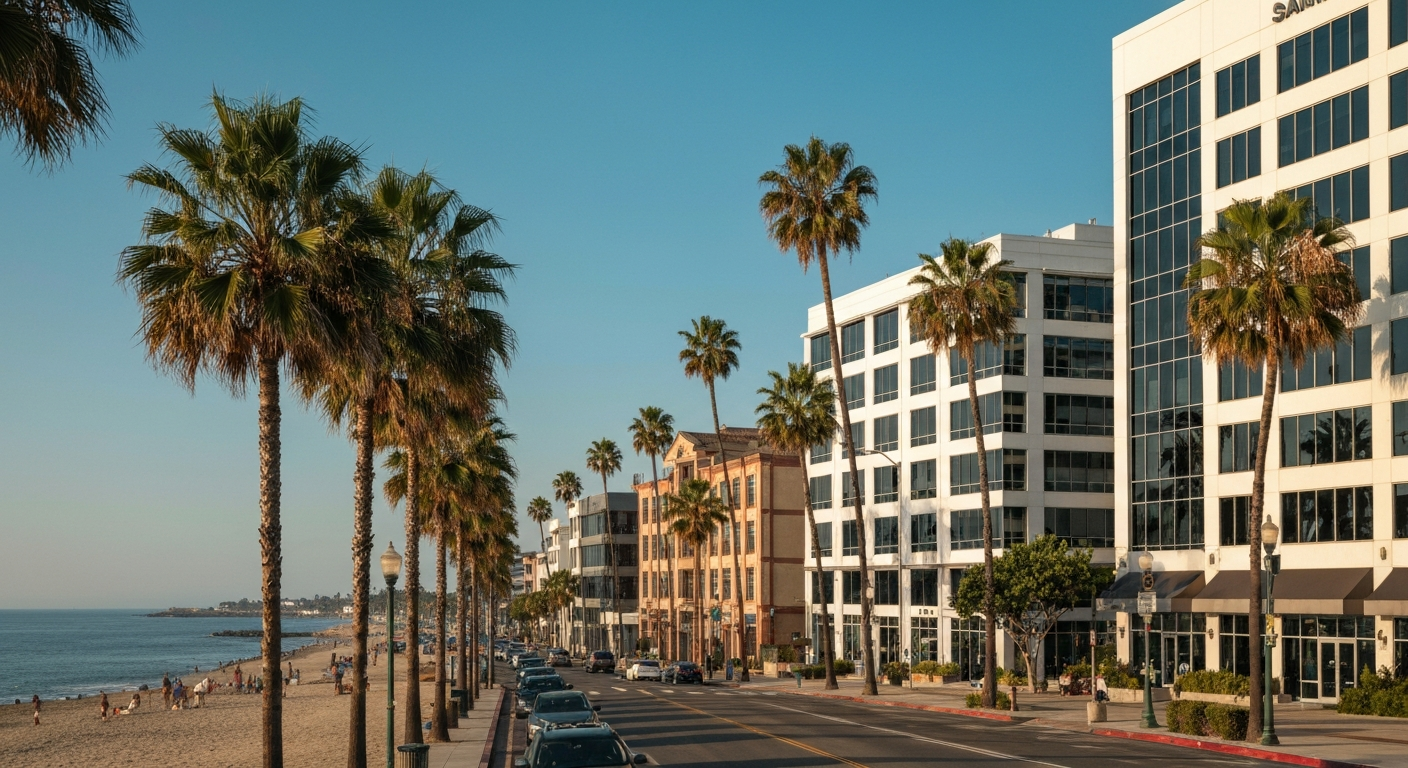
Santa Monica is not an accidental business destination. Snap Inc. built its headquarters here. Hulu, Activision Blizzard, Universal Music Group, Lionsgate Entertainment, and Skydance Media all chose this 5.3-square-mile stretch of coastline to plant their flags. The city calls itself the heart of Silicon Beach — and it lives up to it.
But this is also a city where 4.2 million tourists spend $916 million annually, where the median household income tops $114,885, and where the daytime working population nearly doubles the residential count. If you’re launching a consumer-facing business, a tech startup, or a professional services firm, Santa Monica’s market density is real.
What’s also real: the combined sales tax just hit 10.75%, the state charges you $800 a year in franchise tax starting year one, and the city layers on its own business license tax based on your gross receipts. This is not a casual launch market. It’s a premium market with premium costs.
This guide walks through what it actually costs to start a business in Santa Monica — the fees, the regulatory framework, and what makes this city worth the overhead.
Why Start a Business in Santa Monica?
The numbers first.
Santa Monica’s residential population sits at approximately 89,922 as of 2024, down slightly from the 2020 census peak of 92,919 at a rate of -0.61% annually. But that residential figure masks the real story. The city hosts a massive daytime workforce — people commuting in from across Los Angeles County for jobs in tech, media, entertainment, and professional services. Add 4.2 million annual tourists, and your actual addressable market is measured in the millions, not the thousands.
The median household income of $114,885 significantly outpaces both the California state median ($100,149) and the national median. This matters if you’re selling anything that requires discretionary spending: fitness, dining, professional services, retail. Your customers have purchasing power.
You’re also sitting inside the Los Angeles metro area — 13 million people total. Santa Monica itself is just the anchor. Your market extends to Brentwood, Pacific Palisades, Westwood, Beverly Hills, and across the greater LA basin.
Silicon Beach is here.
Snap Inc. (Snapchat) runs from Santa Monica. So does Hulu — the streaming service that competes directly with Netflix. Activision Blizzard, the gaming and esports giant, has a major presence. Universal Music Group chose Santa Monica. Lionsgate Entertainment and Skydance Media operate here too. This is not theoretical tech infrastructure. These are public companies and major media conglomerates with real payroll, real office space, and real supply chains.
If you’re a B2B software company, a design agency, a recruiting firm, or a cloud services provider, the customer concentration is unmatched in LA. If you’re building something for the entertainment industry — post-production, legal services, accounting, talent representation — the proximity to decision-makers is immediate.
Tourism and hospitality is massive.
Don’t sleep on the visitor economy. 4.2 million people visited Santa Monica in 2024, generating an estimated $916 million in annual revenue. That traffic supports hotels, restaurants, retail, entertainment venues, and service businesses. Accommodation and Food Services alone employ 12,470 people in Santa Monica — 14.6% of the entire city workforce. If you’re in hospitality, tourism, or retail, that visitor base is your customer engine.
The actual employment breakdown.
Professional, Scientific, and Technical Services: 10,818 employees. Information and Media: 5,445 employees. Health Care: 5,389 employees. Accommodation and Food Services: 12,470 employees.
These sectors generate over $130 million annually to the city’s General Fund through sales tax, business license tax, and transit occupancy tax. The city’s economy is diversified enough to support startups across multiple verticals, not just tech.
Step 1: Choose Your Business Structure
Most founders in California default to an LLC, and for good reason.
An LLC provides liability protection — your personal assets are separate from your business debts — without the corporate overhead and double taxation of a C-Corporation. You file Articles of Organization (Form LLC-1) with the California Secretary of State at bizfileOnline.sos.ca.gov. The filing fee is $70, one-time.
But here’s the catch that catches everyone unprepared.
The $800 Franchise Tax is non-negotiable.
Every LLC doing business in California pays $800 per year to the Franchise Tax Board (FTB). This is separate from income tax. It’s separate from the city business license tax. It kicks in the first year, due by the 15th day of the 4th month after formation (so mid-July for most new LLCs), then every April 15 thereafter.
The first-year exemption (AB 85) expired December 31, 2023. That window closed. You don’t get a free pass anymore.
If your LLC grows and gross income exceeds $250,000, you pay an additional LLC fee on a sliding scale: $900 for $250K-$500K, $2,500 for $500K-$1M, $6,000 for $1M-$5M, and $11,790 for $5M and above. This is also in addition to the $800 base.
You’ll also file a Statement of Information (Form LLC-12) within 90 days of formation, then every two years thereafter. Filing fee: $20.
Corporations cost more to file but offer different tax treatment.
Articles of Incorporation cost $100. Corporations are subject to the same $800 franchise tax and additional LLC fees (even though it’s called “LLC fee,” it applies to both entity types). The trade-off: C-Corporations allow you to retain earnings in the business at a lower tax rate (though California’s rate is not competitive nationally). S-Corporations can reduce self-employment tax if structured correctly, but they require more accounting and payroll setup.
For most founders, the LLC wins on simplicity and cost.
Sole proprietorship has no state filing, but massive risk.
You can operate as a sole proprietor with zero state paperwork. But you’re personally liable for all debts and lawsuits. In a city like Santa Monica, where real estate disputes, customer litigation, and employment claims are common, operating without liability protection is a bet against yourself. The $70 LLC filing is cheap insurance.
California’s income tax is the highest in the nation.
Progressive rates scale up to 13.3% — the top rate. Your business income is taxed as personal income if you’re an LLC (pass-through taxation). If you’re a C-Corporation, the corporation pays 21% federal tax, then you pay personal tax on dividends. Run the numbers with an accountant, but don’t assume the LLC is automatically cheaper. California’s rate structure can make incorporation worthwhile for higher-income businesses.
Step 2: Register for State Taxes
Filing your LLC with the Secretary of State is the beginning, not the end.
Seller’s Permit — free, required for retail.
If you’re selling tangible goods — anything physical — you need a Seller’s Permit from the California Department of Tax-Fee Administration (CDTFA) at cdtfa.ca.gov. It’s free. Registration takes minutes. You’ll collect and remit sales tax on every transaction. The combined Santa Monica rate is 10.75%, so factor that into your pricing from day one.
California does NOT have a general statewide business license. The Seller’s Permit is your primary state-level registration for retail operations.
EIN from the IRS — instant and free.
Head to irs.gov/ein. You can get your Employer Identification Number online in real-time. It takes 10 minutes. You need this before opening a business bank account, hiring employees, or filing taxes. Get it immediately.
If you’re hiring, register with the EDD.
The Employment Development Department (EDD) handles payroll taxes, state disability insurance (SDI), and unemployment insurance (UI). Registration is required before your first employee starts. California’s payroll taxes are steep — the state withholding rate is progressive (up to 10.23%), and unemployment insurance rates vary by industry and claims history. Budget accordingly.
AB5 compliance is mandatory and complex.
California’s Dynamex Operations West, Inc. v. Superior Court decision (codified as AB5) created the strictest independent contractor classification law in the nation. The rule: workers are presumed to be employees unless they meet all three prongs of the ABC test. A) Control — the worker is free from your control. B) Scope — the work is outside your usual business. C) Independence — the worker is independently established in that trade.
Misclassification penalties are severe: back wages, payroll taxes, penalties up to $5,000 per violation, plus attorney’s fees. If you’re planning to use independent contractors — freelancers, consultants, gig workers — document that they meet all three prongs. For most Santa Monica businesses, this means paying for employees instead.
Step 3: Get Your Santa Monica Business License
The city requires a business license for ALL businesses operating within city limits. No exceptions. Whether you’re operating from home, a shared office, a retail storefront, or anywhere else in Santa Monica, you need this.
Where to apply and how.
Apply online (fastest option), or submit by email, fax, mail, or in person.
Finance Department: 1685 Main Street, Santa Monica, CA 90401
Phone: (310) 458-8745 for Business License inquiries, or (310) 458-8281 for the Finance Department general line.
Email: [email protected]
The Permit Services Center is open Monday–Thursday, 8am–3pm by appointment only. City Hall hours are Monday–Thursday and every other Friday, 8am–5pm.
Online application is the path of least resistance. You’ll need your business information, ownership details, and an estimate of your first-year gross receipts (to calculate your license tax). Submit it and expect a response within a few business days.
Santa Monica Business License Tax: The Gross Receipts Model
Here’s where Santa Monica differs from many other California cities.
Santa Monica doesn’t charge a flat business license fee. It charges a business license tax based on your gross receipts. This is a recurring annual tax, not a one-time filing fee. And the rate depends on your business classification.
The base structure:
$75 minimum on the first $60,000 of gross receipts.
After that, your rate per $1,000 of receipts depends on your classification:
- Tax Rate Group I (most common — retail, services, professional): $75 + $1.25 per $1,000 of gross receipts over $60,000
- Tax Rate Group III (higher-impact): $75 + $3.00 per $1,000 over $60,000
- Tax Rate Group IV (highest): $75 + $5.00 per $1,000 over $60,000
- Tax Rate Group VIII (mid-range): $75 + $2.50 per $1,000 over $60,000
Additionally, the city charges a Cost of Operations Rate of $2.00 per $1,000 of cost of operations (for some classifications).
Your classification determines your rate.
The city maintains a Classifications & Tax Rates page at finance.smgov.net. Your business type — restaurant, retail shop, professional services, manufacturing, etc. — falls into one of these groups. A restaurant is likely Group III. A tech consulting firm is likely Group I. A gym might be Group IV. Check the city’s rate schedule to know your actual liability before you launch.
Real example: You’re opening a restaurant.
Let’s say you project $500,000 in annual gross receipts.
Base: $75. Receipts over $60,000: $440,000. Tax at Group III rate ($3.00 per $1,000): $440,000 ÷ 1,000 × $3.00 = $1,320. Total annual business license tax: $1,395.
That’s paid annually, due by the date specified on your license.
This is ON TOP of the $800 state franchise tax.
Santa Monica businesses face a double layer of business taxation. The state takes $800. The city takes its gross receipts tax. For a restaurant doing $500K, that’s $800 + $1,395 = $2,195 in annual business taxes alone, before you pay income tax, payroll taxes, or sales tax remittance.
This is not theoretical. Budget it into your operating model from day one.
Sales Tax: 10.75% and Climbing
Santa Monica’s combined sales tax rate is 10.75% as of 2026.
Here’s the breakdown:
- California state: 6.0%
- Los Angeles County: 0.25%
- Santa Monica city: 1.0%
- Special district taxes: 3.5%
This rate increased 0.5% in April 2025, jumping from 10.25% to 10.75%. It’s among the highest in California and puts Santa Monica at a competitive disadvantage for price-sensitive retail.
Why this matters concretely.
If you’re running a restaurant with $800,000 in annual sales, you’re collecting and remitting approximately $86,000 in sales tax annually. Your POS system must be configured correctly to split that tax by jurisdiction — you remit the state portion to the CDTFA, the city portion to Santa Monica, and special district portions accordingly. Get this wrong and you’re liable for penalties.
If you’re a retail shop selling apparel or goods, a 10.75% tax rate is a headwind. Customers in Culver City (9.5%) or other nearby jurisdictions are paying less. You’ll need to justify your location premium through brand, selection, or experience, not price.
If you’re a service business (consulting, legal, accounting, design), sales tax doesn’t apply. Your costs are elsewhere — labor, rent, software.
Costs at a Glance
Here’s what it costs to launch an LLC in Santa Monica.
One-time state filings:
- LLC Articles of Organization: $70
- EIN (IRS): Free
- Seller’s Permit (CDTFA): Free
Annual state taxes:
- Franchise Tax (FTB): $800 (due by the 15th of the 4th month after formation, then April 15 annually)
Biennial:
- Statement of Information: $20 (every two years)
Santa Monica city:
- Business License Tax: $75 base + gross receipts surcharge (varies by classification, calculated on your estimated gross receipts)
Sales Tax (if applicable):
- Combined rate: 10.75%
First-year total for a basic LLC with minimal projected revenue:
- Approximately $950 in government fees (state filings + first franchise tax + business license base), before your city’s gross receipts surcharge is applied.
If you’re projecting $300,000 in first-year gross receipts and you fall into Tax Rate Group I, your city business license tax is approximately $75 + ($240,000 ÷ 1,000 × $1.25) = $75 + $300 = $375. Total first year: roughly $1,325 in business taxes.
If you’re projecting $500,000 and fall into Group III, your license tax is $75 + ($440,000 ÷ 1,000 × $3.00) = $1,395. Total first year: roughly $2,295.
Santa Monica is not cheap. The Franchise Tax alone ($800/year) exceeds what many other states charge for entire business formation and operation. Layer in the city’s gross receipts tax, the 10.75% sales tax, and California’s 13.3% top income tax rate, and you’re operating in one of the most expensive regulatory environments in the country.
But here’s the counterargument: you’re also in a city with 4.2 million annual visitors, a median household income of $114,885, and a daytime workforce density that includes Snap, Hulu, Activision Blizzard, Universal Music Group, and hundreds of smaller tech, media, and professional services firms. The cost is real. The opportunity is real too.
The question isn’t whether Santa Monica is cheap. It’s whether your business model can capture enough of that high-income, high-traffic market to justify the overhead. For some businesses — tourism, hospitality, tech, media, professional services — the answer is absolutely yes. For others — low-margin retail, commodity services, price-sensitive manufacturing — it’s a harder case.
Start with the numbers. Run the numbers. Talk to other business owners in your category operating in Santa Monica. Then decide whether the premium location is worth the premium cost.