How to Get a Business License in Santa Ana, California
How to Get a Business License in Santa Ana, California
Santa Ana requires every business operating within city limits to get a business license. This is not optional, not a formality, and not the same as your California LLC filing or your Franchise Tax bill. It’s a separate city requirement with its own application, its own fee structure, and its own renewal deadline.
The good news: Santa Ana’s system is straightforward. Two classifications. One application. One office to visit. This guide walks you through the exact steps and the costs you’ll actually pay.
What Santa Ana Requires vs. What California Requires
California does not issue a statewide business license. None. This surprises a lot of people.
What California does require:
- An LLC or corporation filing with the Secretary of State ($70-$100)
- An $800 annual Franchise Tax payment to the Franchise Tax Board (every LLC, no exceptions)
- A Seller’s Permit if you’re selling tangible goods (free, from the California Department of Tax and Fee Administration)
What Santa Ana additionally requires:
- A city business license, obtained from Santa Ana’s Business License Tax Office
These are four separate things. Filing your LLC doesn’t get you a business license. Paying the Franchise Tax doesn’t get you a business license. Getting a Seller’s Permit doesn’t get you a business license.
Santa Ana’s business license is also a business tax. You don’t just pay a flat fee once and you’re done. The city charges you based on your gross receipts — how much revenue your business takes in. The more you earn, the more you pay. This is not income tax (that’s California’s job). This is a city tax on the privilege of doing business in Santa Ana.
Every business operating within Santa Ana city limits needs this license. Retail stores. Service providers. Restaurants. Home-based consultants. Contractors. If you have a physical location in Santa Ana or you’re generating revenue from customers in Santa Ana, you need a Santa Ana business license.
The Prerequisite Chain
You cannot get a Santa Ana business license until you’ve done certain things first. Here’s the exact order.
Step 1: Form your business entity
You need an LLC or a corporation. Go to bizfileOnline.sos.ca.gov (the California Secretary of State’s online filing system) and submit your Articles of Organization (for an LLC, $70) or Articles of Incorporation (for a corporation, $100).
You’ll also need to file a Statement of Information within 90 days of formation ($20). After that, it’s due biennially. Do this now — it’s a simple form, and missing the deadline can get your entity suspended.
Step 2: Get your EIN
Apply for an Employer Identification Number from the IRS at irs.gov/ein. This is free. It takes 15 minutes online. You’ll get your number immediately. You need this before you can do much else, including opening a business bank account.
Step 3: Register for a Seller’s Permit (if applicable)
If you’re selling tangible goods — retail merchandise, food, products — you need a Seller’s Permit from the California Department of Tax and Fee Administration. Go to cdtfa.ca.gov and register. It’s free. You’ll use this number when you file your Santa Ana business license if you’re classified as a retail business.
If you’re a pure service business (consulting, cleaning, landscaping), you may not need a Seller’s Permit, but check with the CDTFA to be sure.
Step 4: Pay the California Franchise Tax
Every LLC in California pays $800 per year to the Franchise Tax Board. This is separate from your business license. It’s separate from your city tax. It’s a state tax, due by the 15th day of the 4th month after you form your LLC (so if you form in January, it’s due by May 15). After that, it’s due April 15 annually.
Note: There used to be a first-year exemption under AB 85, but it expired December 31, 2023. If you’re forming a new LLC now, you owe the full $800 in your first year.
Step 5: Apply for your Santa Ana business license
Only after you’ve done steps 1–4 should you apply for your Santa Ana license. You’ll need your LLC formation documents, your EIN, and your Seller’s Permit number (if applicable) when you apply.
Applying for Your Santa Ana Business License
The Santa Ana Business License Tax Office is located at:
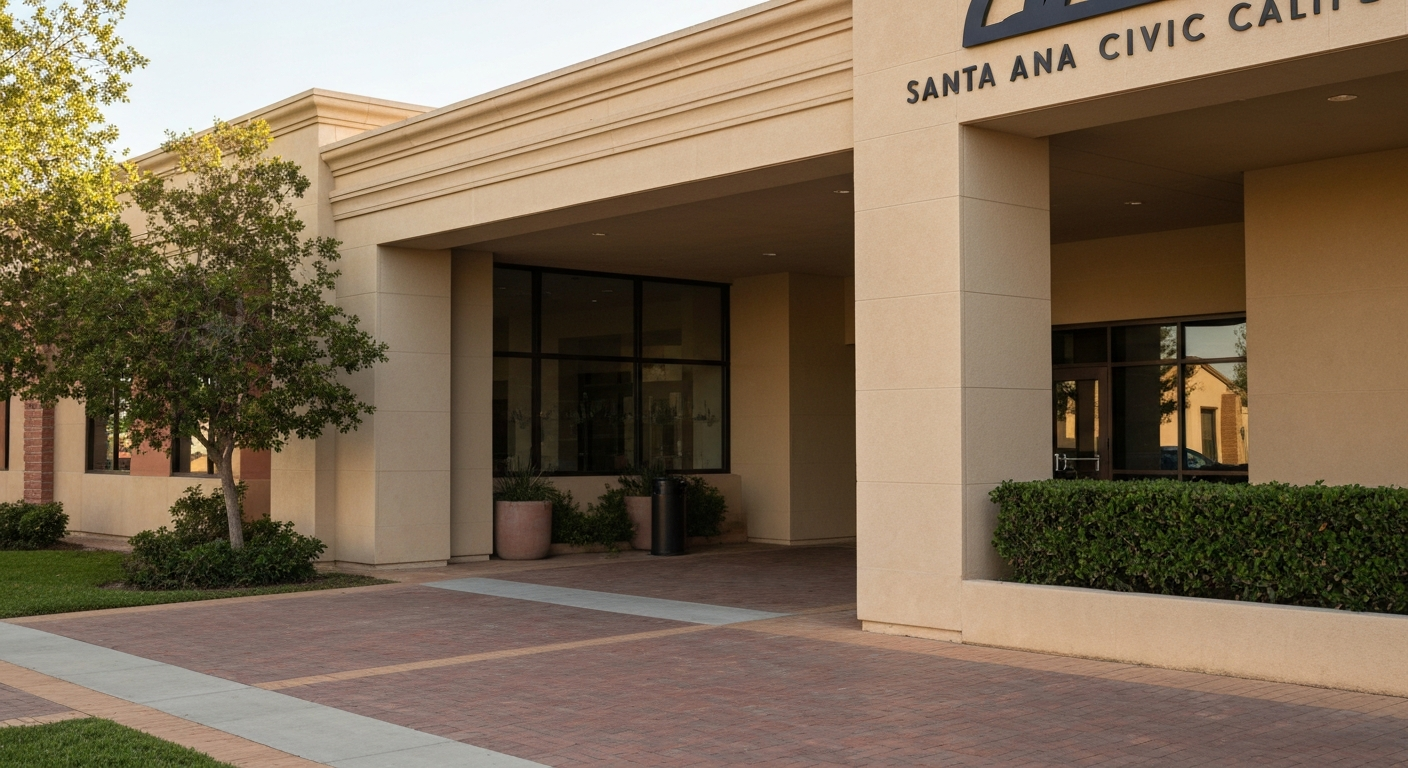
20 Civic Center Plaza, Ross Annex 1st Floor, Room 1100, Santa Ana, CA 92701
Phone: (714) 647-5447 Email: [email protected]
Parking is available in the Civic Center Plaza lot, accessed off Santa Ana Boulevard between Ross Street and Flower Street.
You can apply in person at the office during business hours. Call ahead to confirm current hours and to ask any questions specific to your business type.
Bring these documents:
- Your LLC Articles of Organization or corporate Articles of Incorporation
- Your EIN letter from the IRS
- Your Seller’s Permit number (if you have one)
- Proof of your business location (lease, deed, or occupancy agreement) — even if it’s home-based
- Photo ID
The base application cost is $57.
This is your entry fee. It gets you registered. But this is not your total cost. The city will assess you additional tax based on your gross receipts and your business classification.
The Business License Tax Office has downloadable tax forms and fee schedules at santa-ana.org/business-license-tax-forms/. Download these before you go in. They’ll show you the exact calculation for your business type, and you’ll know your estimated total cost.
Understanding the Classification System
Santa Ana sorts businesses into two main classifications. This is simpler than some California cities (Santa Monica, for comparison, uses four separate rate groups). Here’s how Santa Ana breaks it down:
Classification A: Retail, Services, and Related Businesses
This covers:
- Retail stores (clothing, electronics, groceries, general merchandise)
- Professional services (accountants, lawyers, consultants, marketing firms)
- Real estate brokers and insurance brokers
- Hotels and motels
- Restaurants, cafes, and food establishments
- Theaters and entertainment venues
- Personal services (salons, spas, gyms)
Base fee for Classification A: $60 per location.
Classification B: Manufacturing, Wholesale, and Utilities
This covers:
- Manufacturing facilities
- Processing plants
- Wholesale distributors
- Gasoline and motor fuel sales
- Telephone services
- Public utilities
Base fee for Classification B: $60 per location.
The Gross Receipts Component
Both classifications charge a base fee ($60), but they also add a variable tax on top. The city assesses an additional charge based on your gross receipts — how much money your business brings in.
The fee schedule provided by the city shows the per-$1,000 rate for each classification. For example, a retail business might pay $0.30 per $1,000 in gross receipts (this is a hypothetical figure — check the actual schedule on the city website).
If your retail business generates $100,000 in gross receipts, you’d pay:
- Base fee: $60
- Gross receipts tax: ($100,000 ÷ $1,000) × $0.30 = $30
- Total: $90
If your business generates $500,000 in gross receipts, your tax goes up proportionally.
Annual CPI Adjustments
Here’s something many business owners don’t expect: the base fees ($60) adjust every year based on changes in the Consumer Price Index (CPI). If inflation goes up, the base fee goes up. If there’s deflation, it goes down.
This means your renewal cost in year two might be $62 instead of $60, depending on CPI changes. The city publishes updated fee schedules annually. Check santa-ana.org before you renew so you’re not surprised by the adjusted amount.
Cannabis Businesses
If you’re operating a cannabis retail, cultivation, or distribution business, Santa Ana applies a separate 10% gross receipts tax on top of the standard business license tax. This is in addition to state cannabis taxes and any other applicable licenses. Budget accordingly if this applies to you.
Getting the Exact Numbers
Don’t estimate your gross receipts tax. Download the current fee schedule from santa-ana.org/business-license-tax-forms/ before you apply. The schedule shows the exact per-$1,000 rate for your classification. Plug in your projected annual revenue and calculate your total cost. This prevents surprises at renewal time.
Industry-Specific Requirements
Your Santa Ana business license is one piece of the puzzle. Depending on your industry, you may need additional licenses and permits.
Food Service Businesses
If you’re opening a restaurant, cafe, catering operation, or any food establishment, you need a health permit from the Orange County Health Care Agency. Santa Ana is in Orange County, so the county health department oversees food safety. Contact them directly for requirements around food handling, facility standards, and inspections. Your Santa Ana business license does not replace this.
Alcohol Sales
If you’re selling beer, wine, or spirits, you need a separate Alcoholic Beverage Control (ABC) license from the California Department of Alcoholic Beverage Control. This is a state license, not a city license. ABC has strict rules about location, hours of operation, and signage. Apply well in advance — ABC licenses can take weeks or months to approve.
Home-Based Businesses
If you’re running your business from your home, you may need zoning clearance from Santa Ana’s Planning and Building Agency. Some residential zones allow home-based businesses; others don’t. Some require conditional use permits. Call the Planning and Building Agency before you apply for your business license to confirm your home address is zoned appropriately. The agency is at the same Civic Center Plaza location.
Contractors
If you’re doing construction, electrical work, plumbing, HVAC, or other contracting work, and the job exceeds $500, you need a California Contractors State License Board (CSLB) license. This is state-level, separate from your city business license. The CSLB administers exams and issues licenses. Get your CSLB license before you start any contract work.
Commercial Real Estate Rental
If you’re renting commercial space to tenants, Santa Ana assesses the business license tax on your gross rental receipts. For example, if you own a small commercial building and collect $50,000 per year in rent, your gross receipts for tax purposes are $50,000. The city will tax you accordingly.
Renewal and Compliance
Your Santa Ana business license is not a one-time thing. It requires annual renewal.
Annual Renewal
Every year, your license comes due for renewal. The Business License Tax Office will send you a renewal notice. You report your gross receipts from the past year, and the city calculates your new tax amount based on that revenue.
If your business had a great year and your gross receipts doubled, your tax bill will increase. If business was slower, your tax bill decreases. This is why it’s important to track your gross receipts carefully — your tax obligation depends on it.
Late Penalties
If you miss the renewal deadline, late penalties apply. These penalties can add up quickly. Set a reminder on your calendar well before the renewal date.
Display Your License
Once you have your business license, you’re legally required to display it at your place of business where customers can see it. This is not optional. A missing or expired license can result in fines.
Staying Compliant
Keep records of your gross receipts for at least four years. The city may audit your records to verify that you’re reporting accurately. If you underreport revenue to lower your tax bill, penalties and interest apply.
Local Business Resources
The Santa Ana Chamber of Commerce is a useful resource for local business owners. They provide networking opportunities, business education, and advocacy on local business issues. Membership is optional, but it’s worth exploring if you want to connect with other Santa Ana business owners and stay informed about city policy changes.
For detailed regulations on business licenses, visit santa-ana.org/business-license-regulations/. This resource covers compliance requirements, license suspension and revocation, and specific rules for different business types.
Next Steps
You now have the complete picture: the prerequisites, the application process, the classification system, and what happens after you get your license. The process is linear and straightforward. Form your entity, get your EIN, register for a Seller’s Permit if needed, pay the Franchise Tax, then visit the Business License Tax Office at 20 Civic Center Plaza with your documentation and $57 base fee.
Call (714) 647-5447 or email [email protected] if you have questions about your specific business type. The staff can confirm your classification and give you an exact cost estimate before you apply.
Your Santa Ana business license is valid once issued. Renew it every year, report your gross receipts accurately, and display it where customers can see it. That’s all it takes to stay compliant and avoid penalties.