How to Start a Business in Modesto, California
How to Start a Business in Modesto, California
Modesto is where E. & J. Gallo Winery built the world’s largest family-owned winery operation. A $4 billion annual business. 5,000+ employees. The company didn’t choose Modesto for nostalgia or brand mythology — it chose it for the same reason you should consider it: infrastructure, labor, proximity, and cost.
The Central Valley’s agricultural ecosystem isn’t just farmland. It’s food processing facilities, cold chain logistics, distribution networks, and the packaging operations that feed America’s grocery stores. That density of economic activity attracts serious companies. PepsiCo runs major operations here. So do Frito-Lay, Del Monte, and Stanislaus Foods. Healthcare systems like Sutter Central Valley Hospitals employ thousands. Save Mart Supermarkets is headquartered here.
If you’re starting a business and the Bay Area’s $300-per-square-foot commercial rents and 8.625% sales tax feel like a punch to the gut, Modesto deserves a hard look. Population 218,915. Median household income nearly $80,000. A city with actual economic diversity, not just one industry betting its survival on venture capital.
Here’s what you actually need to do to start a business in Modesto.
Why Start a Business in Modesto?
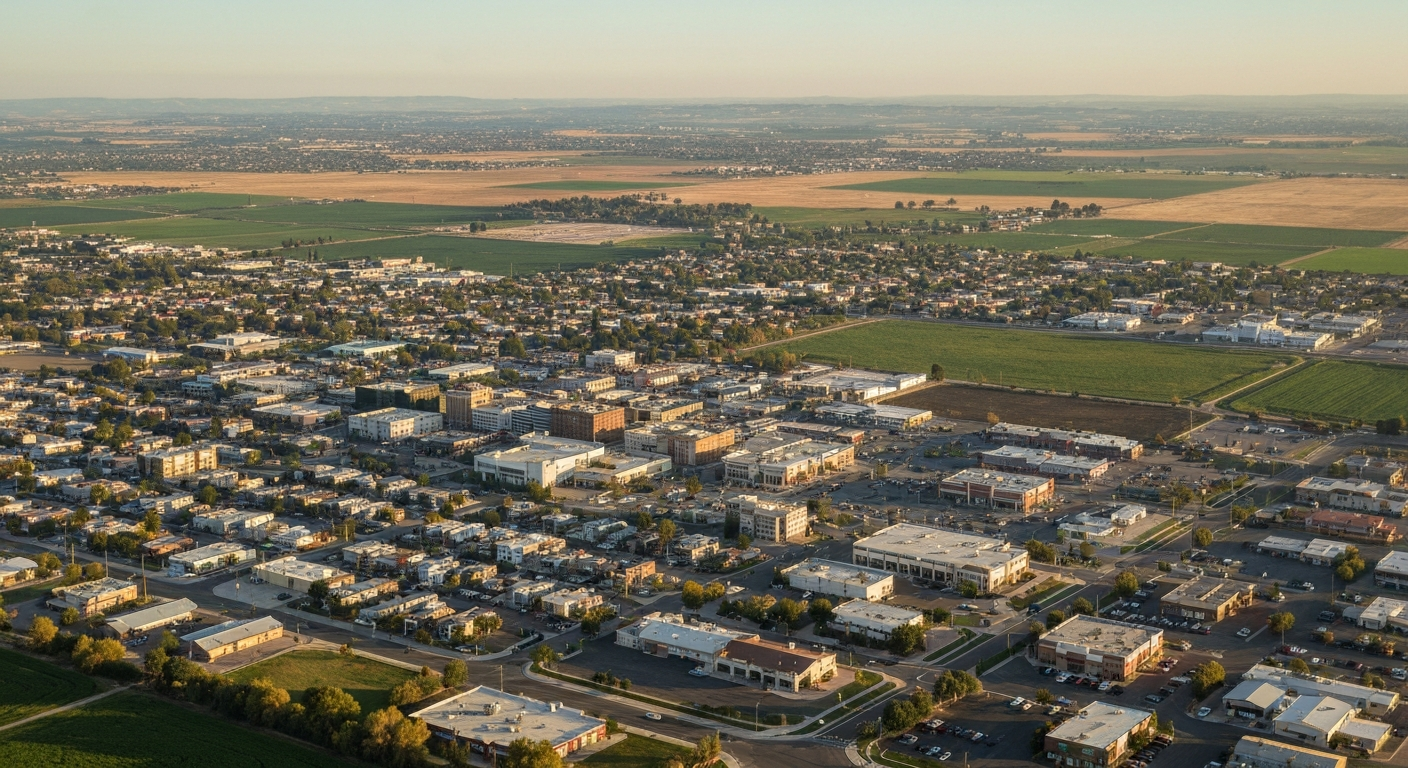
Modesto is the seat of Stanislaus County and the Central Valley’s second-largest city, with a 2024 population of approximately 218,915. The median household income sits around $79,891 — a solid middle-class baseline that mirrors larger metros but with dramatically lower operating costs.
The economic anchor is Gallo. E. & J. Gallo Winery produces roughly a quarter of all wine sold worldwide. That’s not a regional operation — that’s a global business built here because the Central Valley’s agricultural infrastructure, labor availability, and transportation corridors made it rational. Gallo’s success created gravitational pull. It attracted suppliers, logistics companies, and ancillary businesses that now form the backbone of the local economy.
But Modesto isn’t a one-company town. The food and beverage sector is unusually dense for a city this size. PepsiCo, Frito-Lay, Del Monte, Sovena, Rizo Lopez Foods, Stanislaus Foods, and Sciabica Olive Oil all operate here. These aren’t token facilities — they’re major production and distribution hubs. If you’re in food processing, packaging, cold chain logistics, or agricultural technology, you’re plugging into an existing ecosystem of suppliers, talent, and infrastructure.
Healthcare is a second pillar. Sutter Central Valley Hospitals is a significant employer, supporting everything from medical device companies to healthcare IT startups to nursing services. The education sector — Modesto City Schools and Modesto Junior College — provides both a local market and workforce development pipeline.
Retail concentration matters too. Save Mart Supermarkets is headquartered in Modesto, giving the city a retail anchor that most mid-sized Central Valley cities lack.
Geography seals it. Modesto sits on SR-99, equidistant-ish between Sacramento (90 miles north) and Fresno (110 miles south), with I-5 access to the west. If your supply chain or customer base spans the Central Valley, you’re positioned on the spine of the region. If you need to reach the Bay Area or LA, you have highway access without Bay Area pricing.
The sales tax burden is lower than most Bay Area cities. Modesto’s combined rate is 8.88% (state 6% + county 0.25% + city 1% + special 1.63%), compared to 8.625% in San Francisco or 8.375% in Oakland — and those don’t reflect the massive cost-of-living delta. A 50,000-square-foot food processing facility or a distribution center saves serious money on that math.
The city is not trendy. It’s not on the startup circuit. It doesn’t get magazine features about “emerging tech neighborhoods.” That’s the point. It’s a working city with actual industry, reasonable rents, and enough economic diversity that you’re not betting everything on one sector’s mood swings.
Step 1: Choose Your Business Structure
You have three main options: LLC, corporation, or sole proprietorship. Each has different costs and liability implications.
LLC (Limited Liability Company) is what most small businesses choose. You file Articles of Organization (Form LLC-1) with California’s Secretary of State at bizfileOnline.sos.ca.gov. The filing fee is $70 — one-time, paid when you submit.
Within 90 days of formation, you must file a Statement of Information (Form LLC-12). This costs $20. After that, it’s due every two years. It’s not optional, and missing the deadline costs you extra penalties, so mark your calendar.
Here’s the California tax hit: Every LLC doing business in California pays an $800 annual franchise tax to the Franchise Tax Board (FTB). This applies whether you make $1 or $1 million. No first-year exemption — the exemption that existed under AB 85 expired December 31, 2023. You pay it in your first year.
If your gross income exceeds $250,000, you pay an additional LLC fee on top of the $800 minimum. The tiers are:
- $250K-$500K: $900
- $500K-$1M: $2,500
- $1M-$5M: $6,000
- $5M+: $11,790
Corporation (C-Corp or S-Corp) costs $100 to file Articles of Incorporation. Corporations also pay the $800 franchise tax minimum, plus the same tiered fees above $250K in gross income. Corporations are overkill for most small businesses and add accounting complexity, so skip this unless you have a specific reason (venture capital, multiple investors, tax strategy that requires it).
Sole Proprietorship requires no state filing. You operate under your own name or register a fictitious business name with the county. No liability protection, though — your personal assets are exposed if someone sues. Most people move to LLC structure within the first year anyway, so don’t save $70 only to spend $500 on legal fees fixing it later.
For a typical Modesto startup: file as an LLC. It costs $70 upfront, $20 every two years, plus $800 annually to the state. That’s the structure that balances protection, simplicity, and cost.
Step 2: Register for State Taxes
You need three things: an EIN, a Seller’s Permit, and withholding registration if you’re hiring.
EIN (Employer Identification Number) comes from the IRS. It’s free. Go to irs.gov/ein and apply online. You’ll get the number immediately. You need it to open a business bank account, hire employees, and file taxes — so do this first, even before you file your LLC.
CDTFA Seller’s Permit is required if you’re selling tangible goods (products, inventory, physical merchandise). If you’re a service business, you don’t technically need it. But get it anyway — it’s free, and some clients won’t work with you without one. Register at cdtfa.ca.gov. The process takes 10 minutes.
The Seller’s Permit is how California tracks sales tax. Modesto’s combined sales tax rate is 8.88%. That’s state (6%) + county (0.25%) + city (1%) + special district (1.63%). You collect it from customers and remit it quarterly or monthly to the California Department of Tax and Fee Administration, depending on your volume. If you’re selling food products, you need to understand what’s taxable — fresh produce and uncooked foods have different rules than prepared foods and beverages.
State Income Tax is progressive and goes up to 13.3% — the highest in the nation. This applies to your business income. If you’re an LLC taxed as a sole proprietorship (the default), you report business income on your personal return. If you elect S-Corp taxation or file as a C-Corp, the rules are different. For your first year, assume you’ll owe state income tax on net profits.
If you’re hiring employees, register with the California Employment Development Department (EDD) for withholding, State Disability Insurance (SDI), and unemployment insurance. You’ll get an EDD account number and must remit payroll taxes monthly or quarterly. California requires paid family leave (up to 8 weeks, partially state-funded) and paid sick leave (3 days/40 hours per year, by law). The state minimum wage as of January 1, 2026, is $16.90 per hour statewide.
AB5 worker classification applies in California — this is the gig economy law that reclassified many contractors as employees. If you’re hiring, treat people as employees unless you have a strong independent contractor structure (they control their work, they serve multiple clients, they have their own business). Misclassification is expensive.
Step 3: Get Your Modesto Business License
Every business operating in Modesto must obtain a city business license. This is separate from state registration — it’s a local requirement enforced by the city.
You can apply online at bizmod.modestogov.com or in person at the Business License Office located at 1010 10th Street, Suite 2100, Modesto, CA 95354. If you’re mailing an application, send it to City of Modesto, PO Box 3442, Modesto, CA 95353. Phone the office at (209) 577-5389 if you have questions.
License Fees:
Home-based businesses with gross receipts under $2,000 per year pay $20. Commercial businesses with gross receipts under $2,000 per year pay $35. Everything else — which is most businesses — pays the base license fee plus a quarterly mill tax calculated on gross receipts.
The mill tax is where Modesto’s local cost becomes clear. It’s a gross receipts tax, meaning you pay it based on sales, not profit. The rate depends on business type: approximately 0.001 for commercial retail, 0.002 for commercial service. So a retail business with $200,000 in annual gross receipts pays roughly $50 per quarter (0.001 × $200,000 ÷ 4). A service business with the same revenue pays roughly $100 per quarter.
This is quarterly, not annual. You declare gross receipts each quarter and pay accordingly. It’s predictable but it adds up — and it applies whether you’re profitable or not.
Downtown Improvement District (DID) surcharge: If your business is in the Downtown Improvement District, you pay an additional tax at half the mill rate, capped at $1,500 per year. Downtown is experiencing revitalization with city investment, so this surcharge funds that effort. If you’re considering downtown location, factor in this extra cost, but know that the city is actively investing in the area.
Stormwater Discharge Compliance Form: This is a unique Modesto requirement that trips people up. All applicants must submit a Stormwater Discharge Compliance Form with their business license application. This is not optional. It’s a water quality document that certifies your business won’t contaminate stormwater runoff. If your business involves hazardous materials, food waste, chemicals, or outdoor operations, you need to understand what you’re disclosing. Miss this form and your application gets delayed. Check with the Business License Office about what applies to your specific business.
Renewal: Business licenses expire June 30 each year. Renewal is based on a Declaration of Gross Receipts, which you submit by July 31. If you don’t renew on time, you face penalties and potential shutdown notices. Set a calendar reminder.
Step 4: Handle Zoning and Location
Modesto’s Community Development Department handles zoning and planning. Before you sign a lease or buy property, verify that the location is zoned for your business type.
Major commercial corridors include McHenry Avenue, Oakdale Road, and the Briggsmore Avenue area. These are where most retail and commercial businesses cluster, and zoning is straightforward.
Downtown Modesto has been undergoing active revitalization over the past several years. If you’re considering a downtown location, you benefit from city investment in streetscape, events, and pedestrian infrastructure. You also pay the DID surcharge mentioned above. Downtown can work well for food, beverage, retail, and service businesses that benefit from foot traffic.
Home-based businesses are allowed in Modesto, but zoning restrictions apply. Some residential zones permit home offices for professional services (consulting, accounting, etc.). Other uses — manufacturing, retail, significant traffic — are restricted. Contact the Community Development Department to confirm before you invest in a home setup.
Building permits are required for tenant improvements and new construction. If you’re leasing a space that needs modifications, your landlord or you will need to pull permits through the city. This adds time and cost to buildout, so factor it in when negotiating lease terms.
The Community Development Department is your resource for all zoning questions. They’re not obstacles — they’re the source of truth about what’s allowed where. Call before you commit.
Costs at a Glance
Here’s the government cost breakdown for a basic LLC in Modesto during your first year:
- LLC Articles of Organization: $70 (one-time filing to Secretary of State)
- Statement of Information: $20 (due within 90 days, then every two years)
- California Franchise Tax: $800/year minimum (due to Franchise Tax Board)
- Modesto Business License: $35 base (commercial) + quarterly mill tax (approximately $100-200 per quarter for a typical service business, $50-100 for retail, depending on gross receipts)
- Seller’s Permit: Free (if selling tangible goods)
- EIN: Free (IRS)
- Combined Sales Tax: 8.88% (collected from customers, remitted quarterly/monthly)
Total first-year government fees for a basic LLC: Approximately $900-$1,000 before insurance, before rent, before inventory, before any business expenses. That doesn’t include business liability insurance (budget $500-2,000 depending on risk), accounting help (budget $1,500-5,000 if you want professional setup), or a registered agent if you want mail handling separate from your home address.
Compared to a Bay Area city at 8.625% sales tax, higher rent, and the same state and federal fees, Modesto saves you money. Not massive savings, but real ones. On a $500,000 annual revenue business, the 0.255% sales tax difference alone saves you $1,275 per year. Commercial rent in Modesto averages $12-18 per square foot annually; in San Francisco or Oakland, it’s $40-60+. A 2,000-square-foot office costs $24,000-36,000 in Modesto. The same space in the Bay Area costs $80,000-120,000.
The food and beverage companies here — Gallo, PepsiCo, Frito-Lay, Del Monte, Stanislaus Foods — didn’t choose Modesto because they love the weather. They chose it because the math works. That same math applies to your business.
Start with the state filing (LLC, $70). Get your EIN (free). Register for sales tax if you need it (free). Then get your Modesto business license and understand the mill tax. You’re operational legally within a week, for under $100 in government fees.
The rest — location, insurance, hiring, scaling — depends on your specific business. But the path to legal operation is straightforward and affordable. Modesto makes it accessible to start. Whether you stay depends on whether your business fits the local economy. For food and beverage, logistics, agricultural technology, healthcare, retail, or service businesses, the fit is solid. The infrastructure is here. The labor is here. The customers are here.
That’s why Gallo built an empire here. That’s why thousands of other companies did too.