How to Start a Business in Irvine, California
How to Start a Business in Irvine, California
Irvine isn’t just another Orange County city. It’s America’s most successful master-planned community — a corporate engine that generates $28 billion annually and hosts 17,000+ companies. Fortune 500 headquarters like Broadcom, Edwards Lifesciences, and Western Digital operate here. UC Irvine employs 34,076 people and feeds a thriving tech and biotech ecosystem. The population of roughly 314,621 is still climbing, growing at 0.8% annually since the 2020 census.
But here’s what matters to you: Irvine’s business licensing structure is fundamentally different from Los Angeles or Santa Monica. The city charges a flat fee instead of a gross receipts tax. The sales tax is 7.75% — the lowest in Southern California. For a growing business, that’s the difference between thriving and struggling.
This guide walks through the exact steps, costs, and advantages of launching in Irvine. By the end, you’ll know whether this master-planned city is right for your company — and how much it will actually cost.
Why Start a Business in Irvine?
The Economic Snapshot
Irvine is the economic heart of Orange County. With 17,000+ companies contributing $28 billion annually to the local economy, the city has built something rare: a diversified, resilient business ecosystem that isn’t dependent on a single industry.
The population is 314,621 as of 2024 estimates, up 4.98% since the 2020 census count of 308,450. That’s steady growth, and it translates to a growing customer base and labor pool. The median household income is roughly $136,719 — among the highest in Southern California. This means your potential customers have money to spend. It also means your labor costs will be higher than rural California, but you’re getting a skilled, educated workforce.
The Employer Anchor: UC Irvine
UC Irvine isn’t just a university. It’s the second-largest employer in Orange County with approximately 34,076 employees as of Fall 2024. The university generates $8 billion in annual economic impact and functions as a talent pipeline for the entire region’s tech and biotech sectors. Researchers graduating from UCI’s engineering, medicine, and computer science programs don’t leave the area — they start companies or join them.
The Fortune 500 Factor
Four Fortune 500 companies call Irvine home: Broadcom (semiconductor design and infrastructure), Edwards Lifesciences (cardiac devices and hemodynamic monitoring), Western Digital (data storage), and Masimo (non-invasive monitoring technologies). Beyond that, major corporate presences include Blizzard Entertainment (gaming), Rivian (electric vehicles), Mazda North America, Taco Bell’s corporate headquarters, Ingram Micro (IT distribution), Allergan (pharmaceutical), and Alteryx (data analytics).
These aren’t satellite offices. They’re decision-making hubs. When Fortune 500 companies locate their headquarters here, they bring supply chains, service providers, and ecosystem companies with them.
The Three Tech Sectors
Irvine’s economy rests on three pillars: healthcare and medical devices, gaming and advanced computing (including AI), and enabling technologies. These three sectors account for over 62,000 jobs and drive the majority of the city’s economic output. If you’re in biotech, digital health, semiconductor design, game development, or enterprise software, Irvine’s talent pool and customer proximity are unmatched in Southern California.
The Master-Planned City Advantage
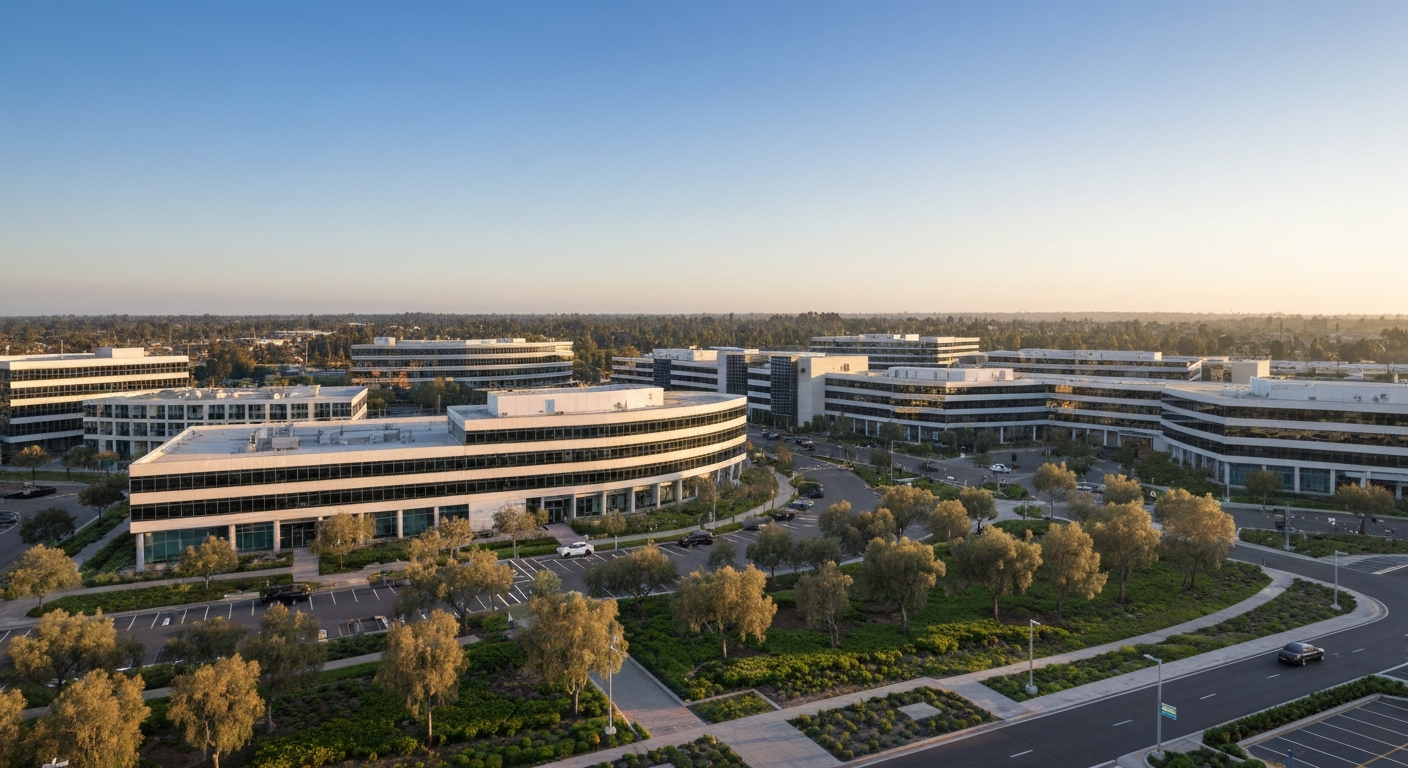
Irvine was literally designed as a city from the ground up. The Irvine Company, beginning in 1960, planned every neighborhood, business district, and infrastructure system. That master-plan approach means ultra-fast internet, well-maintained roads, dedicated business parks, and zoning that actually makes sense. You won’t fight the city bureaucracy over mixed-use zoning or internet infrastructure. The infrastructure exists because it was built in.
Growth Trajectory
Since 2000, Irvine has grown 114.4% — faster than 94% of comparably sized US cities. The city is still in growth mode, not decline. That matters for long-term business viability.
Step 1: Choose Your Business Structure
Your first decision is legal structure. For most founders, it’s between an LLC and a corporation.
Limited Liability Company (LLC)
An LLC gives you personal liability protection without the corporate formality. You file Articles of Organization (Form LLC-1) with California’s Secretary of State at bizfileOnline.sos.ca.gov. The filing fee is $70, one-time.
But here’s the California catch: every LLC doing business in the state pays an $800 annual Franchise Tax to the Franchise Tax Board (FTB). This isn’t optional. This isn’t a tax on profit. It’s a flat $800 per year, due by the 15th day of the 4th month after formation (first year), then April 15 annually.
The first-year exemption under AB 85 expired December 31, 2023. That exemption is gone. You owe the full $800 starting year one.
You’ll also file a Statement of Information (Form LLC-12) within 90 days of formation, then biennially thereafter. That filing is $20 each time.
If your LLC’s gross receipts exceed $250,000, you owe an additional LLC fee on top of the $800. That fee scales: $900 for $250K–$500K in gross receipts, $2,500 for $500K–$1M, $6,000 for $1M–$5M, and $11,790 for over $5M. These fees exist in addition to the base $800.
Corporation
If you incorporate, the Articles of Incorporation filing fee is $100. Corporations pay corporate income tax on net profit at California’s graduated rates, topping out at 8.84% on the corporation’s net income.
For most startups in Irvine, an LLC makes more sense unless you have complex investor agreements or specific tax planning needs. The LLC’s $800 franchise tax is a known cost; corporate taxation depends on profitability.
California’s Income Tax Rate
Regardless of structure, California’s personal income tax applies to any profit you take as an owner. The state’s top marginal rate is 13.3% — the highest in the nation. This applies statewide; Irvine doesn’t change it. Plan for this when modeling cash flow.
Step 2: Register for State Taxes
After you’ve chosen your structure and filed your formation documents, you need state tax registrations.
Seller’s Permit from the California Department of Tax and Fee Administration
If you’re selling any tangible goods — physical products — you must register for a Seller’s Permit with the California Department of Tax and Fee Administration (CDTFA) at cdtfa.ca.gov. This registration is free. It takes about 15 minutes online. You’ll need your Social Security Number or ITIN, your business address, and your estimated monthly sales.
The Seller’s Permit allows you to buy goods wholesale without paying sales tax (you’ll collect it from customers instead). Without this permit, you’ll pay full retail sales tax on your inventory, crushing your margins.
EIN from the IRS
You need a federal Employer Identification Number (EIN) from the IRS, even if you’re a solo LLC. This is free and takes 10 minutes at irs.gov/ein. You can apply online and get your EIN immediately.
An EIN is required for business bank accounts, hiring employees, and filing federal taxes. Get it before you open a business bank account.
EDD Registration for Payroll Taxes
If you’re hiring employees, you must register with California’s Employment Development Department (EDD) for payroll taxes. This registration is free. The EDD handles state income tax withholding, unemployment insurance, and disability insurance deductions. You can register at edd.ca.gov.
AB5 Compliance
California’s Assembly Bill 5 (AB5) created strict rules around classifying workers as independent contractors versus employees. The presumption is that anyone who works for you is an employee unless they meet a three-part test: they control their work, they perform work outside your usual business operations, and they’re independently established in that trade.
In plain terms: you can’t hire a “contractor” and avoid payroll taxes. If someone is integral to your business, they’re an employee. The penalties for misclassification are severe — fines up to $5,000 per violation, back taxes, and potential wage claims. Factor this into your hiring plan.
Step 3: Get Your Irvine Business License
Here’s where Irvine’s local advantage becomes clear.
The City of Irvine requires ALL commercial and residential businesses to obtain a business license prior to conducting business. This isn’t optional. You can’t open your doors, take your first customer, or make your first sale without it.
How to Apply
Apply online at cityofirvine.org or in person at City Hall. The online portal is faster — you can submit and pay in under 10 minutes.
If you prefer in-person service:
City of Irvine City Hall
1 Civic Center Plaza
Irvine, CA 92606
Phone: (949) 724-7128 (Business License)
(949) 724-6310 (Community Development)
Email: [email protected]
Hours:
Business License desk: Monday–Friday, 8am–5pm (closed 12pm–1pm for lunch)
City Hall offices: Monday–Thursday, 7:30am–5:30pm; Friday, 8am–5pm
When you apply, have your Social Security Number, business address, business structure (LLC, corporation, etc.), and your business description ready. The city will cross-reference your application against state filings. If there’s a mismatch, they’ll ask for clarification.
Irvine Business License Fees: Flat Rate (Not Gross Receipts)
This is where Irvine’s competitive advantage shines.
Most California cities — Los Angeles, Santa Monica, San Francisco — use a gross receipts tax model. Your business license fee is based on how much revenue you generate. A business doing $1 million in annual sales pays dramatically more than one doing $100,000.
Irvine doesn’t. The city uses a flat fee model based only on the number of employees.
The Fee Schedule
- 10 or more employees: $148/year
- Fewer than 10 employees: $72/year
- Administrative/executive/research/sales offices with no income generated locally: $50/year fixed
- Businesses with gross receipts under $4,000: may qualify for a reduced rate (contact the city for verification)
- Additional state-mandated fee: $4 on all licenses
So a solo founder operating from a home office pays $72 + $4 = $76/year. A business with 5 employees pays the same $72 + $4 = $76/year. A business with 10 employees pays $148 + $4 = $152/year.
This is radically different from gross receipts taxation. A business generating $10 million in annual revenue still pays $152/year.
Late Payment Penalty
If you don’t renew by the November 30 annual deadline, Irvine assesses a late penalty of $70.45, accruing annually. This is why renewal reminders matter.
The Real Cost Comparison
To see why Irvine’s model matters, compare it to Santa Monica.
Santa Monica uses a gross receipts model. A business generating $1 million in annual revenue pays approximately 0.115% of gross receipts, which comes to roughly $1,150/year. A business generating $5 million pays around $5,750/year.
In Irvine, that same $5 million business pays $152/year.
For a high-revenue retail or e-commerce business, this is a $5,600/year advantage. Over 10 years, you’re saving $56,000 in local taxes — money you can reinvest in hiring, inventory, or product development.
Even compared to Los Angeles (which has a tiered gross receipts tax), Irvine’s advantage is substantial. An LA business with $1 million in revenue might pay $400–$500/year in gross receipts tax alone, plus other fees. Irvine: $152.
This is not a small difference. For businesses with significant local revenue, Irvine’s flat-fee model is a genuine competitive advantage.
Sales Tax: 7.75% — Lowest in This Batch
California’s sales tax is complicated because it layers state, county, city, and special district rates.
Irvine’s Combined Rate
The combined sales tax rate in Irvine is 7.75% as of 2026.
Here’s the breakdown:
- California state: 6.0%
- Orange County: 0.25%
- Irvine city: 0.0%
- Special district: 1.5%
The Critical Point: Irvine Charges No City Sales Tax
Many California cities add their own sales tax on top of the state and county rates. Irvine doesn’t. The entire 7.75% rate consists of state (6.0%), county (0.25%), and special district (1.5%) — but zero from the city itself.
How This Compares
- Santa Monica: 10.75% combined (state 6% + county 0.25% + city 2.25% + special district 2.25%)
- Pasadena: 10.5% combined (state 6% + county 0.25% + city 2.5% + special district 1.75%)
- Riverside: 8.75% combined (state 6% + county 1.25% + city 0% + special district 1.5%)
- Santa Ana: 9.25% combined (state 6% + county 0.25% + city 2.25% + special district 0.75%)
Irvine’s 7.75% is the lowest in Southern California’s major business hubs.
What This Means for Your Business
For a retail or e-commerce business, sales tax is passed to the customer. A 3-percentage-point difference compounds quickly.
A retail business doing $1 million in annual sales in Santa Monica collects $107,500 in sales tax. The same business in Irvine collects $77,500. The difference: $30,000/year.
Your customers aren’t paying that; the state and local governments are collectively taking less. But from a competitive pricing perspective, you can either offer lower prices or higher margins. Either way, Irvine’s rate gives you an advantage.
For a B2B service business, sales tax is typically not applicable to services, so this advantage doesn’t directly apply. But if you’re manufacturing goods or selling products, Irvine’s tax rate matters.
Costs at a Glance
Here’s what you’ll pay in government fees during your first year:
| Item | Cost |
|---|---|
| LLC Articles of Organization (Form LLC-1) | $70 |
| Statement of Information (Form LLC-12), due within 90 days | $20 |
| Annual Franchise Tax (FTB) | $800 |
| Irvine business license (fewer than 10 employees) | $72 |
| State-mandated business license fee | $4 |
| Seller’s Permit (if selling goods) | Free |
| EIN (IRS) | Free |
| EDD registration (if hiring) | Free |
| Total, Year 1 | ~$966 |
For years 2 and beyond, your costs are:
- Franchise Tax: $800/year (mandatory)
- Business license renewal: $72/year (+ $4 state fee)
- Statement of Information: $20 every two years
- Sales tax collection: ~7.75% (passed to customers)
What Irvine’s Advantage Actually Is
California’s state-level costs — the $70 LLC filing, the $800 franchise tax, the 13.3% income tax rate — apply everywhere in the state. You can’t escape them by moving to Pasadena or San Diego.
Irvine’s advantage is at the local level. The flat business license fee ($72–$148/year instead of gross receipts) and the absence of a city sales tax (0% instead of 2–2.5%) save you real money, especially if you’re generating significant revenue.
For a bootstrapped startup making $50,000 in year one, Irvine’s advantage is modest — maybe $200/year compared to LA. But for a business scaling to $1M+ in revenue, you’re saving thousands annually. Over a decade, that’s tens of thousands of dollars you can reinvest in your team, technology, or growth.
The Catch: Labor Costs and Commercial Real Estate
Irvine’s advantages come with trade-offs.
Median household income of $136,719 reflects a wealthy, educated population. That’s excellent for customer purchasing power. It’s challenging for labor costs. Salaries in Irvine are higher than in less affluent regions. Entry-level office staff, engineers, and management all cost more here than they would in San Diego or inland Riverside County.
Commercial real estate is also expensive. Office space in Irvine’s business parks runs $2.00–$3.50+ per square foot annually. That’s premium pricing for a master-planned, well-maintained environment. If you need significant square footage, your real estate costs will dwarf your local tax savings.
For a tech startup or professional services firm with a small, high-skilled team, Irvine’s economics work. For a labor-intensive retail or service business, you might find better economics elsewhere.
Your Next Move
You now have the roadmap. Here’s the sequence:
- Choose your structure (LLC recommended for most founders).
- File with the California Secretary of State at bizfileOnline.sos.ca.gov ($70).
- Register for a Seller’s Permit at cdtfa.ca.gov if you’re selling goods (free).
- Get an EIN from the IRS at irs.gov/ein (free).
- Apply for an Irvine business license at cityofirvine.org or in person at City Hall ($72–$148 + $4).
Total time: 2–3 hours. Total cost: $966–$1,042 in year one.
Irvine offers something rare in California: a master-planned city with genuine economic advantages. The flat-fee licensing and low sales tax aren’t enough to overcome bad economics in your specific industry, but they’re real savings. If your business fits Irvine’s tech, biotech, or healthcare ecosystem, you’re not just getting favorable tax treatment — you’re getting proximity to Fortune 500 companies, a 34,000-person university employment base, and 17,000+ established businesses in your region.
That’s worth more than the tax savings alone.