How to Start a Business in Huntington Beach, California
How to Start a Business in Huntington Beach, California
Huntington Beach isn’t just a place where people vacation. It’s where they spend money—a lot of it.
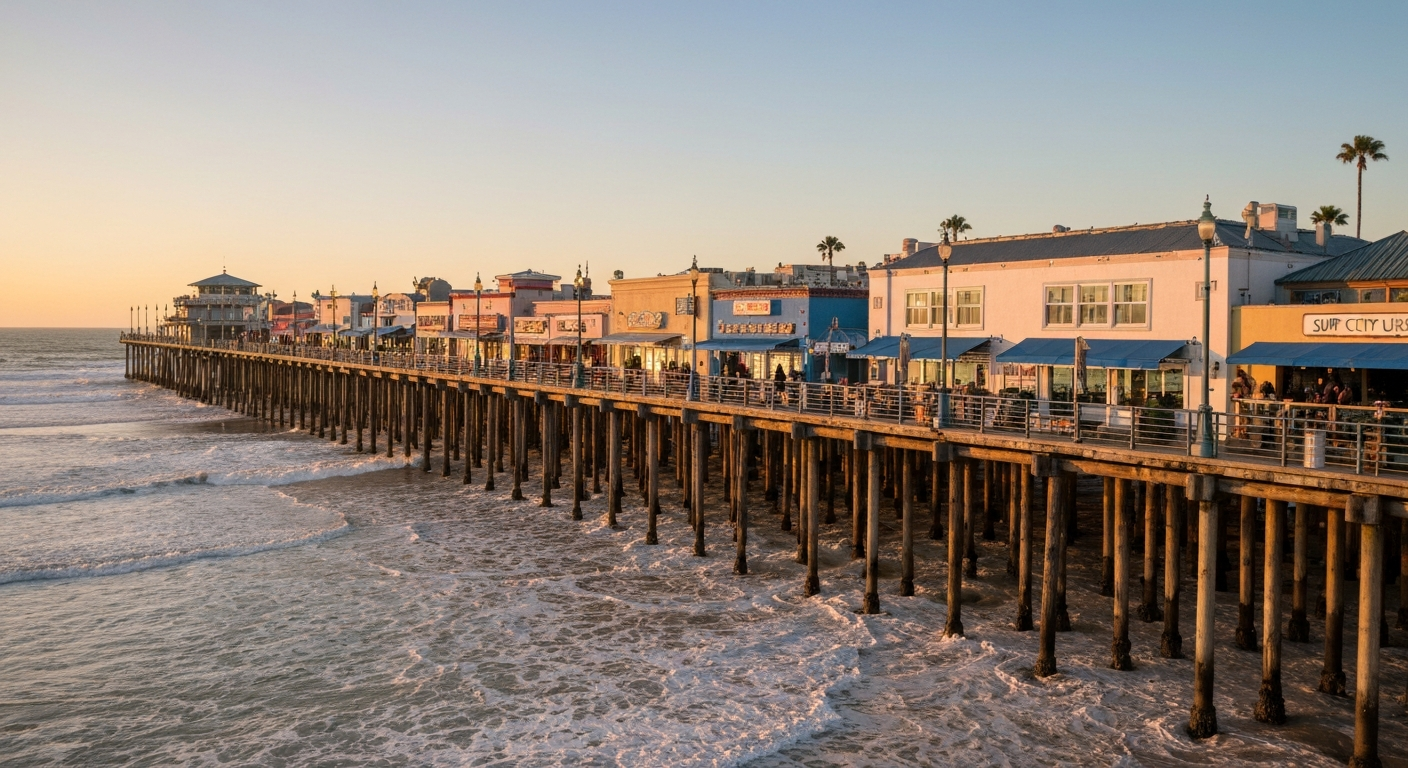
The city officially branded as “Surf City USA” drew 2.34 million visitors in 2024, up 4.4% from the year before. Those visitors generated over $400 million in annual spending and supported roughly 4,500 local jobs. But here’s what separates Huntington Beach from a one-dimensional beach town: Boeing operates a major manufacturing, R&D, and support facility here. Quiksilver runs its global headquarters from these blocks. BJ’s Restaurants, a national chain with hundreds of locations, is based here. The median household income sits at $120,919—well above both the California average ($100,149) and the national figure ($81,604).
This is an affluent, economically diverse coastal city of nearly 195,000 people. And yes, there are real costs to operating here. California’s $800 franchise tax applies. So does the state’s 13.3% income tax. Commercial rents command Orange County prices. But there’s also a genuine advantage most entrepreneurs don’t catch: Huntington Beach has the lowest sales tax rate in much of Southern California because the city doesn’t levy its own sales tax. That’s worth understanding before you commit.
Here’s what it actually takes to start a business in Huntington Beach.
Why Start a Business in Huntington Beach?
The numbers matter, but they tell a specific story.
Huntington Beach has a population around 193,000 to 195,000 as of 2024, making it one of Orange County’s largest cities. That resident base alone provides a substantial market. But the real economic engine is tourism layered on top. In 2024, the city welcomed 2.34 million visitors—a 4.4% increase from 2023. Those visitors didn’t just take photos. They spent money on lodging, food, retail, activities, and services. The total annual visitor spending exceeds $400 million. Tourism directly generated $16 million in lodging and retail sales taxes, funding schools, infrastructure, and city services. Each Huntington Beach household benefits from roughly $272 in annual city services funded by visitor spending. Without tourism revenue, residents would carry that burden themselves.
The employment picture shows why this works. The top employment sectors are healthcare and social assistance (15.4%), retail (10.6%), and manufacturing (10.4%). Unemployment sits at 3.9% as of 2023—38.5% below the statewide average of 5.4%. People here are employed. They have disposable income.
The tourism calendar is specific and predictable. Spring break through Labor Day is peak season. The US Open of Surfing, typically held in July, brings international competitors and spectators. Surf City Surf Dog—a surfing competition for dogs—draws crowds and media attention. The 4th of July celebration ranks among the largest in the United States, regularly drawing hundreds of thousands of people. These aren’t small events. They’re revenue generators for businesses aligned to capture them.
The physical asset that drives all of this is simple: 10 miles of continuous beach. That uninterrupted stretch of sand and water is what brings people here. It’s what makes the “Surf City USA” trademark trademarked and nationally recognized. For a business owner, this means your customer base extends far beyond the 193,000 residents. You’re also competing for—and can capture—visitor spending.
The aerospace and defense sector adds a completely different customer base. Boeing’s Huntington Beach facility is one of the largest employers in California. It drives demand for specialized contractors, engineering services, precision manufacturing, and supply chain businesses that have nothing to do with tourism. Quiksilver’s headquarters here means global supply chain, marketing, and retail operations. BJ’s Restaurants running a national chain from Huntington Beach means corporate jobs, vendor relationships, and service businesses all tied to that presence.
The result: Huntington Beach is a multi-layered economy. Tourism is the visible layer. Aerospace, corporate headquarters, and local healthcare and retail make up the rest.
Step 1: Choose Your Business Structure
The first decision is structural: LLC or corporation.
For most Huntington Beach entrepreneurs, an LLC is the right choice. The filing is straightforward and inexpensive. You submit Articles of Organization (Form LLC-1) to the California Secretary of State at bizfileOnline.sos.ca.gov. The filing fee is $70, a one-time cost. You’ll also need to file a Statement of Information (Form LLC-12) within 90 days of formation, then biennially after that. Each Statement of Information costs $20.
The critical number to understand: California charges every LLC $800 per year in franchise tax to the Franchise Tax Board. This is not optional. It applies regardless of revenue. If your LLC makes $1,000 or $1 million, the franchise tax is $800. There is no first-year exemption—that ended December 31, 2023. AB 85, which had provided relief, expired. If your gross income exceeds $250,000, you’ll pay an additional LLC fee on top of the $800 base: $900 for income between $250K and $500K, $2,500 for $500K to $1M, $6,000 for $1M to $5M, and $11,790 for $5M and above.
A corporation follows a similar structure but with a higher filing fee. Articles of Incorporation cost $100 at the state level. Corporations also pay the $800 franchise tax minimum, plus additional fees if gross income exceeds $250,000.
For tourism-oriented businesses—surf lessons, equipment rentals, food service, events—an LLC provides liability protection specifically valuable for customer-facing operations. If someone is injured during a lesson or a product fails, the LLC structure limits personal liability. This matters more in Huntington Beach than in an office-based business because your customers are actively using your service or product.
Don’t overthink this step. File the LLC online, pay the $70, and move forward.
Step 2: Register for State Taxes
California’s tax system requires multiple registrations. None of them are optional.
Start with an EIN from the IRS. This is your Employer Identification Number, and it’s free. You can apply at irs.gov/ein. The process takes minutes online. You’ll get your EIN immediately. Even if you’re a solo founder with no employees, the EIN separates your personal tax situation from your business. Use it on all business bank accounts and tax filings.
Next: the CDTFA Seller’s Permit. If you’re selling tangible goods—retail products, food items, merchandise—you need this. It’s free to register at cdtfa.ca.gov. The permit allows you to collect and remit sales tax. You cannot legally sell tangible goods in California without it.
Here’s the sales tax detail for Huntington Beach specifically: the combined rate is 7.75%. This breaks down as the statewide base rate of 7.25% plus Orange County’s rate of 0.5%. Critically, Huntington Beach does not levy its own city sales tax. This is a genuine advantage. Most Orange County cities add a local sales tax on top of the county rate, pushing combined rates to 7.75% to 9.25%. Huntington Beach stays at the lower end because the city doesn’t layer on an additional percentage. That 0.5% difference might seem small, but across thousands of transactions, it affects competitiveness.
The caveat: rates can vary slightly by specific location and ZIP code due to special districts. Verify the exact rate for your location at cdtfa.ca.gov/taxes/rates or use Avalara’s tax rate tool.
State income tax is progressive, climbing to 13.3% for the highest earners—the highest marginal rate in the nation. This applies to your business income. There’s no separate state business license; cities handle local licensing (Huntington Beach’s system is covered in the next section).
If you hire employees, you’ll need to register with the EDD (Employment Development Department) for withholding and unemployment insurance. This is separate from your EIN and state tax registration. The EDD handles payroll tax withholding, unemployment insurance, and disability insurance. You’ll set it up through edd.ca.gov.
Step 3: Get Your Huntington Beach Business License
Every business operating in Huntington Beach must obtain a city business license. This is distinct from state registration. It’s a local requirement enforced by the city.
The fee structure is employee-based, not gross-receipts-based. This matters. A high-revenue business with few employees pays less than a lower-revenue business with many employees. Here’s the breakdown:
- First 3 employees: $75.00
- 4 through 12 employees: $4.00 per additional employee
- 13 through 52 employees: $3.00 per additional employee
- 52+ employees: further reduced per-employee rate
The minimum license fee is $75 per year in all classifications. So a solo founder pays $75. A business with three employees pays $75. A business with five employees pays $75 (first three) plus $8 (two additional at $4 each) = $83.
For home-based businesses, you can apply online through the Huntington Beach ACA (Accela Citizen Access) portal. Out-of-city contractors apply online through the same portal with your CSLB license. All other businesses—retail, offices, service locations—apply in person or via email.
Processing time is 3 to 5 business days for new applications. Non-profit organizations must obtain a license but are exempt from fees.
Contact the Business License Office directly if you have questions: (714) 536-5267, [email protected]. They can clarify whether your specific business type qualifies for any exemptions or special classifications.
Step 4: Handle Zoning and Location
Where you operate matters legally and financially.
Huntington Beach’s Community Development Department handles zoning verification and building permits. Before you sign a lease or buy property, verify that the location is zoned for your business type. A retail shop, office, manufacturing operation, or food service business each has different zoning requirements. The Community Development Department can confirm eligibility for your specific address.
Coastal zone regulations add a layer. If your property sits within the California coastal zone, California Coastal Commission regulations may apply. These rules govern land use, environmental impact, and public access near the coastline. For most standard retail and service businesses, this doesn’t create major obstacles, but it’s a consideration. Beachfront properties or those immediately adjacent to the coast should be flagged for Coastal Commission review before you commit.
Location strategy within Huntington Beach breaks into three zones, each with distinct economics and customer bases.
The Pacific Coast Highway (PCH) corridor is prime retail and restaurant real estate. It’s where tourists congregate, where visibility is highest, and where rents are premium. If you’re selling directly to visitors—surf equipment, beachwear, food, activities—PCH is valuable. You’ll pay for that location.
Main Street and downtown Huntington Beach are walkable, tourist-heavy, and ideal for retail, dining, and experiential businesses. This area has been revitalized and draws foot traffic year-round. Rents are high but lower than PCH. The demographic is mixed—tourists and local residents.
Edinger Avenue and Beach Boulevard corridors offer more affordable commercial space with strong local traffic. These areas serve the resident population and commuters. Rents are lower than PCH or downtown. If you’re building a service business focused on locals rather than tourists—accounting, automotive, home services—these corridors make financial sense.
Home-based businesses face residential zoning restrictions. You can operate from home, but you cannot have exterior signage, and customer visits must be limited. This works for consulting, online businesses, and service work that doesn’t require walk-in traffic. If you need visibility and customer flow, a commercial location is necessary.
The Tourism Multiplier
The 2.34 million annual visitors create an economic multiplier that compounds your opportunity.
Your customer base isn’t just the 193,000 residents. It’s 193,000 residents plus 2.34 million annual visitor interactions. That visitor traffic is concentrated but predictable. Spring break through Labor Day is peak season. Plan your staffing and inventory around this. Hire seasonal employees. Stock more inventory before peak months. Adjust your operating hours to match demand.
The major events on the calendar are revenue accelerators. The US Open of Surfing typically happens in July and brings international competitors and spectators. Surf City Surf Dog is a media-friendly event that draws crowds. The 4th of July celebration is one of the largest in the United States. If your business is positioned to capture event traffic—food, retail, accommodations, activities—these events create revenue spikes.
Visit Huntington Beach (surfcityusa.com) is the city’s official destination marketing organization (DMO). If you operate a tourism-adjacent business—hospitality, food service, retail, activities, accommodations—connecting with Visit Huntington Beach can drive visibility. They promote the city to visitors and coordinate with local businesses.
The visitor economy subsidizes resident quality of life. That $400 million in annual visitor spending generates taxes that fund schools, parks, infrastructure, and services. Without tourism revenue, every Huntington Beach household would need to pay approximately $272 more annually to fund the same services. This means resident taxes are lower because visitors are spending. For a business owner, this also means public infrastructure is well-maintained and services are well-funded.
Costs at a Glance
Here’s what you’ll actually pay in your first year to launch an LLC-based business in Huntington Beach with one to three employees:
- LLC filing: $70 (one-time)
- Statement of Information: $20 (due within 90 days, then biennially)
- Franchise tax: $800 per year
- Huntington Beach business license: $75 per year (minimum for 1-3 employees)
- Seller’s Permit: free (if selling tangible goods)
- EIN: free
Total first-year government fees: approximately $965. Add the business license renewal the following year ($75), and ongoing annual costs stabilize at around $895 in franchise tax plus business license.
Sales tax is 7.75%. This isn’t a cost you pay—it’s a tax you collect from customers and remit to the state. But it affects your pricing strategy. In a lower-tax jurisdiction, you might be slightly more competitive.
State income tax applies to your business profit at rates up to 13.3%. This is unavoidable and applies to all California businesses. Don’t underestimate it when modeling profitability.
The real cost variable is commercial rent. Huntington Beach commercial space commands Orange County rates. PCH properties are most expensive. Downtown is moderate to high. Edinger and Beach Boulevard corridors are more affordable. A 1,500-square-foot retail space on PCH might run $3,000 to $5,000 per month. The same space on Beach Boulevard might be $1,500 to $2,500. Home-based operations eliminate rent entirely but limit customer access.
Huntington Beach’s sales tax advantage—7.75% versus 8.25% to 9.25% in nearby areas—is real and worth factoring into your competitive position. For a retail business, that 0.5% difference on every transaction adds up. For a service business, it’s less relevant.
The franchise tax is the biggest sticker shock for many California entrepreneurs. $800 per year for a business that might not yet be profitable. But it’s unavoidable. Plan for it. Budget for it. Don’t be surprised by it in April when the FTB bill arrives.
Start with this foundation. Register your LLC, get your licenses, collect your EIN and Seller’s Permit, and verify your zoning. You’re then positioned to operate legally in Huntington Beach and capture a customer base that extends far beyond the city’s resident population.