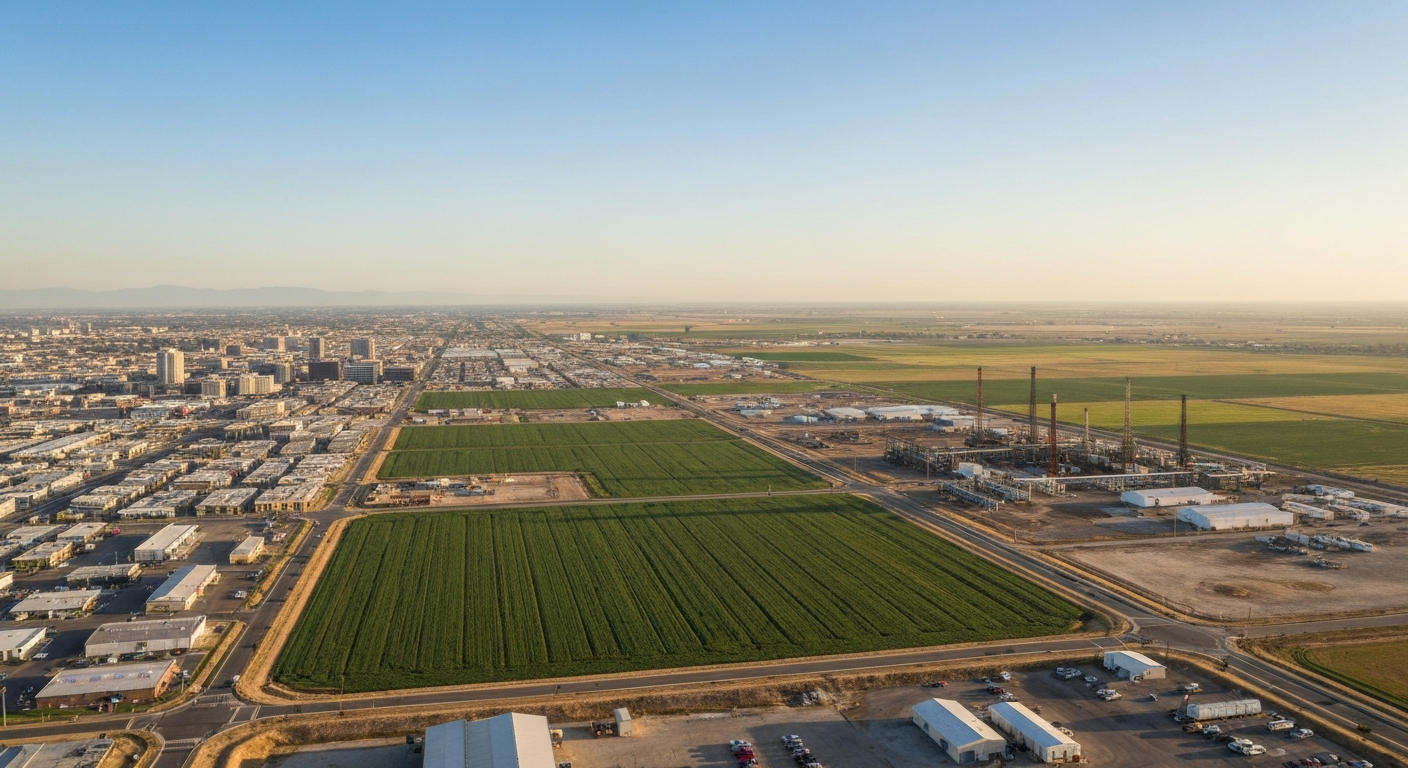
How to Start a Business in Bakersfield, California
How to Start a Business in Bakersfield, California
Bakersfield just led all major California cities in population growth. While Los Angeles, San Francisco, and Sacramento stalled or shrank in 2024, Bakersfield grew at 1.2% — the fastest rate among the state’s ten largest cities. That’s not by accident. The numbers tell a story: a city with dual economic engines, tax rates that reward business growth, and a cost structure that makes capital stretch further than anywhere else in California’s top tier.
If you’re thinking about starting a business in California, Bakersfield deserves serious consideration. The conventional wisdom says “coastal California or bust.” The data says otherwise.
Why Start a Business in Bakersfield?
The growth is real, and it’s fastest in the state.
Bakersfield’s population hit 413,381 in 2024, growing at 1.2% annually. That may sound modest, but it’s the fastest clip among California’s ten largest cities—Los Angeles, San Diego, San Jose, San Francisco, Fresno, Long Beach, Oakland, Stockton, and Riverside all grew slower or contracted. The broader Bakersfield metro area (Kern County) is even larger, at roughly 741,000 people, expanding at 1.51% year-over-year.
Growth matters because it signals demand. New residents need goods, services, housing, healthcare, food. Growth creates both market opportunity and labor availability.
The economy runs on oil and agriculture—California’s most productive combination.
Kern County produces more oil than any other county in California. Full stop. That’s Chevron, Aera Energy, and dozens of service companies supporting extraction, equipment, logistics, and specialized contracting. This isn’t a dying industry; it’s capital-intensive and creates high-paying jobs in engineering, operations, and skilled trades.
At the same time, Kern County ranks as the 4th most productive agricultural county in the United States by value. Bolthouse Farms, Grimmway Farms, and countless smaller operations grow vegetables, cotton, almonds, and dairy. Agriculture spawns secondary industries: food processing, cold storage, packaging, distribution, equipment repair, and logistics.
Few regions in the country—let alone California—have this dual base. It means the local economy isn’t dependent on a single sector. When one softens, the other often strengthens.
The major employers span industries.
Chevron, Aera Energy, Dignity Health, Kern County government, Bolthouse Farms, Grimmway Farms, and Kern Medical anchor the job market. But the employment data reveals the breadth:
- Healthcare & Social Assistance: 45,581 jobs
- Retail Trade: 39,956 jobs
- Agriculture, Forestry, Fishing, and Hunting: 37,801 jobs
That’s three separate sectors with substantial, stable employment—plus logistics, food processing, education, and construction all represented significantly. Businesses that serve these sectors or their workers have built-in demand.
The economy is accelerating.
Bakersfield’s GDP grew 6.3% between 2022 and 2024. That outpaced California’s statewide growth and exceeded most peer cities. Growth at that pace means more business formation, higher consumer spending, and rising commercial investment.
Your money goes further here than anywhere else in California’s top 10 cities.
Commercial rent, office space, industrial land, and housing costs are substantially below coastal California. A warehouse that costs $1.50/sq ft in Oakland might be $0.70/sq ft in Bakersfield. That difference compounds. If you’re bootstrapping or reinvesting early profits, the cost of doing business here is your biggest financial advantage.
Median household income is $82,093, healthy enough to support local consumer spending without the wage inflation that coastal metros demand.
Step 1: Choose Your Business Structure
You have two main options: LLC or corporation. Both offer liability protection. Both cost roughly the same to file in California. The choice depends on your tax situation and long-term plan.
Limited Liability Company (LLC)
Filing an LLC with California Secretary of State costs $70. You’ll file Form LLC-1 (Articles of Organization) online at bizfileOnline.sos.ca.gov. The process takes about 5–10 minutes once you’ve reserved your name (optional, $10, holds for 60 days).
Within 90 days of formation, you must file a Statement of Information (Form LLC-12) for another $20. After that, you file it again every two years on the anniversary of your formation.
Here’s the catch every California business owner learns: the state Franchise Tax of $800 per year. This is not optional, not negotiable, and not waived for new businesses anymore. AB 85 created a first-year exemption that expired December 31, 2023. You now pay the full $800 starting in year one, regardless of revenue or profit.
If your business eventually exceeds $250,000 in gross income, you pay an additional LLC tax on a tiered scale: $900 for income between $250K–$500K, $2,500 for $500K–$1M, $6,000 for $1M–$5M, and $11,790 for $5M and above. This is separate from the $800 base tax.
For most Bakersfield startups, the LLC is the right choice. It’s simple, flexible on taxes (you can elect to be taxed as a corporation if it makes sense later), and the liability protection is straightforward.
Corporation
Incorporating costs $100 for Articles of Incorporation. The $800 annual Franchise Tax applies here too. Corporations are more rigid—more formal board meetings, more paperwork. They’re typically chosen when you plan to raise outside investment or go public. For a local Bakersfield business, an LLC usually does the job better.
Why liability protection matters in Bakersfield specifically
If you’re starting an oil services company, agricultural operation, or anything in these capital-intensive, hazard-prone sectors, the liability shield is critical. Equipment failures, environmental issues, workplace injuries—these risks are real. A sole proprietorship or general partnership leaves your personal assets exposed. An LLC or corporation gives you a legal barrier, assuming you don’t pierce the corporate veil through gross negligence or fraud.
Step 2: State Tax Registration
Once you’ve filed your articles, you need three registrations.
EIN (Employer Identification Number)
Apply for free at irs.gov/ein. The IRS will issue one immediately if you apply online. You need this to open a business bank account, hire employees, and file federal tax returns. Even if you’re a solo operation, get an EIN—it’s free and it separates your personal and business finances, which is critical for liability protection.
CDTFA Seller’s Permit
If you sell tangible goods—retail products, agricultural products, food, anything physical—you need a Seller’s Permit from the California Department of Tax-Fee Administration. Register free at cdtfa.ca.gov. This permit lets you collect sales tax from customers and remit it to the state. You’ll also use it to buy wholesale without paying sales tax on your inputs.
EDD Registration
If you hire employees, register with California’s Employment Development Department. They’ll assign you an account number and set up withholding schedules. This is separate from federal employment registration (which you handle with your EIN).
Agricultural employers: Special registration
If you’re building a workforce in agriculture, the Agricultural Labor Relations Board (ALRB) regulates certain activities. If you have more than a few employees or you’re engaging in specific labor practices, check with the ALRB about registration requirements. Kern County has a substantial agricultural workforce, and compliance matters here.
Step 3: Get Your Bakersfield Business Tax Certificate
Every business operating within Bakersfield city limits—whether you have a storefront, office, warehouse, or work from home—must have a Business Tax Certificate.
How to apply
You can apply in person or online through the city’s Click2Gov portal. The in-person office is the Treasury Division at City Hall North, 1600 Truxtun Ave, Bakersfield, CA 93301. Call (661) 326-3762 or (661) 326-3763 for questions or to walk through your application.
The fees
Your Business Tax Certificate fee depends on your business type and projected gross receipts. There’s no flat fee; the city calculates it based on your industry and revenue forecast. You’ll also pay a $4.00 ADA fee (mandated by AB 1379) on top of the certificate fee.
If you’re running a home-based business, add a Home Occupation Permit for $101.00 (one-time fee).
Why this matters for your budget
The certificate fee is separate from the state Franchise Tax. It’s a local tax, paid to Bakersfield. But it’s based on gross receipts, which is where the city’s competitive advantage becomes apparent.
Bakersfield’s Business-Friendly Tax Rates
This is where Bakersfield’s math changes the equation.
The city charges a gross receipts tax. That means you pay based on what you invoice, not profit. Many entrepreneurs dislike gross receipts taxes because they can apply even when you’re not making money. But Bakersfield’s rates are structured to minimize the burden and reward growth.
The tiered structure
- $0.30 per $1,000 of gross receipts on the first $1,000,000
- $0.15 per $1,000 on gross receipts from $1,000,001 to $10,000,000
- $0.05 per $1,000 on gross receipts above $10,000,000
The rate drops as you scale. This is intentional. The city council designed it to encourage growth.
What this looks like in real dollars
Say you’re projecting $500,000 in year-one revenue. Your Bakersfield city business tax would be approximately:
$500,000 × ($0.30 ÷ 1,000) = $150
That’s it. $150 per year for the city tax.
Compare that to Oakland. Oakland’s rates range from $0.60 to $5.50 per $1,000 depending on your industry classification. For a $500,000 business, Oakland could charge anywhere from $300 to $2,750—ten to eighteen times higher. Long Beach runs 10.5% sales tax. Fresno charges gross receipts taxes comparable to Bakersfield’s but at slightly higher rates.
For a $2 million business in Bakersfield:
First $1M: $300 Second $1M: $150 Total: $450
In Oakland, the same $2 million business could easily pay $1,200–$5,500 in city taxes, depending on classification.
This structure rewards growth deliberately.
As you scale, your effective tax rate drops. A business hitting $50 million in revenue pays 0.05 cents per thousand on that entire amount—a minuscule effective rate. The city is signaling: grow here and your tax burden shrinks as a percentage of revenue.
Sales Tax
Bakersfield’s combined sales tax rate is 8.25%. That’s:
- 6.00% California state rate
- 0.25% Kern County
- 1.00% Bakersfield city tax
- 1.00% special district taxes
For comparison, Oakland is 10.75%, Long Beach is 10.5%, and Fresno is 8.35%. Bakersfield’s rate is below the California average for major cities.
For any retail or consumer-facing business, this is a pricing advantage. You can price at parity with competitors in higher-tax cities and pocket the difference, or undercut them and take market share. Either way, the lower tax rate is margin.
If you’re selling services (not tangible goods), sales tax doesn’t apply, so this is moot. But if you’re selling products—food, equipment, retail goods, agricultural products, anything physical—the 8.25% rate works in your favor.
Costs at a Glance
Here’s your first-year startup cost breakdown for a basic LLC in Bakersfield:
- LLC filing (Articles of Organization): $70
- Statement of Information: $20
- Franchise Tax (state): $800
- Bakersfield Business Tax Certificate: ~$150–$300 (depending on projected gross receipts)
- Home Occupation Permit (if applicable): $101
- EIN: Free
- Seller’s Permit: Free
- Total: approximately $894–$1,341 in government fees
That’s among the lowest total cost to start a business of any major California city. San Francisco, Los Angeles, and Oakland all have higher combined state and local fees. The breakdown of what you’re paying is also more transparent in Bakersfield—no surprise add-ons, no hidden county charges.
In year two, you’ll pay the $800 Franchise Tax annually plus whatever your Bakersfield business tax assessment comes to. After that, growth in revenue actually lowers your effective tax rate thanks to the tiered structure.
The Bakersfield Advantage: Why the Numbers Matter
Bakersfield is growing faster than every other major California city. That’s demand signaling. The economy runs on oil and agriculture—two sectors that create stable, high-paying jobs and spawn secondary business opportunities. Your costs to start are low. Your tax rates reward growth.
None of this means Bakersfield is perfect. It’s inland. Summer heat is intense. The neighborhoods vary widely. But if you’re starting a business and your criterion is “where can I actually afford to operate and build something without coastal California crushing my margins,” Bakersfield’s data makes a compelling case.
The conventional wisdom says California is hostile to business. The data from Bakersfield suggests that applies to coastal metros, not the entire state. A city that grew 1.2% while the state’s other major metros flatlined, with tax rates 83% lower than Oakland’s, and with a diversified economic base anchored by two of California’s strongest industries—that’s not a hostile environment. That’s opportunity.